Have you ever typed “lieing” and wondered whether it looks right? You are not alone. The confusion happens because many English verbs form their -ing form by simply adding -ing, but lie follows a different spelling rule.
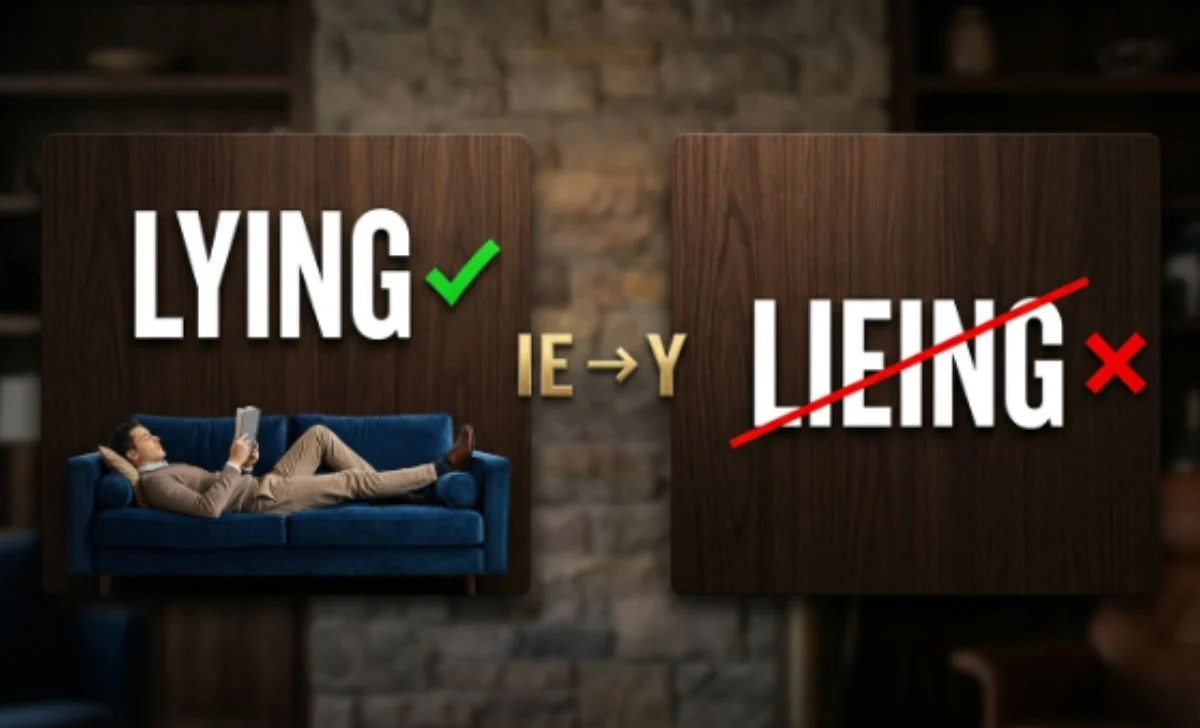
The correct spelling is lying, not lieing, when you mean the present participle of lie.
lie → lying ✓
lie → lieing ✗
The important detail is that lie can have different meanings, and one of them follows a different pattern. Understanding the verb behind the word makes this spelling much easier to remember.
Quick Answer: Lieing or Lying?
Lying is the correct spelling.
Lieing is incorrect when you mean:
- being in a horizontal position
- resting in a particular place
- telling an untruth
Examples:
- She is lying on the sofa.
- He is lying about what happened.
- The book is lying on the table.
The spelling changes from lie to lying because the final -ie changes to y before -ing.
| Form | Correct? | Example |
|---|---|---|
| lying | ✓ | She is lying down. |
| lieing | ✗ | Incorrect spelling |
| lie | ✓ | I need to lie down. |
| lied | ✓ | He lied to me. |
| lay | ✓ | She lay on the bed. |
What Does Lying Mean?
Lying is the present participle of the verb lie.
The word has two common meanings.
Lying = being in a resting position
When a person or object is in a horizontal or resting position, lying is used.
- The baby is lying on the bed.
- My phone is lying on the desk.
- He was lying on the grass.
Lying = telling an untruth
Lying can also mean deliberately saying something that is not true.
- She is lying about her age.
- He was lying to his parents.
- Stop lying to me.
These meanings come from different verbs with different past-tense forms, which is why lie can be confusing.
Why Is It Lying, Not Lieing?
The spelling rule is simple:
When a verb ends in -ie, change ie to y before adding -ing.
The pattern
lie + ing → lying
The ie becomes y:
lie → lying
This is the same spelling pattern seen in:
- die → dying
- tie → tying
- vie → vying
So:
❌ lieing
✅ lying
The reason is not pronunciation. It is a standard English spelling rule for this group of verbs.
The Rule for -IE Verbs Before -ING
One of the easiest ways to remember this is to compare -ie verbs with regular verbs.
Verbs ending in -ie
Change ie to y:
| Base verb | -ing form |
|---|---|
| lie | lying |
| die | dying |
| tie | tying |
| vie | vying |
Verbs ending in -e
Usually remove the final e and add -ing:
| Base verb | -ing form |
|---|---|
| make | making |
| write | writing |
| take | taking |
| hope | hoping |
This distinction explains why:
lie → lying
not:
lie → lieing
Lying vs Laying: Don’t Mix These Up
The spelling problem becomes even more confusing because lying and laying are both correct words.
They come from different verbs.
Lie → lying
Lie means to recline or be in a resting position.
I am lying on the bed.
Lay → laying
Lay means to put or place something somewhere.
I am laying the book on the table.
Compare:
She is lying on the sofa.
She is resting on the sofa.
She is laying the baby on the sofa.
She is placing the baby there.
This is one of the most important distinctions in English grammar.
Lie vs Lay: The Full Verb Forms
Here is where many learners get confused.
Lie = recline
| Tense/form | Word |
|---|---|
| Base | lie |
| Present participle | lying |
| Past | lay |
| Past participle | lain |
Examples:
- I lie down every afternoon.
- Yesterday, I lay on the couch.
- I have lain here for an hour.
- I am lying on the couch now.
Lay = put something down
| Tense/form | Word |
|---|---|
| Base | lay |
| Present participle | laying |
| Past | laid |
| Past participle | laid |
Examples:
- I lay the keys on the table.
- Yesterday, I laid the keys there.
- I have laid the keys on the desk.
- I am laying the keys down now.
Lying vs Laying: A Simple Comparison
| Word | Base verb | Meaning | Example |
|---|---|---|---|
| lying | lie | Resting/reclining | He is lying on the bed. |
| laying | lay | Putting something somewhere | He is laying the book on the bed. |
Quick test
Ask:
Is someone or something resting?
→ lying
Is someone putting something somewhere?
→ laying
What About Lying Meaning “Not Telling the Truth”?
This use has a different verb history.
The verb lie meaning “to tell an untruth” has these forms:
| Form | Word |
|---|---|
| Base | lie |
| Present participle | lying |
| Past | lied |
| Past participle | lied |
Examples:
- He lies often.
- He is lying now.
- He lied yesterday.
- He has lied before.
Notice the past tense:
lie → lied
But for the verb meaning “recline”:
lie → lay → lain
This is why context matters.
Pronunciation of Lying
Lying is usually pronounced:
LY-ing
IPA: /ˈlaɪɪŋ/
It has two syllables:
LY + ing
The word lying does not sound like “ling.”
Compare
- lie → /laɪ/
- lying → /ˈlaɪɪŋ/
- lied → /laɪd/
- lay → /leɪ/
Is Lieing Ever Correct?
No. Lieing is not the standard spelling of the present participle of lie.
When you need the -ing form, write:
lying
For example:
❌ He is lieing on the floor.
✅ He is lying on the floor.
❌ She was lieing to me.
✅ She was lying to me.
American vs British English
There is no American-British spelling difference here.
Both American English and British English use:
lying
| Form | American English | British English |
|---|---|---|
| lying | ✓ | ✓ |
| lieing | ✗ | ✗ |
| lied | ✓ | ✓ |
| laid | ✓ | ✓ |
| laying | ✓ | ✓ |
So lying is not a regional preference. It is the standard spelling in both major varieties of English.
Word Origin: Why Does Lie Become Lying?
The verb lie meaning “to recline” is an old English word with Germanic roots. Its unusual forms developed over centuries, which is why its verb pattern does not look as regular as verbs such as walk or talk.
The modern spelling rule makes the present participle easier to understand:
lie + -ing → lying
English spelling uses y to avoid the awkward sequence ieing.
The same historical spelling pattern appears in:
- die → dying
- tie → tying
- vie → vying
Grammar Rules for Using Lying
Use “lying” with forms of be
The present participle commonly appears with:
- am
- is
- are
- was
- were
- been
- being
Examples:
- I am lying down.
- She is lying on the floor.
- They are lying in the sun.
- He was lying about the incident.
Don’t use “lieing”
The -ie → y rule applies before -ing.
lie → lying
Don’t confuse “lying” with “laying”
Use lying for resting.
The dog is lying under the table.
Use laying for placing something.
She is laying the blanket on the floor.
Everyday Examples of Lying
Home
- The cat is lying under the sofa.
- I am lying in bed.
- The clothes were lying on the floor.
Work
- The documents are lying on my desk.
- He was lying about the deadline.
- The manager caught him lying to the client.
School
- The students were lying on the grass during lunch.
- She admitted that she had been lying about the assignment.
In conversation
- Why are you lying to me?
- I’m not lying.
- He keeps lying about what happened.
Common Mistakes With Lying
Mistake 1: Writing lieing
❌ She is lieing on the bed.
✅ She is lying on the bed.
Mistake 2: Using laying for resting
❌ I am laying on the sofa.
✅ I am lying on the sofa.
If you are resting yourself, use lying.
Mistake 3: Using lying when placing something
❌ I am lying the book on the table.
✅ I am laying the book on the table.
Mistake 4: Confusing lied and lay
❌ Yesterday, I lied on the bed.
If you mean “rested,” the correct sentence is:
✅ Yesterday, I lay on the bed.
If you mean “told an untruth”:
✅ Yesterday, I lied to him.
Synonyms for Lying
The synonym depends on which meaning you intend.
Lying = resting
Possible alternatives include:
- reclining
- resting
- relaxing
- stretched out
- positioned
- settled
Example:
He was lying on the couch.
→ He was reclining on the couch.
Lying = telling an untruth
Possible alternatives include:
- deceiving
- misleading
- fabricating
- being dishonest
- making false claims
These words are not always exact substitutes, because lying specifically involves making a false statement with an intention to deceive.
Antonyms of Lying
Again, the meaning determines the opposite.
Lying = telling an untruth
Possible opposites include:
- telling the truth
- honesty
- truthfulness
- sincerity
Lying = reclining
Possible contrasts include:
- standing
- sitting
- rising
- getting up
A Memory Trick You Won’t Forget
Remember this four-word pattern:
IE becomes Y before ING.
So:
LIE + ING = LYING
Think of these together:
die → dying
tie → tying
lie → lying
Never try to write:
lieing
because English does not keep the ie before -ing in these verbs.
Another quick trick
If you see “lie + ing,” mentally cross out ie and replace it with y:
l[ie] + ing → l[y]ing
That gives you:
LYING ✓
Practice Quiz
Choose the correct form.
1. She is ___ on the sofa.
A. lieing
B. lying
C. laying
2. He was ___ about the results.
A. lieing
B. laying
C. lying
3. I am ___ the keys on the table.
A. lying
B. laying
C. lieing
4. Yesterday, I ___ on the beach.
A. lay
B. lied
C. lain
5. She has ___ there for two hours.
A. laid
B. lain
C. lied
Answers
- B — lying
- C — lying
- B — laying
- A — lay
- B — lain
People Also Ask
Is it lieing or lying?
Lying is correct. Lieing is an incorrect spelling.
Why is lying spelled with a y?
When a verb ends in -ie, the ie changes to y before -ing.
lie → lying
Is “lying” grammatically correct?
Yes. Lying is the present participle of lie and can describe resting or telling an untruth.
Is lying and laying the same thing?
No. Lying comes from lie and usually means resting. Laying comes from lay and means putting or placing something.
Is “lieing” ever correct?
No. The standard spelling is always lying for the present participle of lie.
What is the past tense of lie?
It depends on the meaning.
For lie = recline:
lie → lay → lain
For lie = tell an untruth:
lie → lied → lied
FAQs
How do you spell lying correctly?
The correct spelling is:
L-Y-I-N-G
lying
Why isn’t it lieing?
Because verbs ending in -ie generally change ie to y before adding -ing.
Is “I am lying down” correct?
Yes.
I am lying down.
This means you are reclining or resting.
Is “I am laying down” wrong?
It depends on the meaning. In standard grammar, lay means to put or place something, so laying normally needs an object.
I am laying the baby down.
But:
I am lying down.
What is the difference between lie, lay, and laid?
Lie means recline. Its past tense is lay.
Lay means put or place. Its past and past participle are laid.
Examples:
- I lie down.
- Yesterday, I lay down.
- I lay the book down.
- Yesterday, I laid the book down.
What is the past participle of lie?
For lie = recline, the past participle is lain.
She has lain there all morning.
For lie = tell an untruth, the past participle is lied.
He has lied before.
Final Verdict
If you’re choosing between lieing or lying, choose lying.
Lie → lying
The spelling changes because verbs ending in -ie change ie to y before -ing.
So remember:
lie → lying ✓
die → dying ✓
tie → tying ✓
lieing ✗
And don’t let laying confuse you. Lying means resting or telling an untruth, while laying means putting or placing something.
Once you remember “IE becomes Y before ING,” this spelling problem becomes much easier.
Read More:

Hi, I’m Safdar Ali, an English language teacher with 26 years of teaching experience. My expertise is in English linguistics, grammar, and the differences between British and American English.
Through Gramiffy, I share practical, research-based guides to help students, writers, and English learners improve their language skills. My goal is to make English simple, accurate, and easy for everyone to understand.