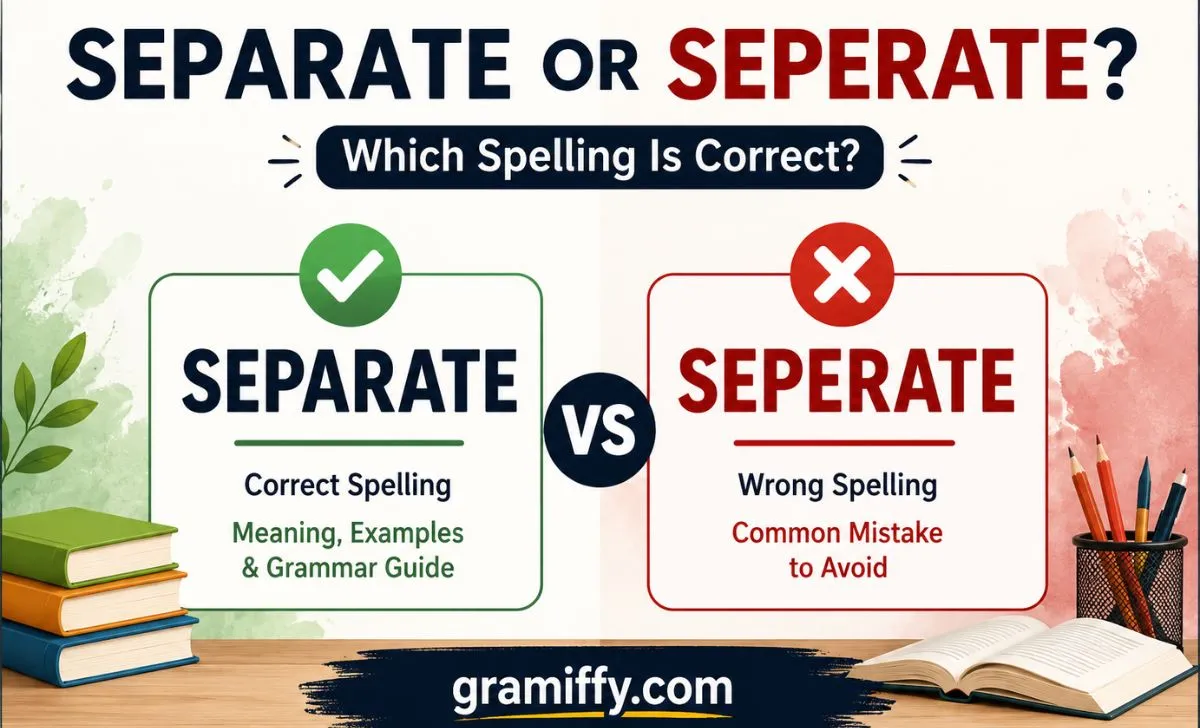
Have you ever paused while writing because you weren’t sure whether to type separate or seperate? If so, you’re far from alone.
Thousands of students, professionals, writers, and English learners search this question every month because “separate” is one of the most frequently misspelled words in English.
The confusion usually comes from pronunciation. When spoken quickly, separate can sound like “sep-er-ate,” leading many people to replace the letter A with E. However, English spelling doesn’t always match pronunciation, and this is one of those cases.
The answer is simple:
Separate ✅ is the only correct spelling.
Seperate ❌ is always a misspelling.
This rule applies everywhere, including:
- American English
- British English
- Canadian English
- Australian English
- Academic writing
- Professional emails
- Business reports
- Books
- Blogs
- Websites
- Exams
Using the correct spelling makes your writing more professional, improves readability, and helps you communicate clearly.
Whether you’re writing an essay, sending an email, publishing a blog post, or preparing a business document, choosing the correct spelling matters.
In this complete guide, you’ll discover:
- Which spelling is correct and why
- Why people commonly write seperate
- The meaning of separate
- Pronunciation and grammar rules
- Easy memory tricks
- Real-life examples
- Common spelling mistakes
- Related word forms
- Frequently asked questions
- Expert writing tips to avoid this mistake forever
By the end of this guide, you’ll know exactly when and how to use separate with confidence.
Separate or Seperate: Which Spelling Is Correct?
If you’re looking for a quick answer, here it is:
✅ Separate is the correct spelling.
❌ Seperate is incorrect.
There is no alternative spelling in standard English.
Unlike words such as color/colour, center/centre, or organize/organise, the spelling of separate never changes based on the country or style guide you follow.
Quick Comparison
| Spelling | Correct? | Used in Dictionaries? | Used in Formal Writing? |
|---|---|---|---|
| Separate | ✅ Yes | ✅ Yes | ✅ Yes |
| Seperate | ❌ No | ❌ No | ❌ No |
Whether you’re writing for school, work, or online publishing, always choose separate.
Featured Snippet Answer
Separate is the correct spelling. Seperate is a common misspelling and is not accepted in standard English. The word separate means to divide, distinguish, or keep things apart. It has the same spelling in both American and British English.
Why Do So Many People Spell It “Seperate”?
This mistake happens because English pronunciation can be misleading.
When native speakers pronounce separate, the second vowel is often reduced to a weak sound called a schwa (/ə/). As a result, many people hear:
sep-er-ate
instead of
sep-a-rate
They naturally type seperate, even though the correct spelling contains A-R-A in the middle.
This is why separate appears on lists of the most commonly misspelled English words.
Is “Seperate” Ever Correct?
No.
The spelling seperate is never correct in modern English.
It is considered a spelling error in:
- Academic essays
- School assignments
- Professional emails
- Business documents
- Books
- Newspapers
- Government publications
- Technical writing
- Website content
- Job applications
If you use seperate, grammar and spell-check tools will almost always recommend changing it to separate.
Why Correct Spelling Matters
A single spelling mistake may seem small, but it can influence how readers perceive your writing.
Correct spelling helps you:
- Build credibility
- Improve professionalism
- Communicate more clearly
- Avoid misunderstandings
- Make a better impression in academic and workplace settings
- Publish higher-quality online content
If you’re creating content for the web, correct spelling also improves user experience, which is an important part of modern SEO.
What Does Separate Mean?
The word separate means to divide, keep apart, distinguish, disconnect, or exist independently.
Depending on the context, it can describe physical objects, people, ideas, organizations, events, or processes.
Examples:
- Please separate the white clothes from the colored ones.
- We booked separate hotel rooms.
- It’s important to separate facts from opinions.
- The company operates as a separate legal entity.
Although the meaning changes slightly depending on the sentence, the central idea remains the same: keeping things distinct or apart.
Separate as a Verb
As a verb, separate means to divide or move things apart.
Examples:
- Separate the eggs before cooking.
- The teacher separated the students into groups.
- Oil naturally separates from water.
- The software separates duplicate files automatically.
- Police separated the two crowds to prevent conflict.
In each example, the word describes an action.
Separate as an Adjective
As an adjective, separate means distinct, independent, or not connected.
Examples:
- We have separate offices.
- Each applicant receives a separate interview.
- They maintain separate bank accounts.
- The investigation involved two separate incidents.
- Separate entrances are available for visitors and staff.
Here, separate describes a noun rather than expressing an action.
Separate as a Noun
In everyday English, separate is rarely used as a noun. However, the plural form separates has a specific meaning in fashion.
Separates are individual clothing items—such as skirts, trousers, or jackets—that are sold individually and can be mixed and matched.
Examples:
- The boutique specializes in women’s separates.
- Neutral separates are perfect for creating professional outfits.
Pronunciation
One reason people misspell separate is that its pronunciation doesn’t clearly reveal its spelling.
Adjective: SEP-uh-rut
Verb: SEP-uh-rate
The middle vowel is pronounced as a schwa (/ə/), a neutral sound that doesn’t clearly resemble either A or E. That’s why many writers mistakenly type seperate.
Remember:
Pronunciation can be misleading, but the spelling is always “separate.”
Is “Seperate” a Real Word?
The short answer is no.
Seperate is not recognized as a correct English word. It appears frequently in search engines because many people accidentally spell separate incorrectly, not because it is an accepted alternative.
Major dictionaries, grammar references, educational institutions, and style guides all recognize only one standard spelling:
✅ Separate
Why Do People Think It’s Correct?
There are several reasons:
Pronunciation Creates Confusion
Because the word is often pronounced as sep-er-ate, many people instinctively replace A with E.
Fast Typing
Even experienced writers occasionally type seperate when writing quickly.
Learning by Sound
Many learners first hear the word before seeing it written, leading them to memorize the incorrect spelling.
English Has Irregular Spellings
English includes many words where pronunciation doesn’t perfectly match spelling, such as:
- Wednesday
- Business
- Colonel
- Comfortable
- Separate
This is one reason English spelling can be challenging, even for native speakers.
Separate vs Seperate: Side-by-Side Comparison
| Feature | Separate | Seperate |
|---|---|---|
| Correct spelling | ✅ Yes | ❌ No |
| Standard English | ✅ Yes | ❌ No |
| Found in dictionaries | ✅ Yes | ❌ No |
| Accepted in academic writing | ✅ Yes | ❌ No |
| Used in professional communication | ✅ Yes | ❌ No |
| American English | ✅ Yes | ❌ No |
| British English | ✅ Yes | ❌ No |
| Grammar checker approval | ✅ Yes | ❌ No |
| Recommended for SEO content | ✅ Yes | ❌ No |
Final Rule to Remember
If you ever hesitate between separate and seperate, remember this simple rule:
Always write “separate.” “Seperate” is never correct.
Master this one spelling rule, and you’ll avoid one of the most common mistakes in English writing.
How to Spell Separate Correctly Every Time
Now that you know separate is the only correct spelling, the next question is:
How can you remember it without stopping to think every time you write it?
The secret isn’t memorizing random letters—it’s understanding the word’s pattern and practicing it in context.
Once you learn a few simple techniques, the correct spelling becomes automatic.
Learn the Correct Letter Pattern
The word is spelled:
S E P A R A T E
Pay close attention to the middle of the word:
A – R – A
This is where almost everyone makes a mistake.
Many people accidentally write:
S E P E R E T E
Notice how both A’s have been replaced with E’s.
A simple way to remember the spelling is:
Separate has two A’s after the letter P.
Memory Trick #1: “A RAT” Is Hidden Inside Separate
One of the most popular spelling tricks is:
There’s “A RAT” inside sepARATe.
Break the word like this:
sep + ARAT + e
Whenever you’re unsure, think about the hidden phrase “A RAT.”
Because it contains two A’s, it reminds you that separate is never spelled with E-R-E.
Memory Trick #2: Connect It With “Apart”
The meaning of separate is closely related to apart.
Notice something interesting:
- Apart contains the letter A.
- Separate also contains the letter A in the same important position.
Think of this sentence:
Things that are apart stay separate.
This simple association helps many learners remember the correct spelling.
Memory Trick #3: Write the Whole Word Family
Instead of memorizing only one word, learn all its related forms together.
| Word Form | Correct Spelling |
|---|---|
| Base word | Separate |
| Past tense | Separated |
| Present participle | Separating |
| Noun | Separation |
| Adverb | Separately |
Every form keeps the same spelling pattern.
If you know separate, you’ll naturally spell the related words correctly too.
Memory Trick #4: Practice in Complete Sentences
Writing the word in context is much more effective than repeating it in isolation.
For example:
- Please separate the documents before scanning.
- We stayed in separate hotel rooms.
- The software separates duplicate records.
- Keep raw meat separate from vegetables.
- The teacher separated the students into groups.
The more often you use the word correctly, the easier it becomes to remember.
Why Do People Misspell “Separate”?
Many people assume spelling mistakes happen because someone isn’t good at English.
That’s not true.
Even experienced writers and native speakers occasionally type seperate.
Here’s why.
1. Pronunciation Is Misleading
English pronunciation doesn’t always match spelling.
When people say separate, the second vowel is usually reduced to a weak sound called a schwa.
Instead of hearing:
sep-a-rate
many people hear:
sep-er-ate
Their brain then converts the sound into the incorrect spelling:
❌ seperate
instead of:
✅ separate
2. English Has Many Irregular Spellings
English developed from several languages, including Latin, French, and Germanic languages.
As a result, many words don’t follow simple spelling rules.
Examples include:
| Correct | Common Misspelling |
|---|---|
| Separate | Seperate |
| Definitely | Definately |
| Necessary | Neccessary |
| Occasion | Occassion |
| Receive | Recieve |
Because English isn’t perfectly phonetic, relying only on pronunciation often leads to mistakes.
3. Fast Typing Creates Typos
Many people know the correct spelling but accidentally type:
- seperate
- seperated
- seperately
- seperation
This is especially common when typing quickly on a keyboard or mobile phone.
A careful proofread usually catches these errors.
4. Learning by Sound Instead of Reading
Children often learn spoken English before they learn written English.
If someone hears sep-er-ate repeatedly, they may assume the spelling should contain E.
Reading books, articles, and quality websites exposes you to the correct spelling again and again, gradually reinforcing it.
5. Similar Words Cause Confusion
Some English words ending in -ate have different spelling patterns.
Examples:
- celebrate
- generate
- operate
- moderate
- educate
Because these words look similar, learners sometimes assume separate follows the same spelling pattern.
It doesn’t.
Understanding the Meaning of Separate in Different Contexts
Although the basic meaning is to divide or keep apart, the word is used in many different situations.
Understanding these contexts will help you choose the correct meaning naturally.
Separate in Everyday Life
Examples:
- Separate the laundry by color.
- Keep medicine separate from food.
- We traveled in separate cars.
- The children have separate bedrooms.
- Please separate the recyclable waste.
In each sentence, separate means to keep things apart.
Separate in School and Education
Teachers frequently use separate when giving instructions.
Examples:
- Write each answer on a separate line.
- The teacher separated the students into teams.
- Keep rough work on a separate page.
- Separate your notes by subject.
- Each chapter begins on a separate page.
Separate in Business
Businesses use separate to describe independent departments, records, or accounts.
Examples:
- Maintain separate financial records.
- Separate invoices will be issued.
- Every department has separate responsibilities.
- Keep business expenses separate from personal expenses.
- The company operates separate offices in different cities.
Separate in Science
Science often involves separating materials or substances.
Examples:
- Scientists separate mixtures using filtration.
- Oil separates naturally from water.
- A magnet can separate iron from sand.
- Distillation separates liquids based on boiling points.
- The centrifuge separates blood into different components.
Separate in Technology
Technology professionals frequently use the word in documentation and software development.
Examples:
- Create separate user accounts.
- Store backups on separate drives.
- Developers maintain separate testing and production environments.
- Use separate passwords for every account.
- Separate databases improve security.
Separate in Law
In legal writing, separate often describes independence.
Examples include:
- Separate legal entity
- Separate property
- Separate agreement
- Separate contract
- Separate ownership
These phrases indicate that something is legally distinct from something else.
Common Collocations With “Separate”
A collocation is a pair or group of words that naturally occur together.
Learning collocations makes your English sound more fluent and natural.
| Common Collocation | Example Sentence |
|---|---|
| Separate account | We opened a separate savings account. |
| Separate room | The children sleep in separate rooms. |
| Separate office | Each manager has a separate office. |
| Separate entrance | Visitors should use the separate entrance. |
| Separate section | The appendix appears in a separate section. |
| Separate issue | That’s a separate issue we can discuss later. |
| Separate category | Premium members are listed in a separate category. |
| Separate list | Please prepare a separate list for new customers. |
| Separate identity | Each brand has its own separate identity. |
| Separate file | Save every project in a separate file. |
Using these natural combinations makes your writing more polished and native like.
Common Expressions With “Separate”
Here are some expressions you’ll often hear:
- Separate from
- Keep children separate from dangerous equipment.
- Facts should be separate from opinions.
- Go separate ways
- After graduation, the friends went their separate ways.
- Separate issue
- That’s a separate issue altogether.
- Separate account
- We keep our household expenses in a separate account.
- Separate room
- The hotel provided separate rooms for the guests.
These expressions are common in both spoken and written English.
How to Use Separate Correctly in Sentences
Knowing the correct spelling is only part of using separate correctly. To become confident in English writing, you should also understand how the word functions in different contexts.
Because separate can be both a verb and an adjective, its meaning changes slightly depending on how it is used in a sentence.
The examples below cover everyday English, academic writing, business communication, technology, science, healthcare, and legal contexts so you can see how native speakers naturally use the word.
Separate as a Verb
As a verb, separate means to divide, disconnect, distinguish, isolate, or move things apart.
Everyday Examples
- Please separate the clean clothes from the dirty ones.
- Separate the vegetables before cooking.
- We should separate recyclable waste from regular trash.
- The referee separated the two players.
- Parents should separate medicine from food.
School Examples
- The teacher separated the students into groups.
- Separate your answers using headings.
- The instructor separated beginners from advanced learners.
- Separate the nouns from the verbs in the exercise.
- Students learned how to separate facts from opinions.
Business Examples
- Separate business expenses from personal expenses.
- The accountant separated taxable income from non-taxable income.
- The company separates customer support from technical support.
- Managers should separate urgent tasks from routine work.
- Separate confidential documents before sharing the files.
Technology Examples
- The software separates duplicate records automatically.
- Developers separate frontend code from backend code.
- The application separates user data into different databases.
- Artificial intelligence can separate spam emails from legitimate messages.
- The system separates uploaded files into different folders.
Science Examples
- Oil naturally separates from water.
- Scientists separate mixtures through filtration.
- A centrifuge separates blood into different components.
- Magnets separate iron from sand.
- Distillation separates liquids based on their boiling points.
Separate as an Adjective
As an adjective, separate means distinct, individual, independent, or not connected.
Examples
- They have separate bedrooms.
- We booked separate hotel rooms.
- The company has separate offices in three countries.
- Two separate incidents were reported yesterday.
- Every employee received a separate ID card.
- Keep these files in separate folders.
- The investigation involved three separate witnesses.
- Students completed separate assignments.
- Each product has a separate warranty.
- The conference includes separate sessions for beginners and professionals.
In these examples, separate describes the noun rather than expressing an action.
Separate as a Noun
Although uncommon, separates is a noun in the fashion industry.
It refers to clothing pieces sold individually so they can be mixed and matched.
Examples:
- The store specializes in women’s separates.
- Neutral separates work well for business travel.
- These separates can be worn with different jackets.
Most learners won’t encounter this meaning often, but it’s useful to know.
Separate vs Apart
Many learners wonder whether separate and apart mean the same thing.
They are related, but they are not always interchangeable.
| Separate | Apart |
|---|---|
| Can be a verb or adjective | Usually an adverb |
| Focuses on division or distinction | Focuses on distance between things |
Examples
✅ Separate the papers into two piles.
❌ Apart the papers into two piles.
✅ Keep the chemicals separate.
✅ Keep the chemicals apart.
(Both are correct, but the emphasis is slightly different.)
✅ The two buildings stand far apart.
❌ The two buildings stand far separate.
Easy Rule
Use separate when you’re talking about dividing or distinguishing.
Use apart when you’re talking about distance or position.
Separate vs Different
These words are also commonly confused.
Separate
Means not joined together.
Example:
- They work in separate offices.
Different
Means not the same.
Example:
- They have different opinions.
Something can be separate but similar, or together but different, so the two words aren’t interchangeable.
Separate vs Divide
Although these words are close in meaning, they are used differently.
Separate
Usually emphasizes keeping things apart.
Example:
- Separate the clean dishes from the dirty ones.
Divide
Often emphasizes splitting something into parts.
Example:
- Divide the cake into eight slices.
In many situations, either word works, but divide often suggests mathematical or equal distribution, while separate focuses on distinction.
Synonyms of Separate
Choosing the right synonym can make your writing more engaging.
As a Verb
Depending on the context, separate can be replaced with:
- Divide
- Split
- Distinguish
- Differentiate
- Disconnect
- Isolate
- Detach
- Segregate
- Partition
- Sort
- Classify
- Sever
Example:
Separate the files by date.
can also become:
Sort the files by date.
As an Adjective
When describing something distinct or independent, you can use:
- Distinct
- Independent
- Individual
- Detached
- Standalone
- Discrete
- Isolated
- Unconnected
- Individualized
Example:
Separate office
can become:
Independent office
depending on the context.
Antonyms of Separate
Understanding opposites also improves vocabulary.
Common antonyms include:
- Join
- Unite
- Connect
- Combine
- Merge
- Integrate
- Attach
- Link
- Gather
- Bring together
Example:
Separate accounts ↔ Combined account
Related Forms of Separate
Every related word keeps the same spelling pattern.
| Word | Part of Speech | Example |
|---|---|---|
| Separate | Verb / Adjective | Separate the files. |
| Separated | Verb (Past) | The reports were separated yesterday. |
| Separating | Present Participle | The machine is separating plastic from paper. |
| Separation | Noun | Their separation lasted several months. |
| Separately | Adverb | Submit each document separately. |
Always remember that if the base word is separate, every related form begins with the same spelling.
Common Mistakes Even Advanced Writers Make
Even experienced writers occasionally make these errors.
Mistake 1: Spelling It as “Seperate”
❌ We need to seperate the reports.
✅ We need to separate the reports.
Mistake 2: Confusing Separate With Different
❌ They work in different offices. (Possible, but changes the meaning.)
✅ They work in separate offices.
Mistake 3: Using the Wrong Word Form
❌ Please submit each file seperately.
✅ Please submit each file separately.
Mistake 4: Forgetting the Grammatical Function
Verb:
- Separate the documents.
Adjective:
- Use separate folders.
Understanding the role of the word helps you write more naturally and accurately.
Expert Tips to Remember “Separate”
Professional editors often recommend these habits:
- Focus on the A-R-A pattern.
- Read quality English content regularly.
- Write the word in complete sentences rather than memorizing it alone.
- Proofread slowly, especially when typing quickly.
- Learn the entire word family together.
- Don’t rely only on pronunciation—English spelling is often historical.
These small habits dramatically reduce spelling mistakes over time.
Knowledge Check
Choose the correct answer.
1. Which spelling is correct?
A. Seperate
B. Separate
✅ Answer: B
2. Which sentence is correct?
A. Please seperate the files.
B. Please separate the files.
✅ Answer: B
3. What is the noun form of separate?
A. Separation
B. Seperation
✅ Answer: A
4. Which sentence uses separate as an adjective?
A. Please separate the books.
B. We booked separate hotel rooms.
✅ Answer: B
5. Which sentence uses separate as a verb?
A. Separate the recyclable materials.
B. We stayed in separate apartments.
✅ Answer: A
If you answered all five correctly, you’ve mastered both the spelling and the most common grammatical uses of separate.
Origin and Etymology of Separate
Understanding a word’s history can make it easier to remember both its meaning and spelling.
The word separate comes from the Latin verb separāre, which means “to divide,” “to set apart,” “to remove,” or “to distinguish.”
It is formed from two Latin elements:
- se- = apart or away
- parāre = prepare or make ready
Together, the original meaning was “to set apart.”
The word later entered Old French as separer before becoming separate in Middle English. While pronunciation gradually changed over time, the spelling remained almost identical.
That historical spelling explains why the word contains the A-R-A pattern instead of E-R-E.
This is also why seperate has never been an accepted spelling in standard English.
Spelling Timeline
| Period | Word Form | Meaning |
|---|---|---|
| Classical Latin | separāre | To divide or set apart |
| Old French | separer | To divide |
| Middle English | separate | To distinguish or divide |
| Modern English | separate | To divide, distinguish, or keep apart |
The spelling has remained remarkably consistent for centuries.
Pronunciation vs Spelling
One of the biggest reasons people write seperate is that English pronunciation and spelling don’t always match.
Pronunciation
As an adjective:
SEP-uh-rut
As a verb:
SEP-uh-rate
The second vowel is usually pronounced as a schwa (/ə/), which is a weak, neutral vowel sound.
Because the schwa doesn’t clearly sound like A or E, many people incorrectly assume the word should be spelled with E.
However, pronunciation should never determine the spelling in this case.
The spelling is always:
Separate
Why “Seperate” Looks Correct to Many People
If seperate is wrong, why do so many intelligent people write it?
There are several reasons.
English Is Not a Phonetic Language
Many English words are not spelled exactly as they sound.
Examples include:
| Pronunciation | Correct Spelling |
|---|---|
| Wed-nes-day | Wednesday |
| Biz-ness | Business |
| Kol-uh-nel | Colonel |
| Feb-yoo-air-ee | February |
| Sep-er-ate | Separate |
This is why learning spelling patterns is often more effective than relying on pronunciation.
The Brain Prefers Familiar Patterns
Our brains naturally look for familiar letter combinations.
Many words ending in -ate have vowel patterns that resemble what we hear when speaking.
Examples:
- generate
- celebrate
- operate
- moderate
- educate
Because of these familiar patterns, people unconsciously replace the A in separate with an E.
Typing Habits
Fast typing can also produce errors.
Many writers know the correct spelling but accidentally type:
- seperate
- seperation
- seperately
- seperated
Proofreading slowly helps catch these mistakes before publishing.
Separate in Different Writing Styles
The word appears frequently across many forms of writing.
Academic Writing
Examples:
- Separate primary sources from secondary sources.
- The experiment contains three separate stages.
- Researchers analyzed the groups separately.
Business Writing
Examples:
- Keep personal and business accounts separate.
- Separate invoices will be issued next week.
- Each department prepares a separate report.
Legal Writing
Examples:
- The company is a separate legal entity.
- Separate agreements govern each transaction.
- Separate ownership protects both parties.
Technical Writing
Examples:
- Install the software on a separate server.
- Save backups in a separate directory.
- Create separate user permissions.
Healthcare Writing
Examples:
- Patients waited in separate treatment rooms.
- Separate equipment reduces contamination.
- Medical records are stored separately.
Everyday Communication
Examples:
- We traveled in separate cars.
- Keep these boxes separate.
- The children have separate bedrooms.
Learn Word Families
Instead of memorizing isolated words, learn related forms together.
For example:
- separate
- separated
- separating
- separation
- separately
This approach makes long-term retention much easier.
Mini Quiz
Test your understanding.
Question 1
Which spelling is correct?
A. Seperate
B. Separate
✅ Answer: B
Question 2
Choose the correct sentence.
A. Please seperate the reports.
B. Please separate the reports.
✅ Answer: B
Question 3
Which word is the noun form?
A. Separation
B. Seperation
✅ Answer: A
Question 4
Which sentence uses separate correctly?
A. We have seperate offices.
B. We have separate offices.
✅ Answer: B
Question 5
Which spelling should you use in professional writing?
A. Separate
B. Seperate
✅ Answer: A
If you answered all five correctly, you’ve mastered the spelling, meaning, grammar, and usage of separate.
Quick Reference Table
| Question | Correct Answer |
|---|---|
| Correct spelling | Separate |
| Incorrect spelling | Seperate |
| Accepted in dictionaries | Separate |
| American English | Separate |
| British English | Separate |
| Verb | Yes |
| Adjective | Yes |
| Noun form | Separation |
| Adverb form | Separately |
| Most common mistake | Seperate |
FAQs
Is it separate or seperate?
Separate is the correct spelling.
Seperate is a common misspelling and is not accepted in standard English. Whether you’re writing an essay, email, resume, business report, or blog post, always use separate.
Is seperate a real English word?
No.
Seperate is not a standard English word. It frequently appears in online searches because many people misspell separate, but it does not appear as a correct spelling in major English dictionaries.
Why do people spell separate as seperate?
There are several reasons:
- The pronunciation can sound like “sep-er-ate.”
- English spelling is not always phonetic.
- People type quickly and make accidental errors.
- Many learners memorize the pronunciation before learning the spelling.
These factors make separate one of the most commonly misspelled words in English.
How do I remember the spelling of separate?
Try these memory tricks:
- There’s “A RAT” inside sepARATe.
- Remember the A-R-A letter pattern.
- Associate separate with apart—both contain the letter A.
- Practice writing complete sentences instead of memorizing the word alone.
Is separate a verb or an adjective?
It can be both.
Verb
- Separate the files before uploading them.
- The machine separates plastic from paper.
Adjective
- We booked separate hotel rooms.
- The reports are stored in separate folders.
The meaning depends on how the word is used in the sentence.
What is the noun form of separate?
The noun form is separation.
Example:
- Their separation lasted several months.
What is the adverb form of separate?
The adverb is separately.
Example:
- Submit each assignment separately.
Is the spelling different in American and British English?
No.
Unlike words such as color/colour or center/centre, separate has the same spelling in both American and British English.
What does separate mean?
The word separate means:
- To divide
- To distinguish
- To disconnect
- To isolate
- To keep apart
- To exist independently
The exact meaning depends on the context.
What are the synonyms of separate?
Common synonyms include:
- Divide
- Split
- Distinguish
- Differentiate
- Isolate
- Disconnect
- Detach
- Segregate
- Partition
- Sever
What are the antonyms of separate?
Common antonyms include:
- Join
- Unite
- Connect
- Combine
- Merge
- Attach
- Integrate
- Link
- Gather
- Bring together
Can I use separate in formal writing?
Yes.
It is appropriate for:
- Academic essays
- Research papers
- Professional emails
- Business reports
- Legal documents
- Technical documentation
- Books
- Website content
- Job applications
Is separate commonly misspelled?
Yes.
It is consistently ranked among the most commonly misspelled English words, even by native English speakers.
People Also Ask
Which is correct: separate or seperate?
Separate is correct. Seperate is always incorrect in standard English.
Is “seperate” acceptable in any dictionary?
No. Reputable dictionaries recognize only separate as the correct spelling.
Why does spell check change “seperate” to “separate”?
Because seperate is a spelling error. Grammar and spell-check tools automatically replace it with the correct spelling.
How can I avoid spelling “separate” incorrectly?
Focus on the A-R-A pattern, use memory tricks like “A RAT” inside sepARATe,” and practice writing the word in complete sentences.
Does “separate” have the same spelling worldwide?
Yes.
The spelling remains separate in:
- American English
- British English
- Canadian English
- Australian English
- New Zealand English
Common Mistakes to Avoid
Avoid these common errors:
| ❌ Incorrect | ✅ Correct |
|---|---|
| Seperate | Separate |
| Seperated | Separated |
| Seperating | Separating |
| Seperation | Separation |
| Seperately | Separately |
If you remember the correct base word, the rest of the word family becomes much easier to spell.
Conclusion
The debate between separate and seperate has a simple answer.
Separate is the only correct spelling in modern English.
Seperate is a spelling mistake caused by pronunciation, typing habits, and confusion about English spelling patterns. It is not accepted in academic writing, professional communication, dictionaries, or style guides.
Whether you’re writing an email, school assignment, business proposal, research paper, website article, or social media post, you should always use separate.
The easiest way to remember it is to focus on the A-R-A pattern or use the classic memory trick:
There’s “A RAT” inside sepARATe.
Once you understand the spelling, meaning, grammar, and usage of separate, you’ll never hesitate between separate and seperate again.
Read More :

I am Bryan A. Garner a lexicographer, and language expert passionate about clear and effective writing.
I contribute grammar, spelling, and usage guides on Gramiffy.com to help readers improve their English skills. Through my work, I aim to make language rules simple, practical, and easy to understand.