Many writers pause when they need to write loveable or lovable. At first glance, both spellings seem correct.
After all, the word comes from love, so keeping the extra “e” feels natural. However, modern English does not always follow what seems logical.
This confusion affects students, bloggers, professionals, and English learners every day.
People often search for loveable or lovable because they want the correct spelling for essays, emails, articles, social media posts, and professional writing. They also want to avoid grammar mistakes and write with confidence.
The good news is that the answer is simple. While both spellings exist, one is clearly preferred in modern English.
In this guide, you will learn the correct spelling, pronunciation, history, usage differences, common mistakes, examples, and expert advice on which version you should use today.
Quick Answer
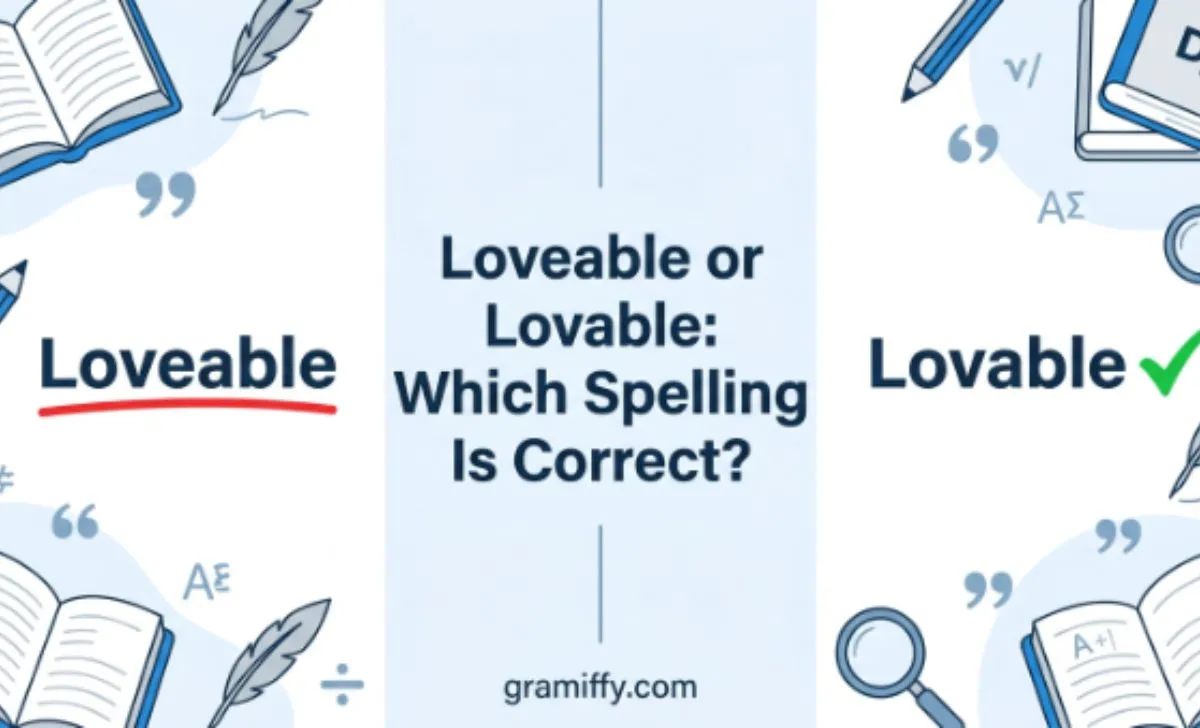
Lovable is the preferred and standard spelling in modern English.
Loveable is an alternative spelling that still appears occasionally, but it is much less common today.
Examples
✅ She has a lovable personality.
✅ The puppy is adorable and lovable.
✅ He became a lovable character in the movie.
Less Common:
✔ She has a loveable personality.
✔ The child is loveable and kind.
Quick Rule
If you are writing for school, work, publishing, blogging, or SEO, use lovable.
Pronunciation of Loveable or Lovable
Both spellings have exactly the same pronunciation.
Pronunciation
Lovable: /ˈlʌvəbəl/
Loveable: /ˈlʌvəbəl/
Simple Pronunciation
LUV-uh-buhl
Example Sentences
- Everyone thinks the puppy is lovable.
- The actress played a lovable character.
- Her cheerful nature makes her lovable.
Since both spellings sound identical, pronunciation does not help writers decide which spelling is preferred. This is one reason why the confusion continues.
Why People Confuse Loveable or Lovable
Many English words ending in -able keep the final “e” from the root word.
Examples include:
- Change → Changeable
- Notice → Noticeable
- Manage → Manageable
Because of these patterns, many people naturally assume:
Love → Loveable
This looks logical.
However, English spelling has evolved over centuries, and some words became simplified. As a result, lovable gradually became the preferred spelling.
People also become confused because:
- Both spellings appear online.
- Older books sometimes use loveable.
- Both words have the same pronunciation.
- Some dictionaries list both spellings.
This combination makes many writers wonder which version is truly correct.
Easy Trick to Remember Loveable or Lovable
A simple memory trick can help you remember the correct spelling forever.
The Lovable Trick
Think:
Modern English loves shorter spellings.
Therefore:
✅ Lovable
❌ Loveable
Another easy reminder:
If you see the word in a dictionary, advertisement, website, or newspaper, it is usually lovable—not loveable.
Remember:
Professional writers choose lovable.
The Origin of Loveable or Lovable
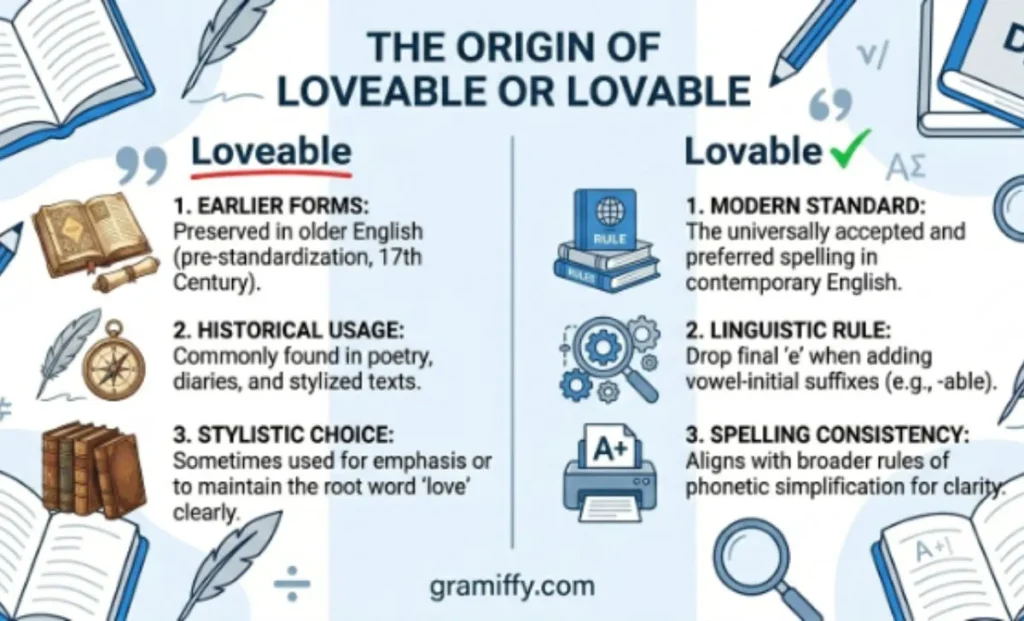
The word comes from the English word love, which traces its roots to the Old English word lufu.
When the suffix -able was added, the meaning became:
“Able to be loved” or “worthy of love.”
Historically, both loveable and lovable appeared in English writing.
During the eighteenth and nineteenth centuries, spelling was less standardized than it is today. Writers often used whichever form they preferred.
As English dictionaries became more influential, publishers began favoring shorter and more consistent spellings. Over time, lovable became the dominant form.
Today, major dictionaries and style guides generally prefer lovable as the standard spelling.
British English vs American English Spelling
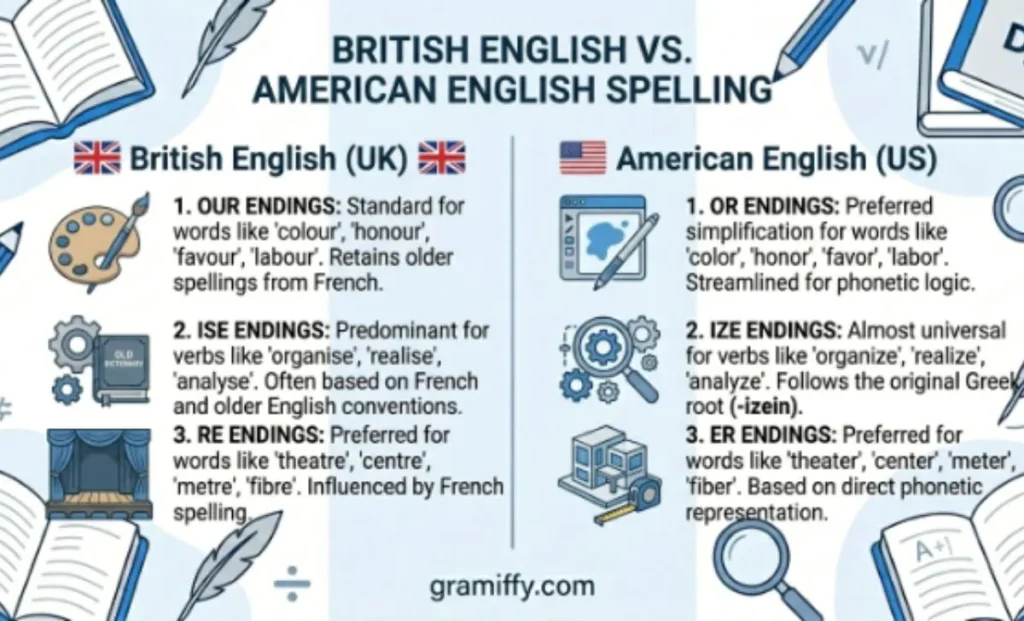
Many spelling debates involve differences between British and American English.
Examples:
| British English | American English |
|---|---|
| Colour | Color |
| Favourite | Favorite |
| Organise | Organize |
However, loveable or lovable is different.
Both British English and American English now generally prefer lovable.
Comparison Table
| Feature | Lovable | Loveable |
|---|---|---|
| Meaning | Worthy of being loved | Worthy of being loved |
| Pronunciation | Same | Same |
| Modern Usage | Very Common | Rare |
| British English | Preferred | Occasionally Seen |
| American English | Preferred | Rare |
| Academic Writing | Recommended | Not Recommended |
| Professional Writing | Recommended | Usually Avoided |
Verdict
Whether you write for readers in the United States, United Kingdom, Canada, Australia, or New Zealand, lovable is the safest choice.
Which Spelling Should You Use?
The answer depends on your audience, but the recommendation is almost always the same.
For American English
Use lovable.
For British English
Use lovable.
For Academic Writing
Use lovable.
For Business Writing
Use lovable.
For SEO Content
Use lovable.
For Global Audiences
Use lovable.
Professional Recommendation
Unless you are quoting an older source, always choose lovable.
It is clearer, more familiar, and more widely accepted.
Common Mistakes with Loveable or Lovable
Writers frequently make several mistakes when using these words.
Mistake #1: Assuming Loveable Is More Correct
Many people think keeping the full word “love” makes more sense.
Example:
❌ She is a very loveable person.
✅ She is a very lovable person.
Mistake #2: Mixing Both Spellings
Some writers switch between spellings within the same article.
Example:
❌ The lovable puppy was friendly. The loveable dog loved everyone.
Consistency matters.
Choose one spelling and stick with it.
Mistake #3: Using Loveable for SEO Content
Modern search results overwhelmingly favor lovable.
Using the standard spelling helps align your content with reader expectations.
Mistake #4: Believing the Spellings Have Different Meanings
Both spellings mean exactly the same thing.
The difference is preference, not meaning.
Loveable or Lovable in Everyday Examples
Understanding real-world usage helps make the rule easier to remember.
In Emails
The new team member is very lovable and easy to work with.
Her lovable attitude helps create a positive workplace.
In Social Media Posts
This puppy is the most lovable dog ever.
What a lovable smile!
In News Articles
The actor became famous for portraying a lovable hero.
Audiences connected with the lovable main character.
In Books and Novels
The author created a lovable protagonist.
Readers immediately fell in love with the lovable character.
In Business Writing
A lovable brand personality can strengthen customer loyalty.
Companies often use lovable mascots to build trust.
In Everyday Conversation
My grandmother is the most lovable person I know.
That kitten is absolutely lovable.
Loveable or Lovable – Google Trends & Usage Data
Modern search behavior clearly favors lovable.
People frequently search for:
- lovable meaning
- lovable definition
- lovable pronunciation
- lovable synonym
- lovable spelling
- loveable or lovable
- how to spell lovable
- lovable examples
- is loveable correct
- lovable vs loveable
Usage Patterns
Lovable dominates in:
- United States
- United Kingdom
- Canada
- Australia
- India
Common Contexts
The word often appears in:
- Character descriptions
- Movie reviews
- Pet content
- Parenting articles
- Relationship advice
- Brand marketing
- Children’s books
As digital publishing has expanded, lovable has become even more dominant than before.
Dictionary Preferences for Lovable
Major dictionaries generally recognize lovable as the preferred spelling.
| Dictionary | Preferred Form |
|---|---|
| Merriam-Webster | Lovable |
| Cambridge Dictionary | Lovable |
| Oxford Dictionaries | Lovable |
| Collins Dictionary | Lovable |
| Dictionary.com | Lovable |
Although some dictionaries acknowledge loveable as a variant spelling, lovable remains the standard choice.
Lovable vs Loveable Comparison Table
| Feature | Lovable | Loveable |
|---|---|---|
| Correct Spelling | Yes | Yes |
| Preferred Today | Yes | No |
| Meaning | Worthy of love | Worthy of love |
| Pronunciation | Same | Same |
| Used in Modern Writing | Frequently | Rarely |
| Used in Academic Writing | Yes | Rarely |
| SEO Friendly | Yes | Less Effective |
| Reader Familiarity | High | Lower |
| Dictionary Preference | Primary | Secondary |
Synonyms of Lovable
If you want variety in your writing, these words can sometimes replace lovable:
- Adorable
- Endearing
- Charming
- Delightful
- Sweet
- Appealing
- Affectionate
- Precious
- Dear
- Likeable
Examples
Lovable child → Adorable child
Lovable personality → Charming personality
Lovable character → Endearing character
FAQs
Is lovable a real word?
Yes. Lovable is a real English word that means worthy of being loved.
Is loveable wrong?
No. It is not technically wrong, but it is much less common than lovable.
Which spelling is more common?
Lovable is far more common in modern English.
Do lovable and loveable mean the same thing?
Yes. Both words have the same meaning.
Why did lovable become more popular?
Modern English gradually adopted shorter and simpler spellings.
Is lovable British or American English?
Both British and American English prefer lovable today.
Which spelling should I use in professional writing?
Use lovable because it is the accepted modern standard.
Is loveable found in dictionaries?
Some dictionaries list it as a variant spelling, but lovable is usually the primary entry.
Is lovable better for SEO?
Yes. It is the spelling most users recognize and search for.
What part of speech is lovable?
Lovable is an adjective used to describe a person, animal, object, or character that is easy to love.
Conclusion
The debate over loveable or lovable is a common spelling question, but the answer is straightforward.
Both words share the same meaning and pronunciation, and both have appeared throughout the history of English.
However, modern dictionaries, publishers, educators, and professional writers overwhelmingly prefer lovable.
While loveable still exists as an alternative spelling, it is now considered uncommon and somewhat old-fashioned.
If your goal is clear, professional, and modern writing, lovable is the spelling you should choose. It works well in emails, essays, business documents, blog posts, books, and SEO content.
By consistently using lovable, you align your writing with current English standards and make your content easier for readers to trust and understand.
Read More :

I am Bryan A. Garner a lexicographer, and language expert passionate about clear and effective writing.
I contribute grammar, spelling, and usage guides on Gramiffy.com to help readers improve their English skills. Through my work, I aim to make language rules simple, practical, and easy to understand.