If you’ve ever stopped mid-sentence and wondered whether “mere” or “mear” is the correct spelling, you’re not alone.
These two words look almost identical, sound similar in some accents, and can easily be confused. But there’s an important catch: both are genuine English words.
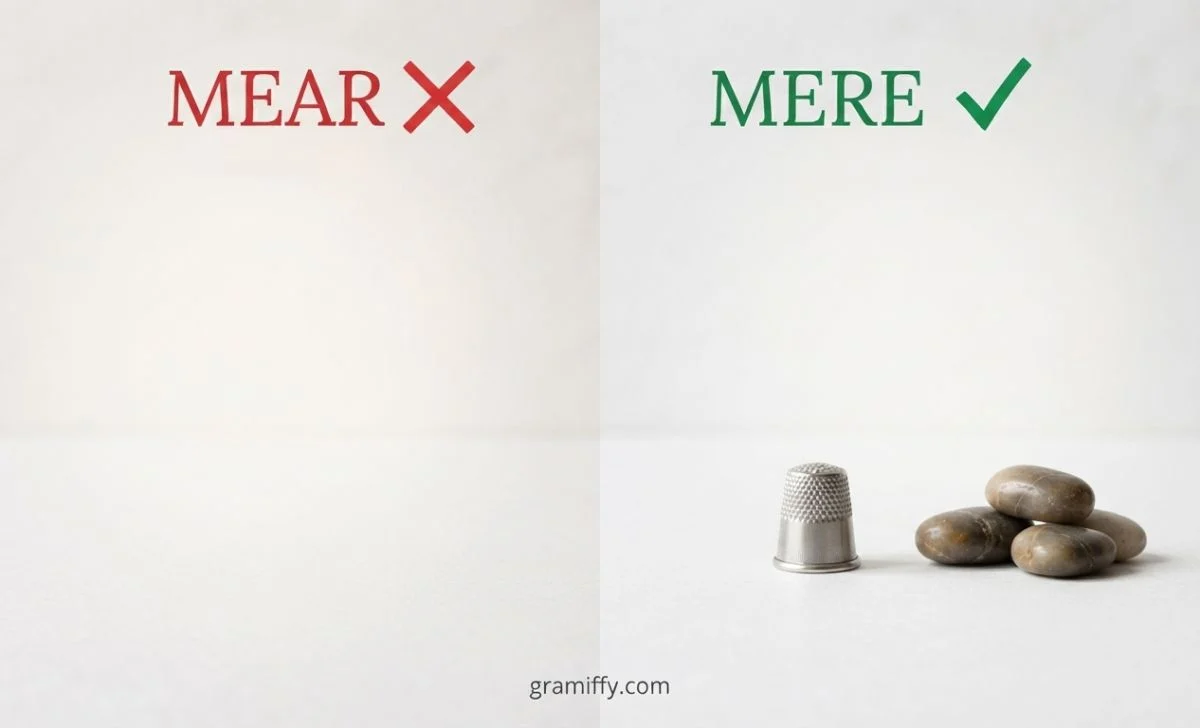
The difference is that mere is a common modern English word, while mear is a rare, archaic, or dialectal word associated mainly with boundaries and boundary markers.
So if you’re writing an email, essay, article, or everyday message, mere is almost certainly the word you need.
But mear isn’t simply a misspelling. It has its own history and meaning.
Let’s look at the difference between mere and mear, when each word is used, and why spell-checkers sometimes make this particular mix-up surprisingly easy to miss.
Quick Answer
Use “mere” in modern everyday English. It usually means nothing more than, only, or just.
It was a mere misunderstanding.
“Mear” is a rare historical or dialectal word referring to a boundary, boundary line, or boundary marker. You may encounter it in historical documents, dialect writing, or terms such as mearstone.
So, if you’re trying to say only, just, or nothing more than, the correct spelling is mere.
Mere: The Common Modern Word
Mere is an adjective meaning nothing more than, only, or simply. It is commonly used to emphasize that something is smaller, less important, or less significant than might otherwise be expected.
Examples of “mere”
- It was a mere misunderstanding.
- The task took a mere ten minutes.
- She won by a mere two points.
- He dismissed the problem as a mere technicality.
- A mere suggestion turned into a major project.
In each example, mere has the sense of only or nothing more than.
Mere can also mean a lake
There is another, much older meaning of mere: a lake or body of water, particularly in British English and place names.
For example, Windermere contains the Old English element mere, meaning a lake or body of water.
This is a different historical word from the adjective mere meaning “only” or “nothing more than.” The two forms eventually came to have the same spelling in modern English.
You are unlikely to need this sense in ordinary writing, but it explains why mere can sometimes appear in geographical names.
Mear: A Rare Historical Word
Mear is a real English word, but it is extremely uncommon in contemporary standard English.
Historically, mear has been used for a boundary, boundary line, or boundary marker, particularly in descriptions of land.
It can therefore appear in historical documents involving property, estates, land surveys, or territorial boundaries.
For example:
The old document described the mear between the two properties.
This is not the normal modern way to describe a property boundary. Today, writers would generally use boundary, boundary line, or property line instead.
Mearstone
One place where you may encounter mear is in the historical term mearstone, meaning a stone used to mark a boundary.
You may also encounter the related form merestone in historical or dialectal material.
These terms are much more likely to appear in historical records or discussions of traditional land boundaries than in everyday modern English.
Mere vs. Mear: The Difference at a Glance
| Word | Meaning | Modern Usage |
|---|---|---|
| Mere | Only; nothing more than; simply | Common |
| Mere | A lake or body of water | Rare; mainly geographical or British |
| Mear | A boundary or boundary marker | Very rare; historical or dialectal |
The key distinction is simple:
Mere = only / nothing more than
Mear = boundary (rare and historical)
Why Do People Confuse Mere and Mear?
The confusion is understandable because the words are extremely similar in spelling and pronunciation.
1. They look almost identical
The only difference is the final vowel:
- mere
- mear
When typing quickly, it is easy to switch the letters.
2. They can sound similar
Depending on the speaker’s accent and pronunciation, mere and mear may sound identical or very similar.
That can make it difficult to determine the spelling from speech alone.
3. Mear is a real word
This is an unusual part of the confusion.
If someone types mear into a spell-checker, it may not always be flagged as an error because the word has genuine historical and dialectal uses.
That does not mean mear is an alternative spelling of mere. The two words have different meanings.
4. The common word is overwhelmingly “mere”
Most modern writers encounter mere regularly but rarely, if ever, encounter mear.
As a result, someone who has only heard the word mere may accidentally write mear when trying to spell it.
Mere or Mear in a Sentence?
Compare these examples:
Correct for “only”:
It was a mere coincidence.
Not:
It was a mear coincidence.
Here, mere means nothing more than.
For the historical boundary meaning:
The document referred to the mear between the two estates.
Here, mear refers to a boundary.
The meaning determines the spelling.
Mere or Mear in British and American English
Mere is standard in both British and American English when it means only, simply, or nothing more than.
The older geographical sense of mere meaning a lake is more visible in British English, particularly in traditional place names.
Mear, meanwhile, is not a normal everyday alternative to mere in either variety of modern standard English. Its use is primarily historical, dialectal, or specialized.
So if you’re writing for a modern British or American audience and mean only or nothing more than, choose mere.
Common Mistake: “Mear” for “Mere”
A common error is writing:
It was a mear five minutes away.
The correct version is:
It was a mere five minutes away.
Why? Because mere means only or no more than.
Another example:
❌ She made a mear suggestion.
✅ She made a mere suggestion.
Again, mere is the correct word because the intended meaning is only a suggestion.
How to Remember the Difference
Here’s a simple memory trick:
MERE = MORE THAN IT SEEMS? No — only.
Think of:
mere = merely = only
If you can replace the word with merely, you almost certainly need mere.
For example:
It was a mere formality.
You could say:
It was merely a formality.
That connection makes the spelling easier to remember.
For mear, think of land boundaries and historical mearstones.
Quick Test
Choose mere or mear in each sentence.
1. It was a ___ misunderstanding.
Answer: mere
Here, mere means “only” or “nothing more than.”
2. The old document described the ___ between the properties.
Answer: mear
Here, mear refers to a historical boundary.
3. The entire process took a ___ five minutes.
Answer: mere
The meaning is “only five minutes.”
4. Which word should you normally use in a modern business email?
Answer: mere
If you mean only, simply, or nothing more than, use mere.
Frequently Asked Questions
Is “mear” a misspelling of “mere”?
Not exactly. Mear is a genuine but very rare English word associated historically with boundaries or boundary markers. However, if someone writes mear when they mean only or nothing more than, it is a spelling mistake. The correct word is mere.
Is “mear” still used in English?
Yes, but its use is highly limited. It can occur in historical, dialectal, or specialized contexts, particularly those relating to land boundaries.
Is “mere” the correct spelling?
Yes, when you mean only, simply, or nothing more than.
For example:
It was a mere coincidence.
Can “mere” mean a lake?
Yes. In older and geographical usage, particularly in Britain, mere can refer to a lake or body of water. It also survives in place names such as Windermere.
Are “mere” and “mear” pronounced the same?
They can be pronounced the same or very similarly depending on accent and context. Because pronunciation does not always distinguish them, the intended meaning is important when choosing the spelling.
Should I use “mear” in modern writing?
Generally, no — unless you are discussing a historical boundary, using a dialectal term, or reproducing historical material. For ordinary modern writing, use mere when you mean only or nothing more than.
Final Answer: Mere or Mear?
For almost every modern sentence, mere is the word you want.
Use mere when you mean:
- only
- simply
- nothing more than
- insignificant or small in comparison
Mear is a genuine but very rare word connected with boundaries and boundary markers, mainly found in historical or dialectal contexts.
So if you’re writing an email, essay, website article, or everyday message and you’re wondering whether something is a mere detail or a mear detail, choose mere.
Mere = common modern word
Mear = rare historical/dialectal boundary word
Read More:

Hi, I’m Safdar Ali, an English language teacher with 26 years of teaching experience. My expertise is in English linguistics, grammar, and the differences between British and American English.
Through Gramiffy, I share practical, research-based guides to help students, writers, and English learners improve their language skills. My goal is to make English simple, accurate, and easy for everyone to understand.