Two spellings, one meaning, and a very familiar British-versus-American English difference: familiarise or familiarize? If you have ever hesitated over the final letters, you are not alone.
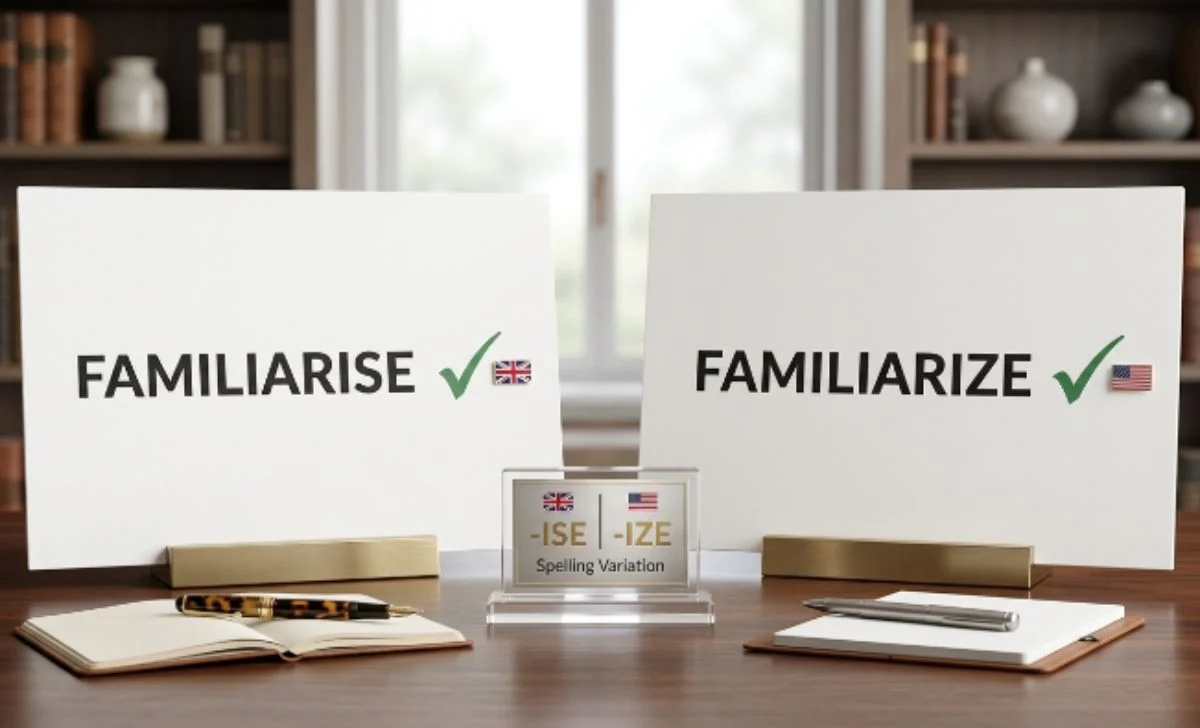
The good news is that both spellings are correct. The difference is mainly regional. Familiarise is preferred in British English, while familiarize is the standard spelling in American English.
Both mean to make someone or yourself familiar with something.
So, neither spelling is wrong. The important thing is to choose the form that matches the variety of English you are using and remain consistent throughout your writing.
Quick Answer: Familiarise or Familiarize?
Both familiarise and familiarize are correct.
- Familiarise = British English spelling
- Familiarize = American English spelling
Examples
British English:
Please familiarise yourself with the safety rules.
American English:
Please familiarize yourself with the safety rules.
The meaning and pronunciation are essentially the same.
| Spelling | English variety | Correct? |
|---|---|---|
| familiarise | British English | Yes |
| familiarize | American English | Yes |
| familarise | — | No |
| familarize | — | No |
What Does Familiarise or Familiarize Mean?
Familiarise/familiarize is a verb meaning to make someone familiar with something or to become familiar with something.
In simple terms, it means:
to learn about something so that it becomes known or easier to understand
For example:
You should familiarize yourself with the new software.
This means you should spend time learning how the software works.
Another example:
Employees must familiarise themselves with the emergency procedures.
Here, the employees are expected to learn and understand the procedures.
Familiarise vs Familiarize: The Main Difference
There is no difference in meaning between the two spellings.
The difference is mainly the spelling convention used in different varieties of English.
Familiarise → British English
Familiarize → American English
This is similar to:
- organise / organize
- realise / realize
- recognise / recognize
- apologise / apologize
British English traditionally uses -ise in many such words, while American English generally uses -ize.
However, British dictionaries and style guides may also accept -ize spellings in some cases. So the situation is slightly more nuanced than simply saying that -ize is always American and -ise is always British.
How Do You Pronounce Familiarise and Familiarize?
Both forms are generally pronounced the same way.
A common pronunciation is:
familiarise/familiarize
/fəˈmɪliəraɪz/
The ending sounds like:
-eyes
So:
familiar + eyes
The spelling changes, but the pronunciation does not normally change.
Familiarise/Familiarize in a Sentence
Here are examples using both forms:
British spelling
Please familiarise yourself with the instructions.
New employees should familiarise themselves with company policies.
I need to familiarise myself with the new system.
American spelling
Please familiarize yourself with the instructions.
New employees should familiarize themselves with company policies.
I need to familiarize myself with the new system.
The meaning remains exactly the same.
Grammar: How to Use Familiarise/Familiarize
Familiarise/familiarize is a verb.
A very common structure is:
familiarize + someone + with + something
For example:
The manager familiarized the staff with the new system.
Another extremely common structure is:
familiarize yourself with + something
For example:
Please familiarize yourself with the company rules.
Common grammatical patterns
| Pattern | Example |
|---|---|
| familiarise yourself with | Familiarise yourself with the rules. |
| familiarize yourself with | Familiarize yourself with the rules. |
| familiarise someone with | She familiarised him with the process. |
| familiarize someone with | She familiarized him with the process. |
A common mistake is forgetting with.
❌ Familiarize yourself the rules.
✅ Familiarize yourself with the rules.
Is “Familiarise Yourself With” Correct?
Yes.
Familiarise yourself with is a standard British English expression.
Please familiarise yourself with the terms and conditions.
The American equivalent is:
Please familiarize yourself with the terms and conditions.
Both are grammatically correct.
Familiarise/Familiarize: Verb Forms
Because the spelling difference only affects the -ise/-ize ending, the other forms follow the same pattern.
British English
- familiarise
- familiarises
- familiarised
- familiarising
American English
- familiarize
- familiarizes
- familiarized
- familiarizing
| Form | British | American |
|---|---|---|
| Base | familiarise | familiarize |
| Third person | familiarises | familiarizes |
| Past | familiarised | familiarized |
| -ing form | familiarising | familiarizing |
Word Origin of Familiarise/Familiarize
The word comes from familiar, which ultimately traces back to Latin familiaris, meaning something associated with a household or family.
The verb developed from the idea of making something familiar or known.
The suffix -ize has a long history in English and comes through Greek and Latin influence. The British -ise spelling developed as a variant.
This is why you can encounter both:
familiarise
and
familiarize
without there being a difference in meaning.
British English vs American English
This is one of the clearest examples of a spelling difference between British and American English.
British English
British publications commonly use:
familiarise
Example:
Please familiarise yourself with the new policy.
American English
American publications generally use:
familiarize
Example:
Please familiarize yourself with the new policy.
Comparison
| Feature | British English | American English |
|---|---|---|
| Preferred spelling | familiarise | familiarize |
| Meaning | Same | Same |
| Pronunciation | Same | Same |
| Past tense | familiarised | familiarized |
| -ing form | familiarising | familiarizing |
| Related word | realise | realize |
Which Spelling Should You Use?
The best spelling depends on your audience.
Writing for a British audience?
Use:
familiarise
This is a natural choice for British English content.
Writing for an American audience?
Use:
familiarize
This is the standard American spelling.
Writing for an international audience?
Either can work, but consistency matters.
If your website generally follows American English, use familiarize.
If your website follows British English, use familiarise.
Don’t randomly switch between the two throughout the same article.
Common Mistakes
Mistake 1: Thinking one spelling is completely wrong
❌ “Familiarise is always wrong.”
Not true.
Familiarise is standard British English.
Mistake 2: Thinking familiarize is always American-only
Familiarize is strongly associated with American English, but -ize forms are also accepted in some British English contexts and dictionaries.
Mistake 3: Mixing styles
For example:
Please familiarise yourself with the policy and organize your notes.
This mixes spelling conventions.
A consistent British style would be:
Please familiarise yourself with the policy and organise your notes.
A consistent American style would be:
Please familiarize yourself with the policy and organize your notes.
Mistake 4: Forgetting “with”
❌ Familiarize yourself the system.
✅ Familiarize yourself with the system.
Synonyms for Familiarise/Familiarize
Depending on the context, useful synonyms include:
- acquaint
- introduce
- educate
- inform
- teach
- brief
- train
- orient
- learn
- understand
Examples:
Familiarize yourself with the software.
Could become:
Learn how the software works.
Or:
Become acquainted with the software.
Antonyms
Possible contrasting expressions include:
- ignore
- unfamiliarize
- confuse
- mislead
- forget
- neglect
There is no single perfect antonym in every context because familiarize can mean either teaching someone something or becoming familiar with it.
Everyday Examples
At work
Please familiarize yourself with the company’s policies.
At school
Students should familiarise themselves with the course requirements.
With technology
I need to familiarize myself with this new application.
Before traveling
We should familiarise ourselves with the local customs.
In safety training
Employees must familiarize themselves with the emergency exits.
Before starting a job
New workers are encouraged to familiarise themselves with workplace procedures.
Familiarise vs Familiarize: Quick Comparison Table
| Question | Familiarise | Familiarize |
|---|---|---|
| Is it correct? | Yes | Yes |
| Main variety | British English | American English |
| Meaning | To make/become familiar | To make/become familiar |
| Pronunciation | Same | Same |
| Past tense | familiarised | familiarized |
| Present participle | familiarising | familiarizing |
| Best use | British-style writing | American-style writing |
A Simple Memory Trick
Think of the spelling patterns:
British = -ISE
American = -IZE
So:
familiarise → British
familiarize → American
You can connect it with other familiar examples:
organise / organize
realise / realize
recognise / recognize
apologise / apologize
If your article uses British spelling, choose familiarise.
If it uses American spelling, choose familiarize.
Practice Exercise
Choose the spelling that best fits the requested variety of English.
1. British English
Please ______ yourself with the new rules.
A. familiarise
B. familiarize
2. American English
Employees should ______ themselves with the safety procedures.
A. familiarise
B. familiarize
3. Is “familiarise” a correct spelling?
A. Yes
B. No
4. Is “familiarize” a correct spelling?
A. Yes
B. No
5. Complete the phrase:
Familiarize yourself _____ the instructions.
A. to
B. with
C. for
Answers
- familiarise
- familiarize
- Yes
- Yes
- with
People Also Ask
Is it familiarise or familiarize?
Both are correct. Familiarise is commonly used in British English, while familiarize is the standard American spelling.
Is familiarise British or American?
Familiarise is primarily associated with British English.
Is familiarize American spelling?
Familiarize is the standard spelling in American English.
Do familiarise and familiarize mean the same thing?
Yes. Both mean to make someone familiar with something or to become familiar with something.
Is familiarize with grammatically correct?
Usually, the standard construction is:
familiarize yourself with something
For example:
Familiarize yourself with the rules.
What is the past tense of familiarise?
The British form is:
familiarised
The American form is:
familiarized
What is the noun form of familiarize?
A related noun is familiarization, meaning the process of becoming familiar with something.
Is familiarise a real word?
Yes. Familiarise is a standard British English spelling.
FAQs
Should I use familiarise or familiarize on my website?
Choose the spelling that matches your site’s overall English style. Use familiarise for British English and familiarize for American English.
Can I use both spellings?
You can, but it is better to remain consistent within the same piece of writing.
Is “familiarise yourself with” correct?
Yes. It is a common and grammatically correct British English construction.
What is the American version of familiarise?
The American spelling is:
familiarize
What is the British version of familiarize?
The British spelling commonly used is:
familiarise
Are familiarise and familiarize pronounced differently?
Normally, no. The two spellings have essentially the same pronunciation.
What is the difference between familiar and familiarize?
Familiar is usually an adjective meaning known or recognized. Familiarize/familiarise is a verb meaning to make or become familiar with something.
Compare:
I am familiar with the software.
I need to familiarize myself with the software.
Final Verdict: Familiarise or Familiarize?
There is no single spelling that is universally “more correct.”
Both familiarise and familiarize are standard English spellings.
Use:
FAMILIARISE → British English
FAMILIARIZE → American English
The meaning stays the same, and the pronunciation is essentially unchanged. The most important rule is consistency. If your writing follows British English, familiarise is a natural choice. If you are writing in American English, familiarize is the standard choice.
So the next time you hesitate between the two, don’t ask, “Which one is wrong?” Ask:
“Which English style am I using?”
That one question will give you the answer.
Read More:

Hi, I’m Safdar Ali, an English language teacher with 26 years of teaching experience. My expertise is in English linguistics, grammar, and the differences between British and American English.
Through Gramiffy, I share practical, research-based guides to help students, writers, and English learners improve their language skills. My goal is to make English simple, accurate, and easy for everyone to understand.