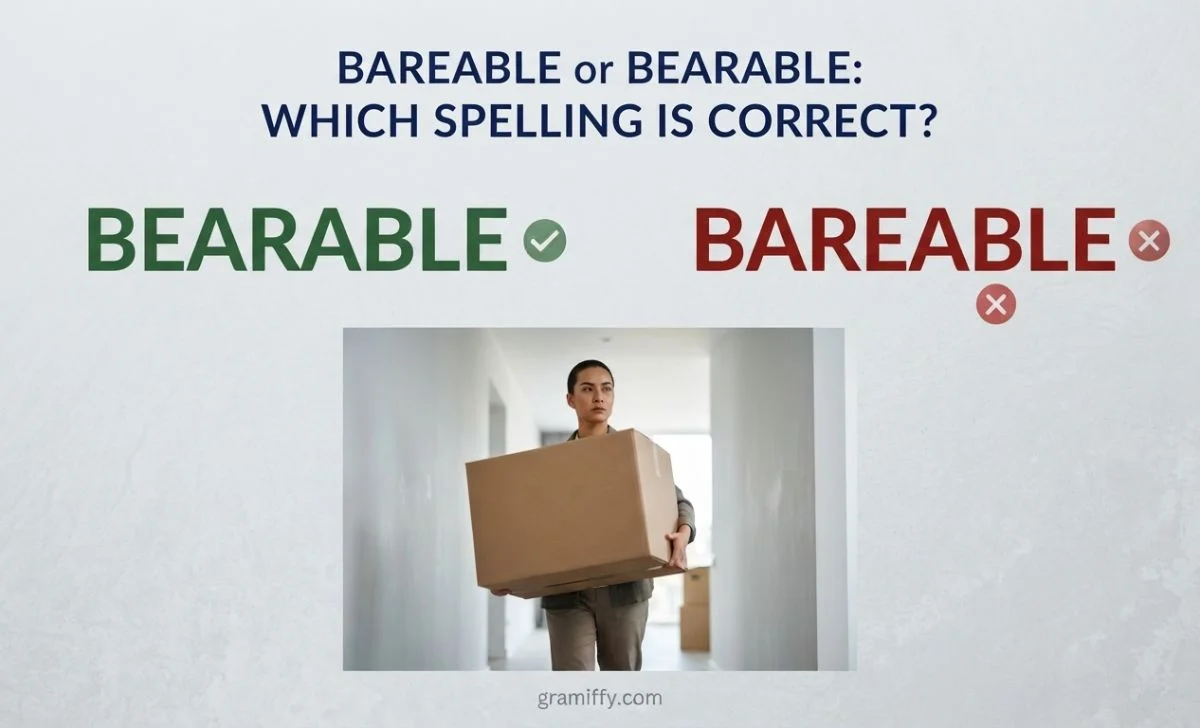
If you mean able to be endured or tolerated, the correct word is bearable.
Bareable is not the standard spelling of this word. The confusion happens because bear and bare are pronounced the same, but they have completely different meanings.
So if you can tolerate the heat, survive the noise, or get through a difficult situation, it is bearable—not bareable.
Quick Answer: Bearable or Bareable?
Bearable is correct.
Bareable is incorrect in standard modern English.
| Word | Correct? | Meaning |
|---|---|---|
| bearable | ✅ Yes | Able to be endured or tolerated |
| bareable | ❌ No | Not the standard spelling |
For example:
The heat was uncomfortable but bearable.
Not:
The heat was uncomfortable but bareable.
The correct word comes from the verb bear, meaning to endure, tolerate, or carry.
What Does “Bearable” Mean?
Bearable is an adjective meaning able to be endured, tolerated, or dealt with.
It describes something unpleasant, difficult, painful, or uncomfortable that you can nevertheless tolerate.
Examples:
- The heat was intense but still bearable.
- The pain became more bearable after a few minutes.
- The long journey was bearable with good company.
- The workload is difficult, but it is still bearable.
- Turning on the air conditioner made the room more bearable.
The opposite is unbearable, meaning something that is too difficult, painful, or unpleasant to tolerate.
The noise was unbearable.
Why Is It “Bearable” Instead of “Bareable”?
The answer becomes much clearer when you identify the base word.
Bearable comes from the verb bear:
bear + -able = bearable
Here, bear means to endure, tolerate, or carry.
For example:
I can’t bear the noise.
From the same word:
The noise is bearable.
The spelling is therefore connected directly to the verb bear.
Bare, on the other hand, means uncovered, exposed, empty, or lacking something.
He walked across the floor with bare feet.
That meaning has nothing to do with tolerating something.
Bear vs. Bare: What’s the Difference?
Bear and bare are homophones. They have the same pronunciation in most varieties of English, but their meanings and spellings are different.
| Word | Part of speech | Meaning | Example |
|---|---|---|---|
| bear | verb | endure or tolerate | I can’t bear the noise. |
| bear | verb | carry or support | The bridge can bear the weight. |
| bear | verb | produce | The tree bears fruit. |
| bear | noun | an animal | We saw a black bear. |
| bare | adjective | uncovered or exposed | He walked with bare feet. |
| bare | adjective | empty or minimal | The room had bare walls. |
| bare | verb | uncover or expose | He bared his teeth. |
The word bearable comes from the verb bear, not the adjective or verb bare.
The Easy Rule: If You Can “Bear” It, It’s “Bearable”
This is the simplest way to remember the spelling.
If you can bear something, then it is bearable.
I can bear the pain.
The pain is bearable.She can bear the workload.
The workload is bearable.We can bear the heat.
The heat is bearable.
The ea in bear stays in bearable.
Think:
bear → bearable → unbearable
That word family makes the spelling much easier to remember.
What About “Bareable”?
Bareable is not the standard spelling of the adjective meaning “able to be endured.”
It is usually created by taking bare and adding -able, but that produces the wrong word because the intended meaning comes from bear, not bare.
This is especially easy to do because bear and bare sound alike.
For example:
❌ The heat is bareable.
✅ The heat is bearable.
❌ The noise was barely bareable.
✅ The noise was barely bearable.
The correct spelling is always tied to bear when the meaning is “endure” or “tolerate.”
Bearable and Unbearable
A useful way to remember the spelling is to learn the opposite at the same time.
Bearable
Something that can be tolerated.
The temperature was bearable.
Unbearable
Something that cannot be tolerated.
The temperature became unbearable.
Both words contain bear:
bear → bearable → unbearable
Not:
bare → bareable → unbareable
So if you’re unsure about bearable, remember its very common opposite: unbearable.
“Bear With Me” or “Bare With Me”?
The same bear/bare confusion appears in the expression bear with me.
The correct phrase is:
Bear with me.
It means please be patient with me.
The verb bear here means to tolerate or endure.
Please bear with me while I explain.
Bare with me is incorrect when you’re asking someone to be patient.
This connection can help you remember the spelling:
bear with me → bear it → bearable
All three use bear in the sense of tolerating or enduring something.
Bearable vs. Barely Bearable
Here’s a useful phrase that contains both words:
The heat was barely bearable.
This sentence is completely correct.
Why?
Barely means only just or hardly.
Bearable means able to be tolerated.
So:
The heat was barely bearable.
means:
The heat was only just tolerable.
Notice that barely is spelled with bare, while bearable is spelled with bear.
That’s because they come from different words.
Related Words You Should Know
Once you know bearable, several related forms become easy.
Bear
To endure, tolerate, carry, or support.
I can’t bear the noise.
Bearable
Able to be endured or tolerated.
The noise is bearable.
Unbearable
Too difficult or unpleasant to endure.
The noise is unbearable.
Bearably
In a bearable or tolerable manner.
The temperature was bearably warm.
Unbearably
To an intolerable degree.
It was unbearably hot.
These words all retain bear.
The History Behind “Bearable”
The verb bear has a very old history in English. It comes from Old English beran, meaning to carry or bring.
Over time, the verb developed several related senses, including carrying a burden and enduring something difficult.
That idea of carrying or enduring is still visible in modern expressions:
- bear the burden
- bear the cost
- bear the pain
- bear responsibility
- bear the consequences
- bear the pressure
Bearable developed from this same sense of being able to endure something.
So the spelling isn’t connected to bare, even though the two words sound identical.
Common Spelling Mistakes
Here are some common examples to help reinforce the difference:
| Incorrect | Correct |
|---|---|
| The heat was bareable. | The heat was bearable. |
| The pain became bareable. | The pain became bearable. |
| The noise was unbareable. | The noise was unbearable. |
| Bare with me for a moment. | Bear with me for a moment. |
| The situation was barely bareable. | The situation was barely bearable. |
The pattern is simple: when the meaning involves enduring or tolerating, use bear.
Bearable in American and British English
There is no standard British-versus-American spelling difference here.
Both varieties use:
bearable
You may encounter the same word in British English, American English, Canadian English, Australian English, and other varieties of standard English.
Bareable does not become the correct spelling simply because of regional English differences.
A Simple Memory Trick
Use this sentence:
If you can bear it, it’s bearable.
That gives you the spelling automatically.
You can also remember:
BEAR = ENDURE
So:
BEAR + ABLE = BEARABLE
And:
UN + BEARABLE = UNBEARABLE
If you see bareable when the meaning is “tolerable,” stop and replace bare with bear.
Quick Quiz: Bearable or Bareable?
Choose the correct word.
- The pain was difficult but still __.
(bearable / bareable) - The noise became __ after midnight.
(unbearable / unbareable) - Please __ with me while I check the information.
(bear / bare) - The room had __ walls and almost no furniture.
(bear / bare) - After the temperature dropped, the heat became more __.
(bearable / bareable) - The journey was __ bearable because of the long delays.
(barely / bearly)
Answers
- bearable
- unbearable
- bear
- bare
- bearable
- barely
FAQs
Is “bareable” a word?
Bareable is not the standard spelling of the adjective meaning “able to be endured.” The correct word is bearable.
Is it bearable or bareable?
Bearable is correct when you mean something that can be tolerated or endured.
Why is bearable spelled with “bear”?
Because it comes from the verb bear, meaning to endure, tolerate, carry, or support.
What does bearable mean?
Bearable means able to be endured, tolerated, or dealt with.
What is the opposite of bearable?
The opposite is unbearable, meaning too difficult, painful, or unpleasant to tolerate.
Is “bear with me” or “bare with me” correct?
Bear with me is correct when you mean “please be patient with me.”
Are bear and bare homophones?
Yes. In standard pronunciation, bear and bare sound alike but have different meanings and spellings.
Is bearable the same in British and American English?
Yes. Bearable is the standard spelling in both British and American English.
Final Answer: Bearable or Bareable?
Bearable is the correct spelling.
Use bearable when something can be endured, tolerated, or dealt with:
The pain was bearable.
The workload is bearable.
The heat became more bearable after sunset.
Bareable is not the standard spelling for this meaning.
The easiest rule is:
If you can bear it, it’s bearable.
Remember the word family:
bear → bearable → unbearable
And don’t let the identical pronunciation of bear and bare fool you. When the meaning is endure, choose bear.
Read More:

Hi, I’m Safdar Ali, an English language teacher with 26 years of teaching experience. My expertise is in English linguistics, grammar, and the differences between British and American English.
Through Gramiffy, I share practical, research-based guides to help students, writers, and English learners improve their language skills. My goal is to make English simple, accurate, and easy for everyone to understand.