If you’ve ever paused while typing grammar and wondered whether it should actually be grammer, you’re far from alone.
Every month, thousands of students, professionals, writers, bloggers, teachers, and English learners search Google for questions like “grammar or grammer,” “is it grammar or grammer,” and “how do you spell grammar?”
The confusion is understandable. The two words differ by just one letter, and their pronunciation is similar enough that many people accidentally type grammer instead of grammar.
Because of this, grammar or grammer has become one of the most frequently searched English spelling questions.
Fortunately, the answer is simple.
Grammar is the correct spelling.
Grammer is an incorrect spelling when referring to the rules of a language.
Although you may occasionally see Grammer used as a surname or in the name of a business or organization, it is not the correct spelling for the English language term.
If you’re writing:
- a school assignment
- a business email
- a resume
- a research paper
- a social media post
- a professional report
- or simply trying to improve your English
you should always use grammar.
This complete guide explains everything you need to know, including:
- Which spelling is correct: grammar or grammer
- Why people confuse these words
- The meaning and definition of grammar
- Why grammer is incorrect
- The history and origin of the word
- Grammar pronunciation
- Real-life sentence examples
- Grammar rules every writer should know
- Common mistakes to avoid
- British vs. American English usage
- Memory tricks that make the spelling easy to remember
- Frequently asked questions
- Expert writing tips
Whether you’re a beginner learning English or an experienced writer looking for a quick answer, this guide will help you use the correct spelling confidently every time.
Featured Snippet Answer
Grammar is the correct spelling. It refers to the system of rules that governs how a language is written and spoken, including sentence structure, punctuation, syntax, and word usage. Grammer is a common misspelling and should not be used when referring to the English language or its rules.
Quick Answer
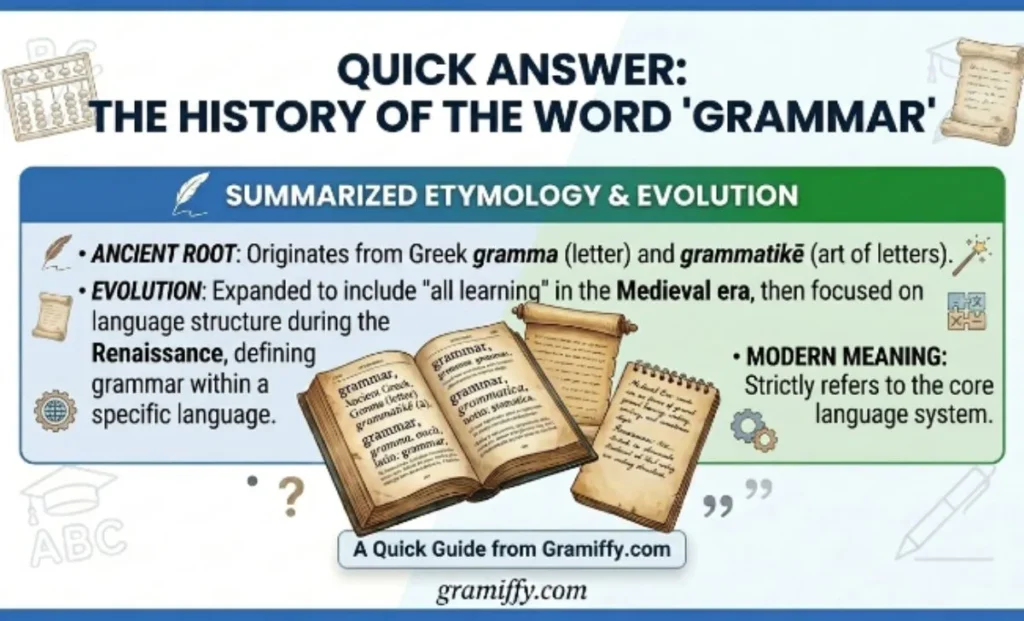
Here’s the answer in a simple table.
| If You Mean… | Correct Spelling |
|---|---|
| English language rules | ✅ Grammar |
| Sentence structure | ✅ Grammar |
| Grammar lessons | ✅ Grammar |
| Grammar checker | ✅ Grammar |
| Correct English writing | ✅ Grammar |
| “Grammer” | ❌ Incorrect spelling |
If your sentence is about language, writing, punctuation, syntax, or communication, the correct word is always grammar.
Is It Grammar or Grammer?
The correct spelling is grammar.
The spelling grammer is incorrect in standard English when referring to language rules.
For example:
✅ Good grammar helps people communicate clearly.
✅ She studies English grammar every evening.
❌ I want to improve my grammer.
❌ Good grammer is important for writing.
Even though grammer appears frequently in search engines, that doesn’t make it correct. It appears because many people accidentally misspell the word while searching.
The accepted spelling in schools, universities, dictionaries, style guides, and professional writing is grammar.
Why Do So Many People Search for “Grammer”?
If grammer is incorrect, why do so many people search for it?
There are several reasons.
It Sounds Similar
English spelling isn’t always phonetic.
Many learners hear the second syllable and assume the word should end with -mer instead of -mar.
This leads to:
- grammar ❌ grammer
The pronunciation can be misleading, especially for beginners.
It’s a Common Typing Mistake
Typing quickly often results in small spelling errors.
Since a and e are frequently confused in English words, many people accidentally write:
- grammer
instead of
- grammar
Search engines recognize this common typo and still return results for the correct word.
English Contains Many Irregular Spellings
English includes countless words whose spelling doesn’t perfectly match pronunciation.
Examples include:
- business
- Wednesday
- colonel
- comfortable
- rhythm
- grammar
Because English has borrowed vocabulary from many different languages, spelling patterns are not always predictable.
New English Learners Often Guess the Spelling
Many learners encounter the word before they’ve seen it written.
Instead of checking a dictionary, they spell it based on pronunciation, producing grammer.
This is completely normal—and one reason articles like this are so widely searched.
What Does Grammar Mean?
Grammar is much more than simply avoiding mistakes.
It is the complete system of rules that makes meaningful communication possible.
Definition of Grammar
Grammar is the set of rules that determines how words, phrases, clauses, and sentences are formed in a language.
It explains:
- how sentences are built
- how verbs change
- how nouns function
- where punctuation belongs
- how ideas are organized
- how meaning is communicated clearly
Without grammar, language would become confusing because there would be no consistent structure for expressing ideas.
Simple Definition
In simple English:
Grammar is the system of rules that helps people speak and write correctly.
These rules tell us:
- how to form sentences
- how to choose the correct verb
- where punctuation should go
- how words work together
- how ideas should be organized
Every language has its own grammar.
English grammar differs from Spanish grammar, French grammar, Arabic grammar, Urdu grammar, and Chinese grammar, but each language follows its own set of grammatical rules.
Why Is Grammar Important?
Some people think grammar only matters in school.
In reality, grammar influences nearly every form of communication.
Good grammar helps people:
- communicate clearly
- avoid misunderstandings
- write professional emails
- publish better blog posts
- perform well in exams
- write stronger research papers
- create effective business reports
- improve resumes
- produce high-quality website content
- build credibility as writers
Imagine receiving two job applications.
One contains clear, accurate grammar.
The other contains frequent grammar mistakes.
Most employers naturally view the first applicant as more careful and professional.
That’s one reason grammar continues to play such an important role in education and the workplace.
Grammar Is Used Everywhere
Many people associate grammar only with English classes.
In reality, grammar appears in almost every part of daily life.
Education
Students use grammar when they:
- write essays
- complete assignments
- answer examination questions
- prepare presentations
- conduct research
Strong grammar helps students communicate ideas more effectively and earn better grades.
Business
Professionals rely on grammar every day.
Examples include:
- emails
- proposals
- contracts
- presentations
- reports
- policies
- meeting notes
Clear grammar reduces confusion and improves communication between colleagues and clients.
Digital Marketing
Bloggers, copywriters, and content creators depend on grammar to produce content that readers trust.
Good grammar improves:
- readability
- user experience
- professionalism
- audience engagement
It also makes content easier to understand, encouraging readers to spend more time on the page.
Grammar in Everyday Communication
Grammar isn’t only for classrooms, textbooks, or exams. Every day, millions of people use grammar without even thinking about it.
Whether you’re sending a text message, replying to an email, posting on social media, or speaking with friends, grammar helps your message make sense.
Consider these examples:
Without proper grammar:
i am coming tomorrow dont wait outside
Although readers may understand the message, it looks careless and can easily cause confusion.
With proper grammar:
I am coming tomorrow. Don’t wait outside.
The second version is clearer, more professional, and easier to read.
This simple example shows why grammar matters in everyday life.
What Does Good Grammar Include?
Many people think grammar only means avoiding spelling mistakes.
In reality, grammar is much broader.
It includes every rule that helps us communicate correctly.
The main areas of grammar include:
Sentence Structure
Sentence structure explains how words combine to form complete thoughts.
Every complete sentence generally needs:
- a subject
- a verb
- a complete idea
Example:
✅ The teacher explained the lesson clearly.
This sentence has everything needed to express a complete thought.
Parts of Speech
Every English word belongs to a grammatical category called a part of speech.
The eight traditional parts of speech are:
- Nouns
- Pronouns
- Verbs
- Adjectives
- Adverbs
- Prepositions
- Conjunctions
- Interjections
Understanding these categories helps you build stronger, more accurate sentences.
Example:
The young student quickly completed the assignment.
- student → noun
- young → adjective
- quickly → adverb
- completed → verb
Verb Tenses
Grammar tells us when an action happens.
Common English tenses include:
- Present Simple
- Present Continuous
- Present Perfect
- Past Simple
- Past Continuous
- Future Simple
- Future Continuous
- Future Perfect
Examples:
Present:
She studies English every evening.
Past:
She studied English yesterday.
Future:
She will study English tomorrow.
Choosing the correct tense makes your writing precise and easy to understand.
Subject Verb Agreement
One of the most important grammar rules is making sure the subject and verb agree.
Correct:
He works every day.
Correct:
They work every day.
Incorrect:
He work every day.
Small grammar mistakes like this can make writing appear less polished.
Punctuation
Punctuation helps readers understand pauses, questions, quotations, and sentence boundaries.
Important punctuation marks include:
- Period (.)
- Comma (,)
- Question mark (?)
- Exclamation mark (!)
- Colon (:)
- Semicolon (;)
- Apostrophe (‘)
- Quotation marks (” “)
A famous example shows how punctuation changes meaning:
Let’s eat, Grandma!
Without the comma:
Let’s eat Grandma!
One punctuation mark completely changes the message.
Capitalization
Grammar also includes capitalization rules.
Always capitalize:
- the first word of a sentence
- names of people
- countries
- cities
- languages
- days of the week
- months
- holidays
Is “Grammer” Ever Correct?
For the English language term, the answer is no.
If you’re referring to:
- English grammar
- grammar rules
- grammar lessons
- grammar books
- grammar exercises
- grammar checkers
the spelling is always:
✅ Grammar
Never:
❌ Grammer
However, there is one important exception.
“Grammer” as a Proper Noun
Grammer may appear as:
- a surname
- a family name
- a company name
- a brand name
For example, someone may have the last name Grammer.
In those cases, Grammer is correct because it is a proper noun—not the English language term.
Why Dictionaries Use “Grammar”
Every major English dictionary recognizes grammar as the standard spelling.
Although the wording varies slightly, dictionaries consistently define grammar as the system of rules governing a language.
These rules include:
- sentence formation
- syntax
- punctuation
- word structure
- language usage
This consistency across trusted dictionaries is another reason you should always write grammar, not grammer, when referring to language rules.
Grammar vs Spelling
Many people mistakenly believe grammar and spelling are the same thing.
They are closely related, but they are different.
| Grammar | Spelling |
|---|---|
| Rules for using language correctly | Correct arrangement of letters in words |
| Covers sentence structure | Covers individual words |
| Includes punctuation | Includes correct letter order |
| Includes syntax | Includes word formation |
| Includes verb agreement | Includes accurate spelling |
Example:
Incorrect spelling:
I need to improve my grammer.
Correct spelling:
I need to improve my grammar.
The sentence uses correct grammar only when the word itself is spelled correctly.
At a Glance
| Question | Correct Answer |
|---|---|
| Correct spelling | ✅ Grammar |
| Incorrect spelling | ❌ Grammer |
| Part of speech | Noun |
| Meaning | Rules of a language |
| Used in dictionaries | Yes |
| Used in schools | Yes |
| Used in professional writing | Yes |
| Used in British English | Yes |
| Used in American English | Yes |
| Is “grammer” correct? | No (except as a proper noun) |
Why Is “Grammar” Spelled This Way?
One of the most common questions English learners ask is:
Why is the word spelled “grammar” instead of “grammer”?
The answer lies in the word’s history.
Unlike many modern English words, grammar did not develop from simple English spelling rules. Instead, it traveled through several languages before becoming part of modern English.
Its spelling has remained remarkably consistent for centuries, which is why grammar is the accepted form today.
The spelling grammer may look logical based on pronunciation, but it has never become the standard English spelling for the language term.
The History of the Word “Grammar”
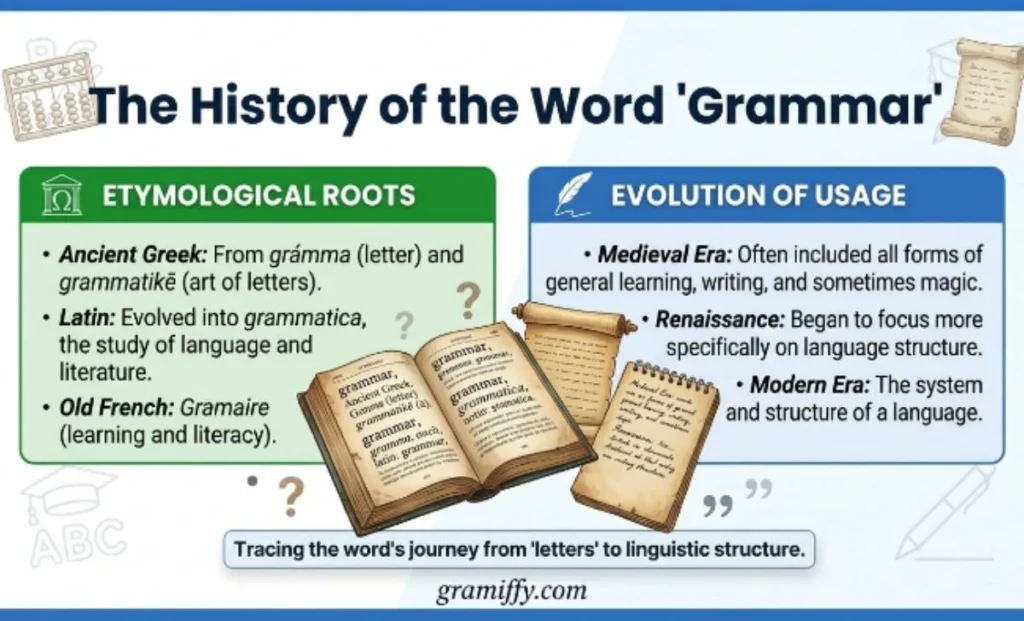
Understanding a word’s history often makes it much easier to remember.
The word grammar has existed for more than 2,000 years.
Its journey looks like this:
Ancient Greek
grammatikē
↓
Latin
grammatica
↓
Old French
gramaire
↓
Middle English
gramere
↓
Modern English
grammar
Originally, the word referred to the study of letters and writing. Over time, its meaning expanded to include the rules governing an entire language.
Today, grammar refers to the complete system of language rules that helps people communicate clearly.
Dictionary Definition of Grammar
Although dictionaries phrase the definition differently, they all describe the same concept.
Simple Definition
Grammar (noun):
The system of rules that governs how a language is spoken and written.
These rules determine:
- sentence structure
- word order
- verb forms
- punctuation
- syntax
- agreement
- capitalization
- meaning
Every language has grammar.
For example:
- English grammar
- Spanish grammar
- French grammar
- German grammar
- Arabic grammar
- Urdu grammar
Each language has its own grammatical system.
Different Types of Grammar
Grammar is a broad subject with many branches.
Here are the most common types.
Traditional Grammar
Traditional grammar teaches the rules most students learn in school.
It focuses on:
- nouns
- verbs
- adjectives
- adverbs
- punctuation
- sentence structure
This is the type of grammar used in most classrooms.
Descriptive Grammar
Descriptive grammar explains how people actually use language in everyday life.
Instead of telling people what they should say, descriptive grammar studies real conversations and writing.
For example, it records changes in vocabulary and sentence patterns over time.
Prescriptive Grammar
Prescriptive grammar explains the rules that are generally expected in formal writing and speech.
Examples include:
- using correct punctuation
- following subject-verb agreement
- avoiding sentence fragments
- choosing standard spellings
Schools, businesses, publishers, and examinations typically follow prescriptive grammar.
Comparative Grammar
Comparative grammar studies the similarities and differences between languages.
For example, linguists may compare:
- English grammar
- German grammar
- French grammar
- Spanish grammar
This helps researchers understand how languages have evolved.
Generative Grammar
Generative grammar is a linguistic theory that explores how humans naturally produce and understand an unlimited number of sentences using a finite set of grammatical rules.
Although it is mainly studied in linguistics, it has influenced modern language research and education.
What Are Grammar Rules?
Grammar rules are the guidelines that help people build correct and meaningful sentences.
These rules explain:
- how words should be arranged
- how verbs should change
- where punctuation belongs
- how nouns and pronouns relate
- how ideas connect logically
Without grammar rules, written and spoken communication would become confusing.
Essential Grammar Rules Everyone Should Know
Here are some of the most important grammar rules in English.
Capitalize the First Word of Every Sentence
Correct:
The meeting begins at nine.
Incorrect:
the meeting begins at nine.
End Sentences with Proper Punctuation
Correct:
Are you ready?
Correct:
We finished the project.
Incorrect:
We finished the project
Punctuation helps readers understand where one sentence ends and another begins.
Match Subjects and Verbs
Correct:
She enjoys reading.
Correct:
They enjoy reading.
Incorrect:
She enjoy reading.
This rule is called subject-verb agreement.
Use Complete Sentences
Every sentence should express a complete thought.
Correct:
The children played in the park.
Incorrect:
Because the children played.
The second example leaves readers waiting for additional information.
Choose the Correct Verb Tense
Correct:
I visited London last year.
Incorrect:
I visit London last year.
Verb tense tells readers when an action occurred.
Real Life Examples of Grammar
Grammar appears everywhere.
In Schools
Students use grammar when they:
- write essays
- answer examination questions
- prepare reports
- complete assignments
Example:
Good grammar helps students express their ideas clearly.
In Business
Professionals rely on grammar every day.
Examples include:
- emails
- contracts
- proposals
- presentations
- reports
Example:
Clear grammar improves professional communication.
In Social Media
Even short posts benefit from good grammar.
Correct grammar makes posts:
- easier to read
- more professional
- more engaging
Common Searches About Grammar
People search Google using many different questions about this topic.
Some of the most common include:
- grammar or grammer
- grammar vs grammer
- is grammar correct
- how do you spell grammar
- grammar meaning
- grammar definition
- grammar pronunciation
- grammar examples
- grammar rules
- English grammar
- grammar checker
- grammar mistakes
- grammar in a sentence
- grammar for beginners
- why is grammar spelled grammar
- is grammer a word
- difference between grammar and grammer
- grammar exercises
- grammar guide
- grammar basics
This guide answers all of these questions in one place, making it a complete resource for anyone trying to understand the correct spelling and usage.
Quick Facts
| Fact | Answer |
|---|---|
| Correct spelling | Grammar |
| Incorrect spelling | Grammer |
| Part of speech | Noun |
| Meaning | Rules of a language |
| Used worldwide | Yes |
| British spelling | Grammar |
| American spelling | Grammar |
| Common mistake | Writing grammer instead of grammar |
| Found in dictionaries | Yes |
| Suitable for academic writing | Yes |
The Main Components of English Grammar
Grammar is much more than knowing how to spell words correctly. It is a complete system that explains how words work together to create clear and meaningful communication.
Understanding these components will improve your writing, speaking, reading, and editing skills.
The major parts of English grammar include:
- Parts of speech
- Sentence structure
- Clauses
- Phrases
- Verb tenses
- Subject-verb agreement
- Active and passive voice
- Punctuation
- Capitalization
- Articles
- Determiners
- Prepositions
- Conjunctions
- Pronouns
- Modifiers
- Word order
Let’s examine each one.
Parts of Speech
Every English word belongs to a grammatical category known as a part of speech.
These categories explain the function of each word within a sentence.
Nouns
A noun names a person, place, thing, or idea.
Examples:
- teacher
- student
- London
- computer
- honesty
Sentence:
The teacher explained the lesson.
Pronouns
Pronouns replace nouns to avoid repetition.
Examples:
- I
- you
- he
- she
- they
- it
- we
Sentence:
Sarah finished the project because she worked hard.
Verbs
A verb expresses an action or state of being.
Examples:
- write
- study
- walk
- become
- think
- is
- are
Sentence:
The students studied grammar yesterday.
Adjectives
Adjectives describe nouns.
Examples:
- beautiful
- large
- intelligent
- difficult
- interesting
Sentence:
She bought a beautiful notebook.
Adverbs
Adverbs describe verbs, adjectives, or other adverbs.
Examples:
- quickly
- carefully
- always
- never
- slowly
Sentence:
He answered the question carefully.
Prepositions
Prepositions show relationships between words.
Examples:
- in
- on
- under
- beside
- between
- across
Sentence:
The book is on the table.
Conjunctions
Conjunctions connect words, phrases, and clauses.
Examples:
- and
- but
- because
- although
- while
- or
Sentence:
She studied hard because she had an exam.
Interjections
Interjections express emotion.
Examples:
- Wow!
- Oh!
- Ouch!
- Congratulations!
- Hurray!
Sentence:
Wow! That was an excellent presentation.
Sentence Structure
One of the most important areas of grammar is sentence structure.
A complete sentence should contain:
- a subject
- a verb
- a complete thought
Example:
The manager approved the proposal.
Subject:
The manager
Verb:
approved
Object:
the proposal
Because the sentence expresses a complete idea, it is grammatically correct.
Types of Sentences
Grammar classifies sentences into four major types.
Declarative Sentence
Makes a statement.
Example:
Grammar improves communication.
Interrogative Sentence
Asks a question.
Example:
Is grammar important?
Imperative Sentence
Gives a command or instruction.
Example:
Read the instructions carefully.
Exclamatory Sentence
Expresses strong emotion.
Example:
What an amazing presentation!
Clauses
A clause contains a subject and a verb.
There are two main types.
Independent Clause
Can stand alone.
Example:
She completed the assignment.
Dependent Clause
Cannot stand alone.
Example:
Because she completed the assignment…
It requires another clause to complete the thought.
Phrases
Unlike clauses, phrases do not contain both a subject and a verb.
Examples:
- after lunch
- in the classroom
- with great enthusiasm
- during the meeting
Example sentence:
We discussed grammar during the meeting.
Subject Verb Agreement
One of the most frequently tested grammar rules is subject-verb agreement.
The subject and verb must agree in number.
Correct:
The teacher explains grammar.
Correct:
The teachers explain grammar.
Incorrect:
The teacher explain grammar.
Maintaining agreement makes sentences sound natural and grammatically correct.
Verb Tenses
Verb tense indicates when an action occurs.
Present Simple
Used for habits and general truths.
Example:
She studies grammar every evening.
Present Continuous
Used for actions happening now.
Example:
She is studying grammar.
Present Perfect
Used for actions connected to the present.
Example:
She has completed the grammar lesson.
Past Simple
Used for completed actions in the past.
Example:
She studied grammar yesterday.
Past Continuous
Used for ongoing actions in the past.
Example:
She was studying when I called.
Future Simple
Used for future actions.
Example:
She will study grammar tomorrow.
Active Voice vs Passive Voice
Grammar distinguishes between active and passive voice.
Active Voice
The subject performs the action.
Example:
The editor corrected the article.
Passive Voice
The subject receives the action.
Example:
The article was corrected by the editor.
Active voice is usually clearer and more direct, while passive voice is useful when the action is more important than the person performing it.
Articles
English uses three articles.
- a
- an
- the
Examples:
I bought a book.
She ate an apple.
The book is on the desk.
Correct article usage is essential for natural English.
Determiners
Determiners introduce nouns.
Examples include:
- this
- that
- these
- those
- my
- your
- each
- every
- some
- many
Example:
These grammar exercises are helpful.
Pronoun Agreement
Pronouns should clearly match the nouns they replace.
Correct:
Every student submitted their assignment. (Common in modern English)
Also correct in formal singular agreement:
Every student submitted his or her assignment.
Incorrect:
Every student submitted our assignment.
Word Order
English generally follows this sentence pattern:
Subject + Verb + Object
Example:
The student completed the assignment.
Changing the order can make sentences confusing.
Incorrect:
Completed the assignment the student.
Correct word order improves readability.
Common Grammar Rules Everyone Should Follow
To write clearly and professionally, remember these essential rules:
- Start every sentence with a capital letter.
- End every sentence with appropriate punctuation.
- Match subjects and verbs correctly.
- Keep verb tenses consistent.
- Use complete sentences.
- Avoid double negatives.
- Use commas where necessary.
- Place modifiers next to the words they describe.
- Proofread before publishing or submitting your writing.
These rules form the foundation of effective communication.
Why Learning Grammar Takes Time
Many learners expect to master grammar within a few weeks.
In reality, grammar develops gradually through:
- reading
- writing
- speaking
- listening
- editing
- regular practice
The more quality English you read, the more naturally grammar becomes part of your writing.
Professional writers continue improving their grammar throughout their careers.
Grammar Skills That Employers Value
Strong grammar is one of the most valuable communication skills in the workplace.
Employers appreciate candidates who can:
- write professional emails
- prepare accurate reports
- create clear documentation
- communicate effectively with clients
- produce polished presentations
Good grammar demonstrates attention to detail and professionalism.
Grammar vs Grammer: What’s the Difference?
At first glance, grammar and grammer look almost identical. The only difference is one letter, yet that single letter completely changes whether the word is correct or incorrect.
If you’re referring to the rules of a language, there is only one correct spelling:
✅ Grammar
❌ Grammer
Although millions of people search for grammer every year, it remains a spelling mistake rather than an accepted English word in this context.
Here’s a detailed comparison.
| Feature | Grammar | Grammer |
|---|---|---|
| Correct English spelling | ✅ Yes | ❌ No |
| Standard dictionary word | ✅ Yes | ❌ No (for language rules) |
| Used in schools | ✅ Yes | ❌ No |
| Used in universities | ✅ Yes | ❌ No |
| Used in academic writing | ✅ Yes | ❌ No |
| Used in business writing | ✅ Yes | ❌ No |
| Refers to language rules | ✅ Yes | ❌ No |
| Accepted in British English | ✅ Yes | ❌ No |
| Accepted in American English | ✅ Yes | ❌ No |
| Common spelling mistake | ❌ No | ✅ Yes |
The conclusion is simple:
Always write “grammar” when referring to the rules of a language.
Why “Grammer” Is a Common Misspelling
Many people wonder why this mistake happens so often.
There are several reasons.
1. Pronunciation Can Be Misleading
The ending of grammar sounds similar to -mer, leading many learners to assume the spelling should match the sound.
English, however, is not always phonetic.
Examples of similarly confusing words include:
- business
- Wednesday
- rhythm
- comfortable
- restaurant
- grammar
Learning the correct spelling through reading and practice is more reliable than relying on pronunciation alone.
2. Typing Too Quickly
Fast typing often leads to simple spelling errors.
The letters a and e are commonly confused, especially when writing quickly.
Many searches for grammer are simply typing mistakes.
3. English Has Many Irregular Spellings
Unlike highly phonetic languages, English borrows words from Greek, Latin, French, German, and many other languages.
As a result, spelling often reflects history rather than pronunciation.
Grammar is one of those historical spellings that has remained unchanged.
4. Learners Memorize Sounds Instead of Spellings
Beginning English learners often hear words before seeing them written.
Without checking a dictionary, they naturally guess the spelling.
This explains why grammer appears so frequently in online searches.
How to Remember the Correct Spelling
Fortunately, remembering grammar is easier than many people think.
Memory Trick #1
Think of this sentence:
Grammar Helps Great Minds Communicate.
The repeated G reminds you of the correct word.
Memory Trick #2
Remember these common expressions:
- grammar book
- grammar rules
- grammar lesson
- grammar school
- grammar exercises
- grammar checker
- grammar quiz
- grammar guide
You’ll never see:
- grammer book
- grammer rules
Your brain gradually memorizes the correct spelling through repetition.
Memory Trick #3
Imagine opening any English dictionary.
You’ll always find:
✅ Grammar
Never:
❌ Grammer
This simple visualization works surprisingly well.
Grammar in British English vs American English
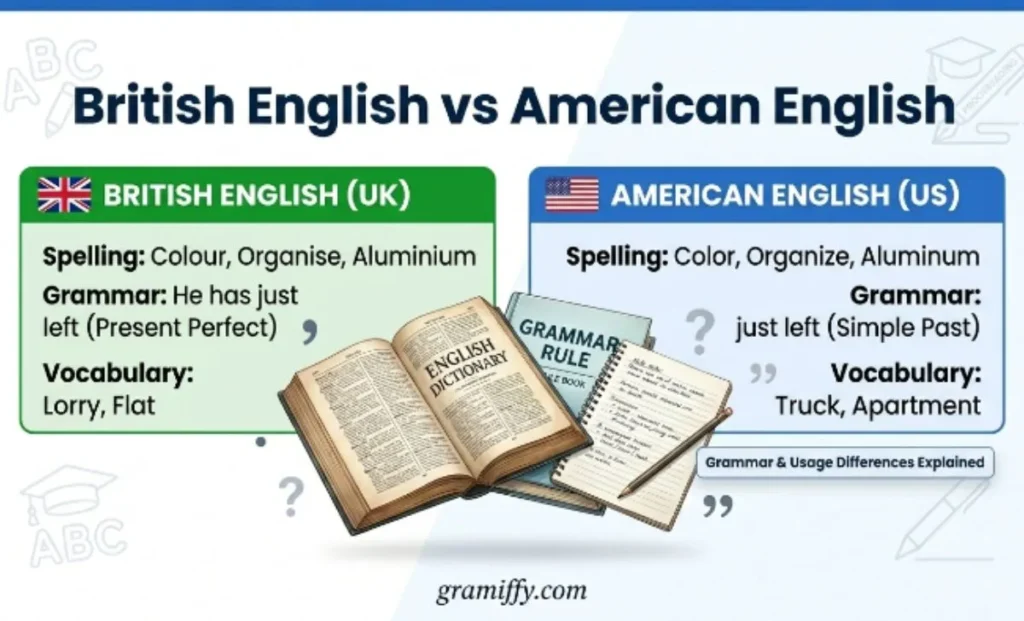
Some English words have different spellings depending on the variety of English.
Examples include:
| British English | American English |
|---|---|
| colour | color |
| honour | honor |
| organise | organize |
| centre | center |
| traveller | traveler |
Many learners assume grammar may also have two spellings.
It doesn’t.
Both varieties use exactly the same word.
British English:
Grammar
American English:
Grammar
There is no accepted spelling grammer in either variety.
Grammar Around the World
Grammar exists in every language, although the rules differ.
Examples include:
- English grammar
- Spanish grammar
- French grammar
- German grammar
- Italian grammar
- Portuguese grammar
- Arabic grammar
- Urdu grammar
- Hindi grammar
- Chinese grammar
- Japanese grammar
- Korean grammar
Each language has its own system for:
- sentence order
- verb forms
- punctuation
- agreement
- word formation
Learning grammar helps learners understand these systems more effectively.
Common Grammar Terms You Should Know
As you study grammar, you’ll encounter these important terms.
Syntax
Syntax refers to the arrangement of words within a sentence.
Example:
Correct:
She enjoys reading books.
Incorrect:
Enjoys she books reading.
Morphology
Morphology studies how words are formed.
Example:
- play
- played
- playing
- player
These related forms demonstrate morphological changes.
Clause
A clause contains a subject and a verb.
Example:
Because she studied hard…
Phrase
A phrase is a group of words without both a subject and a verb.
Example:
after school
Modifier
A modifier describes another word.
Example:
The extremely talented musician performed brilliantly.
Correct placement of modifiers prevents confusion.
Grammar in Real Life Situations
Grammar isn’t limited to textbooks.
It influences communication in almost every profession.
Students
Students use grammar when writing:
- essays
- assignments
- reports
- dissertations
- examination answers
Strong grammar often contributes to better grades.
Teachers
Teachers rely on grammar to:
- explain language rules
- prepare lessons
- grade assignments
- improve student writing
Bloggers
Content creators use grammar to publish articles that are:
- accurate
- trustworthy
- engaging
- easy to understand
Well-written content keeps readers on the page longer.
Business Professionals
Professionals depend on grammar when writing:
- proposals
- contracts
- presentations
- emails
- policies
- manuals
Clear grammar reduces misunderstandings and improves workplace communication.
Job Seekers
Resumes and cover letters with correct grammar create stronger first impressions.
Recruiters often notice grammar mistakes immediately.
Common Searches Related to Grammar
People also search for:
- grammar or grammer
- grammar vs grammer
- is grammar correct
- grammar meaning
- grammar definition
- grammar pronunciation
- grammar examples
- grammar rules
- grammar checker
- grammar mistakes
- grammar exercises
- grammar basics
- grammar guide
- English grammar
- how to improve grammar
- grammar test
- grammar quiz
- grammar in a sentence
- grammar for beginners
- why is grammar spelled grammar
Understanding these related questions helps answer the broader topic comprehensively.
Quick Knowledge Check
Choose the correct answer.
1. Which spelling is correct?
A. Grammar
B. Grammer
✅ Answer: Grammar
2. Which sentence is correct?
A. Good grammar improves communication.
B. Good grammer improves communication.
✅ Answer: A
3. Which spelling appears in dictionaries?
A. Grammar
B. Grammer
✅ Answer: Grammar
4. Which spelling should you use in business writing?
A. Grammar
B. Grammer
✅ Answer: Grammar
5. Which spelling is accepted in both British and American English?
A. Grammar
B. Grammer
✅ Answer: Grammar
If you answered all five correctly, you’ve mastered one of the most commonly misspelled words in English.
How to Improve Your Grammar
Knowing that grammar is the correct spelling is only the beginning. Developing strong grammar skills takes consistent practice, but anyone can improve with the right approach.
Here are some proven strategies.
Read Every Day
Reading high-quality English exposes you to correct grammar naturally.
Excellent resources include:
- Books
- Newspapers
- Magazines
- Academic articles
- Trusted blogs
- Professional websites
The more you read, the more familiar correct sentence patterns become.
Write Regularly
Writing helps you apply grammar rules instead of simply memorizing them.
Try writing:
- Daily journal entries
- Emails
- Blog posts
- Essays
- Product descriptions
- Social media captions
The more you write, the more confident you’ll become.
Learn One Rule at a Time
Trying to learn every grammar rule at once can be overwhelming.
Instead, focus on one topic each week, such as:
- Subject-verb agreement
- Verb tenses
- Punctuation
- Articles
- Prepositions
- Sentence structure
Building your knowledge gradually is more effective than trying to memorize everything at once.
Proofread Your Work
Even experienced writers make mistakes.
Before publishing or submitting your work, check for:
- Spelling errors
- Grammar mistakes
- Missing punctuation
- Incorrect capitalization
- Repeated words
- Awkward sentence structure
Reading your work aloud can also help you spot mistakes more easily.
Practice with Exercises
Grammar improves through repetition.
Helpful activities include:
- Grammar quizzes
- Sentence correction exercises
- Fill-in-the-blank activities
- Editing practice
- Reading comprehension exercises
Regular practice strengthens long-term writing skills.
Common Grammar Mistakes to Avoid
Many writers struggle with the same grammar mistakes. Learning to recognize them will make your writing clearer and more professional.
1. Subject-Verb Agreement
The subject and verb must agree in number.
❌ Incorrect:
She write every day.
✅ Correct:
She writes every day.
2. Incorrect Verb Tense
Choose the correct tense to show when an action happens.
❌ Incorrect:
Yesterday I go to school.
✅ Correct:
Yesterday I went to school.
3. Sentence Fragments
A sentence should express a complete thought.
❌ Incorrect:
Because I was tired.
✅ Correct:
Because I was tired, I went to bed early.
4. Run-on Sentences
Separate independent ideas correctly.
❌ Incorrect:
I finished my homework I watched television.
✅ Correct:
I finished my homework, and then I watched television.
5. Apostrophe Errors
❌ Incorrect:
Its raining today.
✅ Correct:
It’s raining today.
Remember:
- It’s = It is
- Its = Possessive form
6. Confusing Similar Words
English contains many commonly confused words.
Examples include:
- Your / You’re
- Than / Then
- Affect / Effect
- Advice / Advise
- Accept / Except
- Lose / Loose
- Principal / Principle
- Stationary / Stationery
- Compliment / Complement
Learning these word pairs improves both grammar and vocabulary.
Grammar in Academic Writing
Strong grammar is essential for students and researchers.
Good grammar helps you:
- Write clearer essays
- Improve assignments
- Produce stronger research papers
- Communicate ideas effectively
- Achieve better grades
Poor grammar can distract readers and make even good ideas harder to understand.
Grammar in Professional Writing
Grammar influences how others perceive your professionalism.
Clear grammar improves:
- Business emails
- Reports
- Proposals
- Contracts
- Presentations
- Resumes
- Cover letters
- Client communication
Employers often view accurate grammar as a sign of attention to detail and effective communication.
Grammar in Digital Marketing
Content creators, bloggers, and marketers rely on good grammar to build trust.
Well-written content is:
- Easier to read
- More engaging
- More professional
- More persuasive
- More likely to be shared
Grammar in Everyday Life
Grammar isn’t only for formal situations.
You use grammar when:
- Sending text messages
- Posting on social media
- Writing comments
- Sending emails
- Chatting with friends
- Filling out forms
- Writing applications
Using good grammar makes your communication clearer and easier to understand.
Memory Tricks to Remember “Grammar”
If you often type grammer, these memory techniques can help.
Trick #1: Grammar Has an “A”
Think of this phrase:
Grammar helps you Achieve accuracy.
The word Achieve reminds you that grammar contains the letter A, not E.
Trick #2: Think of Common Expressions
You’ll often see phrases like:
- Grammar rules
- Grammar book
- Grammar lesson
- Grammar checker
- Grammar guide
- Grammar exercises
Notice that every one uses grammar, never grammer.
Trick #3: Picture a Dictionary
Imagine opening a dictionary.
You’ll always find:
✅ Grammar
Never:
❌ Grammer
This visualization reinforces the correct spelling.
Grammar Myths
Let’s clear up some common misconceptions.
Myth 1: Grammar Only Matters in School
Fact: Grammar is important in education, business, publishing, marketing, and everyday communication.
Myth 2: Native Speakers Never Make Grammar Mistakes
Fact: Native speakers also make grammar mistakes and often need to proofread their writing.
Myth 3: Spell Check Fixes Everything
Fact: Spell check tools are useful, but they cannot catch every grammar error or awkward sentence.
Myth 4: Grammar and Spelling Are the Same
Fact: Grammar governs how words work together in sentences, while spelling concerns the correct arrangement of letters within individual words.
Quick Quiz
Test your understanding.
Question 1
Which spelling is correct?
A. Grammar
B. Grammer
✅ Answer: A
Question 2
Which sentence is correct?
A. My grammar is improving.
B. My grammer is improving.
✅ Answer: A
Question 3
Grammar is primarily concerned with:
A. Language rules
B. Mathematics
✅ Answer: A
Question 4
Which spelling appears in dictionaries?
A. Grammar
B. Grammer
✅ Answer: A
Question 5
Which spelling should you use in professional writing?
A. Grammar
B. Grammer
✅ Answer: A
At a Glance
| Question | Correct Answer |
|---|---|
| Correct spelling | ✅ Grammar |
| Incorrect spelling | ❌ Grammer |
| Part of speech | Noun |
| Meaning | Rules governing a language |
| Accepted worldwide | Yes |
| British English | Grammar |
| American English | Grammar |
| Used in schools | Yes |
| Used in business | Yes |
| Used in academic writing | Yes |
FAQs
Is it grammar or grammer?
Grammar is the correct spelling. It refers to the system of rules that governs how a language is written and spoken.
Grammer is an incorrect spelling when referring to language rules.
Is “grammer” a real word?
Not in standard English when talking about language.
However, Grammer may appear as:
- a surname
- a company name
- a brand name
If you mean the rules of English, always use grammar.
Why do people spell grammar as grammer?
The mistake usually happens because:
- the pronunciation can be misleading
- English spelling isn’t always phonetic
- people type quickly
- beginners often spell words the way they hear them
How do you spell grammar correctly?
The correct spelling is:
✅ Grammar
Incorrect:
❌ Grammer
A simple way to remember it is to read quality English regularly and notice how the word is consistently spelled.
What does grammar mean?
Grammar is the system of rules that explains how words, phrases, and sentences are formed in a language.
It includes:
- sentence structure
- punctuation
- syntax
- verb tenses
- subject-verb agreement
- capitalization
- parts of speech
Why is grammar important?
Good grammar helps people:
- communicate clearly
- avoid misunderstandings
- write professionally
- achieve better academic results
- create trustworthy online content
- make positive first impressions
Is grammar the same as spelling?
No.
Grammar refers to the rules for constructing sentences.
Spelling refers to arranging letters correctly within individual words.
Both are essential, but they serve different purposes.
Does British English spell it differently?
No.
Both British English and American English use exactly the same spelling:
Grammar
There is no accepted spelling grammer in either variety.
Can grammar improve my writing?
Absolutely.
Strong grammar helps make your writing:
- clearer
- more professional
- easier to understand
- more persuasive
- more credible
Whether you’re writing essays, emails, reports, or blog posts, good grammar improves the quality of your communication.
How can I improve my grammar?
You can improve by:
- reading every day
- writing regularly
- studying grammar rules
- practicing with exercises
- proofreading your work
- learning from your mistakes
Consistency is more important than trying to learn everything at once.
Is grammar difficult to learn?
Grammar can seem challenging at first, but it becomes easier with regular practice.
Focus on one topic at a time and apply what you learn through reading and writing.
What are the most common grammar mistakes?
Some of the most common include:
- subject-verb agreement errors
- incorrect verb tenses
- punctuation mistakes
- sentence fragments
- run-on sentences
- apostrophe errors
- confusing similar words
Learning to recognize these mistakes will improve your writing significantly.
Grammar Checklist
- ✅ Is every sentence complete?
- ✅ Are all words spelled correctly?
- ✅ Is punctuation accurate?
- ✅ Do subjects and verbs agree?
- ✅ Are verb tenses consistent?
- ✅ Are capital letters used correctly?
- ✅ Have you avoided common grammar mistakes?
- ✅ Did you proofread your work?
This simple checklist can prevent many writing errors.
Final Verdict
If you’re still asking whether the correct spelling is grammar or grammer, remember this simple answer:
✅ Grammar is always the correct spelling when referring to the rules of a language.
❌ Grammer is a common misspelling and should be avoided in standard English writing.
Although the two words look similar, only grammar appears in dictionaries, textbooks, academic papers, style guides, and professional writing.
Whether you’re a student, teacher, writer, blogger, content creator, editor, or business professional, using the correct spelling demonstrates accuracy, attention to detail, and strong communication skills.
Whenever you’re discussing:
- English grammar
- grammar rules
- grammar lessons
- grammar books
- grammar checkers
- grammar exercises
- grammar mistakes
the correct word is always grammar.
A helpful memory trick is:
Grammar has an “A” after the double “M,” and it’s the spelling accepted by every major dictionary.
Once you remember this simple rule, you’ll never confuse grammar and grammer again.
Trusted References
For accurate definitions, spelling standards, and grammar guidance, consult trusted language resources such as:
- Merriam-Webster Dictionary
- Oxford English Dictionary (OED)
- Cambridge Dictionary
- Collins English Dictionary
- The Chicago Manual of Style
- APA Publication Manual
- MLA Handbook
- Garner’s Modern English Usage
These respected references consistently recognize grammar as the correct spelling for the system of language rules.
Read More :

I am Constance Hale, an, editor, and writing expert dedicated to helping people write with clarity and confidence. Through my articles on Gramiffy.com, I simplify grammar, spelling, and language usage for readers of all levels. My goal is to make English writing more engaging, accurate, and enjoyable.