Grisly and grizzly are easy to mix up because they look almost identical and sound very similar. But they describe completely different things.
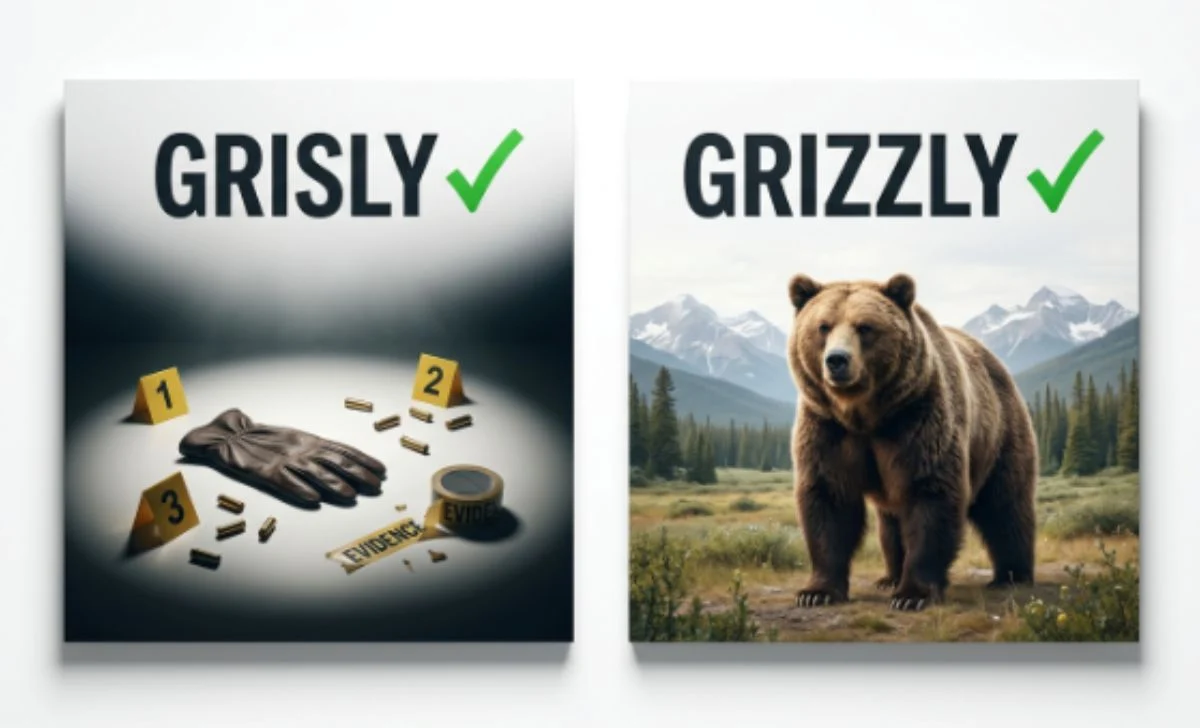
Grisly means horrifying, gruesome, or involving blood, death, or violence.
Grizzly usually refers to a grizzly bear, a large North American brown bear. It can also mean gray or streaked with gray, although that use is much less common.
So the easiest rule is:
Grisly = gruesome or horrifying
Grizzly = a bear
Quick Answer: Grisly or Grizzly?
Both grisly and grizzly are correct English words, but they are not interchangeable.
| Word | Meaning | Example |
|---|---|---|
| grisly | Horrifying, gruesome, or involving violence/death | The police discovered a grisly scene. |
| grizzly | A North American brown bear | A grizzly crossed the trail. |
| grizzly | Gray or streaked with gray | He had grizzly hair. |
The fastest way to remember them
If you’re talking about something horrible or gruesome, use:
grisly
If you’re talking about the animal, use:
grizzly
What Does Grisly Mean?
Grisly is an adjective used for something that causes horror, disgust, or shock, especially because it involves death, injury, blood, or violence.
Examples:
- The detectives arrived at a grisly scene.
- The documentary described a grisly murder.
- Investigators uncovered grisly details about the accident.
- The novel contains some grisly descriptions.
The word is usually associated with something disturbing rather than simply unpleasant.
Grisly does not mean simply “bad”
You would not normally say:
The weather was grisly.
Instead, grisly is especially appropriate when something is gruesome or horrifying.
What Does Grizzly Mean?
Grizzly has two main meanings.
Grizzly = a bear
A grizzly bear is a North American subspecies or population of brown bear, scientifically associated with Ursus arctos.
Examples:
- We saw a grizzly bear from a safe distance.
- The park is home to grizzly bears.
- The hikers carried bear spray because grizzlies live in the area.
The shortened form grizzly can refer to the animal by itself:
A grizzly was spotted near the river.
Grizzly = gray or streaked with gray
A less common use of grizzly describes something that is gray or mixed with gray.
For example:
The old sailor had grizzly hair.
This sense is much less common in everyday modern English than the bear-related meaning.
Grisly vs Grizzly: The Main Difference
The key distinction is meaning, not grammar.
Grisly
Think:
blood + death + horror = grisly
The investigation revealed grisly details.
Grizzly
Think:
bear + wilderness = grizzly
A grizzly was seen near the campsite.
This distinction works in most everyday situations.
Grisly vs Grizzly Comparison Table
| Feature | Grisly | Grizzly |
|---|---|---|
| Part of speech | Adjective | Noun / adjective |
| Main meaning | Gruesome or horrifying | Grizzly bear |
| Other meaning | — | Gray or streaked with gray |
| Common phrase | grisly details | grizzly bear |
| Associated with | Death, violence, horror | Wildlife, North America |
| Example | a grisly discovery | a grizzly attacked |
| Pronunciation | GRIZ-lee | GRIZ-lee |
The words are pronounced the same in many varieties of English, which is why spelling is the real trap.
Pronunciation: Grisly vs Grizzly
In standard modern English, grisly and grizzly are generally pronounced the same.
Grisly
IPA: /ˈɡrɪzli/
Approximate pronunciation:
GRIZ-lee
Grizzly
IPA: /ˈɡrɪzli/
Approximate pronunciation:
GRIZ-lee
That makes them homophones for most speakers.
Because they sound alike, you cannot reliably choose the spelling by pronunciation.
You have to use the meaning.
Is Grisly the Same as Gruesome?
They are very close.
Grisly describes something that is horrifying or disturbing, especially because of death, blood, injury, or violence.
Gruesome is broader and can describe anything extremely unpleasant, shocking, or horrifying.
Compare:
The detective described the grisly crime scene.
The film contains several gruesome scenes.
Both can work in certain contexts, but grisly often has a stronger connection with death or violence.
Is Grizzly Only Used for Bears?
No.
Although grizzly bear is by far the most familiar use, grizzly can also function as an adjective meaning gray or streaked with gray.
For example:
He had a grizzly beard.
However, this meaning is relatively uncommon compared with the animal-related meaning.
In modern everyday English, if someone says:
I saw a grizzly.
the natural interpretation is:
I saw a grizzly bear.
Grisly vs Grizzly in Real-Life Examples
News
Police reported a grisly discovery early Monday morning.
Here, grisly means horrifying.
Crime writing
The novel begins with a grisly murder.
Here, grisly describes the disturbing nature of the murder.
Wildlife
A grizzly bear was photographed near the forest.
Here, grizzly refers to the animal.
Hiking
The hikers were warned that grizzlies were active in the area.
Here, grizzlies is the plural of grizzly when referring to the bears.
Appearance
His grizzly beard was streaked with gray.
Here, grizzly describes a gray or mixed-gray appearance.
Singular and Plural Forms
Grisly
Grisly is an adjective, so it does not have a singular or plural form.
You can say:
- a grisly scene
- two grisly scenes
- a grisly discovery
- several grisly discoveries
The adjective stays the same.
Grizzly
When grizzly means the bear, it can be used as a noun.
Singular: grizzly
Plural: grizzlies
Examples:
- A grizzly was spotted nearby.
- Several grizzlies live in the region.
Notice the spelling change:
grizzly → grizzlies
American vs British English
There is no major American-British spelling difference between grisly and grizzly.
Both varieties use the same spellings and meanings.
| Word | American English | British English |
|---|---|---|
| grisly | ✓ | ✓ |
| grizzly bear | ✓ | ✓ |
| grizzly | ✓ | ✓ |
| grizzlies | ✓ | ✓ |
The difference is semantic rather than regional.
Word Origin: Where Does Grisly Come From?
Grisly has a long history in English and is related to words associated with fear and horror.
It developed from Middle English forms such as grisly, meaning terrifying or horrible, and is connected with an older Germanic root associated with fear or terror.
That history fits its modern meaning:
grisly = horrifying or terrifying
The word has been used in English for centuries to describe things that inspire fear or horror.
Where Does Grizzly Come From?
The word grizzly used for the bear is related to the bear’s characteristic grizzled or gray-tipped fur.
The name is associated with the idea of hair or fur being mixed with gray.
This gives you a useful connection:
grizzly → grizzled-looking fur → grizzly bear
The animal’s coat can have grayish or silver-tipped hairs, giving it a distinctive appearance.
Grammar Rules for Grisly
Because grisly is an adjective, it normally modifies a noun.
Examples:
- grisly murder
- grisly scene
- grisly discovery
- grisly details
- grisly accident
Correct
The newspaper described the grisly details.
Incorrect usage
The newspaper grisly described the details.
Here, the adjective is being placed incorrectly.
Grammar Rules for Grizzly
When grizzly refers to the bear, it can be either a noun or an adjective.
As a noun
A grizzly crossed the road.
As an adjective
A grizzly bear crossed the road.
Plural noun
Several grizzlies were observed.
The word changes from grizzly to grizzlies in the plural.
Common Mistakes
Mistake 1: “A grisly bear”
If you mean the animal, the usual expression is:
❌ grisly bear
✅ grizzly bear
A grisly bear would literally mean a bear that is horrifying or gruesome, which is grammatically possible but completely different.
Mistake 2: “A grizzly murder”
If you mean a horrifying murder:
❌ grizzly murder
✅ grisly murder
Mistake 3: Choosing by sound
Because the words usually sound alike, listening for the correct spelling will not help.
Instead, ask:
Am I describing horror?
→ grisly
Am I talking about a bear?
→ grizzly
Mistake 4: Confusing grizzly with grisly
This is a classic spelling error because only one letter changes:
grisly
vs.
grizzly
The extra z belongs to grizzly.
Grisly vs Grizzly vs Grizzled
These three words can cause additional confusion.
Grisly
Horrifying or gruesome
a grisly crime
Grizzly
A type of brown bear
a grizzly bear
Grizzled
Gray or streaked with gray
a grizzled old man
The connection between grizzly and grizzled helps explain why the bear got its name.
Synonyms and Related Words
Synonyms for Grisly
Depending on context:
- gruesome
- horrifying
- horrific
- macabre
- ghastly
- bloody
- gory
- disturbing
- shocking
- gruesome
Example:
The story contains grisly details.
Possible alternatives:
The story contains gruesome details.
Related words for Grizzly
When referring to the bear:
- grizzly bear
- brown bear
- bear
- wild bear
However, grizzly and brown bear are not always perfect substitutes in every scientific or geographic context.
Antonyms
Grisly
Possible opposites include:
- pleasant
- peaceful
- beautiful
- cheerful
- harmless
- comforting
The exact opposite depends on the context.
Grizzly
As an animal name, grizzly does not have a direct antonym.
If grizzly means gray or streaked with gray, contextual opposites might include:
- dark
- solid-colored
- ungrayed
An Easy Memory Trick
Here is the simplest way to remember the difference:
GRISLY = GRUESOME
Both begin with the idea of something horrible:
GRISLY → GRUESOME
GRIZZLY = BEAR
Think of the extra Z as the bear’s claws or stripes:
GRIZZLY → BEAR
You only need to remember:
One Z = horror
Two Zs = bear
Quick visual trick
grisly → ☠️
grizzly → 🐻
If you’re writing about a crime scene, choose grisly.
If you’re writing about wildlife, choose grizzly.
Practice Exercise
Choose grisly or grizzly.
1.
The investigators discovered a ______ scene.
2.
A ______ bear was spotted near the river.
3.
The documentary included ______ details about the accident.
4.
The hikers encountered several ______ in the national park.
5.
The newspaper reported a ______ murder.
6.
A ______ crossed the trail at dawn.
Answers
- grisly ✓
- grizzly ✓
- grisly ✓
- grizzlies ✓
- grisly ✓
- grizzly ✓
People Also Ask
Is it grisly or grizzly?
Both are correct words, but they have different meanings. Grisly means horrifying or gruesome, while grizzly usually refers to a grizzly bear.
What is the difference between grisly and grizzly?
Grisly describes something horrifying, especially involving death or violence. Grizzly usually refers to the North American grizzly bear.
Is a grizzly a bear?
Yes. A grizzly is commonly used as a shortened form of grizzly bear.
What does grisly mean?
Grisly means horrifying, gruesome, or involving something disturbing, especially death, blood, or violence.
What does grizzly mean?
Grizzly most commonly refers to a grizzly bear. It can also describe something gray or streaked with gray.
Are grisly and grizzly homophones?
Yes. In most varieties of English, they are pronounced the same: GRIZ-lee.
Is it a grisly bear or grizzly bear?
If you mean the animal, the correct expression is grizzly bear.
Is it a grisly murder or grizzly murder?
The correct phrase is grisly murder when you mean a horrifying or gruesome murder.
FAQs
Can grisly describe a person?
Yes, although it is usually used to describe a scene, event, discovery, story, or details associated with something horrifying.
Can grizzly be used without bear?
Yes.
A grizzly was spotted near the campsite.
Here, grizzly functions as a noun and means grizzly bear.
What is the plural of grizzly?
The plural is grizzlies.
Several grizzlies live in the region.
What is the plural of grisly?
Grisly is an adjective, so it does not have a plural form.
You say:
grisly scenes
not:
grislies scenes
Does grisly mean scary?
It can, but grisly usually suggests something more specific: horrifying or gruesome, often because of death, violence, blood, or injury.
Is grizzly related to gray?
Yes. The name grizzly is associated with the grizzled or grayish appearance of the bear’s fur.
Final Verdict
The difference between grisly and grizzly is easy once you connect each spelling to its meaning.
Grisly = horrifying, gruesome, or disturbing
The detectives found a grisly scene.
Grizzly = a type of bear
A grizzly bear crossed the trail.
Remember:
GRISLY = GRUESOME
GRIZZLY = BEAR
They may sound alike, but putting the extra z in the wrong place can completely change your sentence.
Read More:

Hi, I’m Safdar Ali, an English language teacher with 26 years of teaching experience. My expertise is in English linguistics, grammar, and the differences between British and American English.
Through Gramiffy, I share practical, research-based guides to help students, writers, and English learners improve their language skills. My goal is to make English simple, accurate, and easy for everyone to understand.