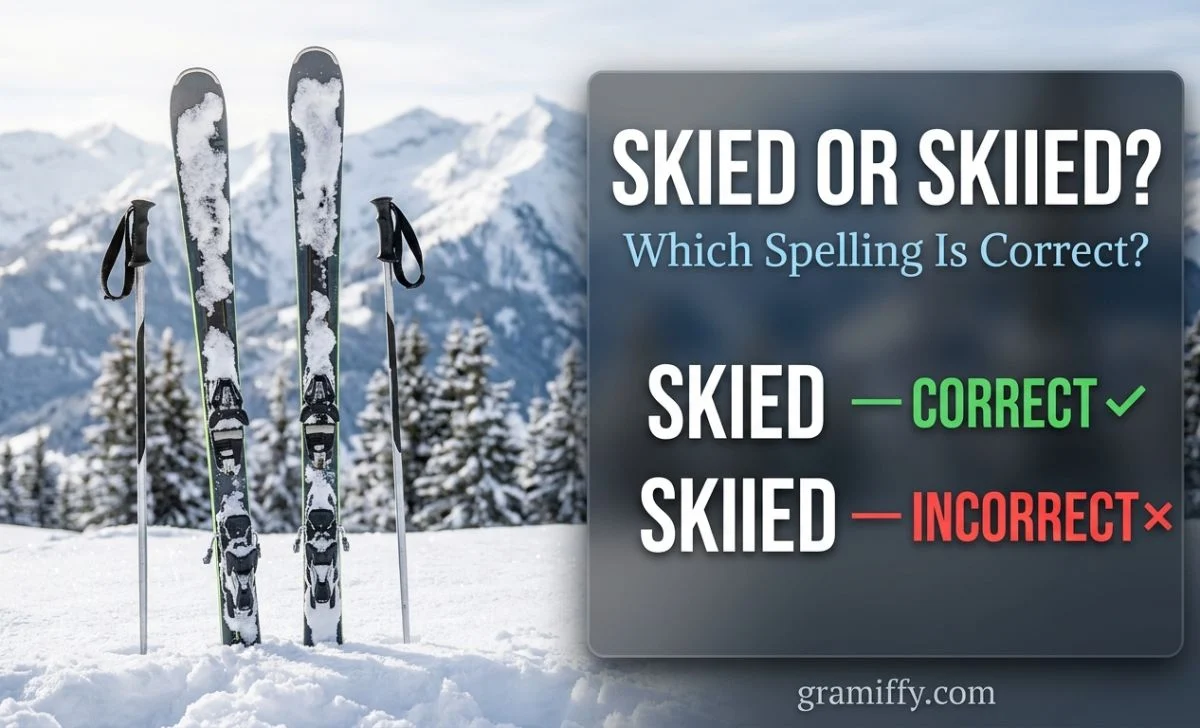
Imagine writing about an unforgettable day on the slopes, only to pause over one small word: skied or skiied?
Both may look reasonable, especially if you assume that adding -ed to a verb always follows a familiar pattern.
But English spelling has a few surprises, and this is one worth remembering. Whether you’re describing your first ski trip, a professional skier’s adventure, or a thrilling ride down a snowy mountain, choosing the correct spelling matters.
So, is it skied or skiied? The answer is simpler than you might expect.
Let’s explore the spelling rule, real-world examples, and an easy trick to help you remember the correct form every time.
Quick Answer: Skied or Skiied?
Skied is the correct spelling. It is the past tense and past participle of the verb ski, meaning to travel over snow on skis. Skiied is a common misspelling and is not the standard form in English.
| Word | Correct or incorrect? | Explanation |
|---|---|---|
| Skied | Correct | Past tense and past participle of ski |
| Skiied | Incorrect | Contains an unnecessary extra letter |
| Ski | Correct | Base form of the verb |
| Skis | Correct | Third-person singular present tense or plural noun |
| Skiing | Correct | Present participle and gerund |
Remember: When you want to describe an activity that happened in the past, write skied.
Why Is Skied Correct?
The confusion comes from the final letter in ski. Because the word ends in i, writers sometimes assume they should keep that letter and add another i before the past-tense ending.
However, the standard past-tense form is made by adding -ed directly to ski:
- Ski + ed = skied
The resulting word is skied, with one i before the ending -ed.
For example:
- Correct: We skied in the mountains last winter.
- Incorrect: We skiied in the mountains last winter.
The second version adds an unnecessary letter. Although skiing contains two consecutive i’s, that does not mean every form of the verb needs two i’s.
English spelling often depends on the particular ending being added. Learning each form of a verb is more reliable than applying one spelling pattern to every situation.
What Does Skied Mean?
Skied is the past tense and past participle of ski. It describes the action of travelling over snow using skis, typically for recreation, sport, or transportation.
The word can be used in different situations, from a casual winter holiday to a competitive skiing event.
Examples:
- We skied together during our winter vacation.
- She skied down the mountain with remarkable confidence.
- They skied for several hours before taking a break.
- He has skied in three different countries.
- I skied for the first time when I was twelve.
In each sentence, skied describes an action that occurred in the past or forms part of a perfect-tense construction.
The word does not change its spelling according to the subject. You write I skied, she skied, they skied, and we skied.
Skied vs Skiied: What’s the Difference?
The difference is straightforward: skied is the accepted spelling, while skiied is a misspelling.
Both forms may appear in online writing because people naturally associate skiied with skiing. However, seeing a spelling mistake on a website or social media post does not make it standard English.
Consider these examples:
- Correct: Daniel skied down the beginner’s slope.
- Incorrect: Daniel skiied down the beginner’s slope.
- Correct: We have skied on several Alpine mountains.
- Incorrect: We have skiied on several Alpine mountains.
The meaning intended by the incorrect form is usually clear, but using the standard spelling is important in school assignments, professional writing, articles, and other formal contexts.
If you are unsure, remember that skied is the form used in standard English dictionaries.
How to Use Ski, Skis, Skied, and Skiing
One of the easiest ways to avoid spelling mistakes is to learn the common forms of the verb together.
| Verb form | Usage | Example |
|---|---|---|
| Ski | Base form | I want to ski this weekend. |
| Skis | Present tense with he, she, or it | Maya skis every winter. |
| Skied | Simple past tense | Maya skied yesterday. |
| Skied | Past participle | Maya has skied before. |
| Skiing | Present participle or gerund | Maya is skiing today. |
| Skier | Noun for a person | Maya is an experienced skier. |
Notice the difference between skied and skiing. The past-tense form adds -ed, whereas the present participle adds -ing.
That gives you:
- Ski → skied
- Ski → skiing
- Ski → skis
The spelling changes according to the form you need, so avoid assuming that one form determines the spelling of every other form.
Examples of Skied in Sentences
Seeing a word in context makes it easier to remember. Here are more examples of the correct spelling in everyday English.
- Past holiday: My family skied in Switzerland during the winter break.
- A first experience: I skied for the first time last January.
- A competition: The athlete skied down the course in record time.
- A school trip: Our class skied at a nearby resort.
- A challenging slope: She skied carefully because the snow was icy.
- A long day: They skied until the lifts closed.
- A personal achievement: He has skied every winter for the past five years.
- A childhood memory: My grandfather skied when he was young.
- A weekend activity: We skied on Saturday and rested on Sunday.
- A travel experience: The visitors skied through the snowy mountain resort.
Each example uses skied correctly. You can use the same spelling whether the subject is a person, a group, or an athlete.
Common Mistakes to Avoid
Even familiar words can cause confusion when their spelling differs from what we expect. Here are three mistakes to watch for.
1. Writing Skiied Instead of Skied
This is the main error. Writers sometimes add an extra i because they remember the spelling of skiing.
Incorrect: We skiied all morning.
Correct: We skied all morning.
2. Assuming Skiing and Skied Follow Identical Patterns
Both words come from ski, but they use different endings.
- Ski + ing = skiing
- Ski + ed = skied
The double i in skiing results from adding -ing to ski. It does not justify writing skiied.
3. Using the Wrong Tense
The spelling may be correct, but the tense must also match the sentence.
Incorrect: Yesterday, we ski down the hill.
Correct: Yesterday, we skied down the hill.
Use ski for the base form, skis for the third-person singular present tense, skied for the past, and skiing for an ongoing action or an activity used as a noun.
Is Skied Spelled the Same Way in American and British English?
Yes. Skied is the standard spelling in both American and British English. Unlike words such as color and colour, this verb does not have separate standard US and UK spellings.
Examples:
- American English: We skied in Colorado last February.
- British English: We skied in Scotland during the holidays.
The spelling remains the same regardless of location. You should not use skiied as a British alternative.
FAQs
Is Skied a Real Word?
Yes. Skied is the standard past tense and past participle of ski. For example, “They skied yesterday” and “They have skied before” are both correct.
Is Skiied Ever Correct?
No. Skiied is not the standard spelling of the past tense or past participle of ski. Use skied instead.
What Is the Past Tense of Ski?
The past tense of ski is skied. For example, “We skied at the resort last weekend.”
Why Does Skiing Have Two I’s?
The word skiing is formed by adding -ing to ski. The final i in ski remains next to the i that begins the ending -ing, producing skiing. The past-tense form is different: ski becomes skied.
Is Skied Also the Past Participle?
Yes. Skied functions as both the simple past tense and the past participle. For example, “She skied yesterday” uses the simple past, while “She has skied before” uses the past participle.
How Do You Remember the Correct Spelling?
Remember this simple contrast: skiing has two consecutive i’s, but skied does not. When describing a completed skiing activity, choose skied.
Conclusion: Skied or Skiied?
The correct spelling is skied, while skiied is a common spelling mistake. Use skied when describing a past skiing activity or forming the past participle, as in “We skied yesterday” and “We have skied before.”
Although skiing contains two consecutive i’s, skied follows a different spelling pattern. Learning the forms of the verb together makes the distinction easier to remember.
The next time you write about a snowy holiday or a trip down the slopes, choose skied. It is the standard spelling in both American and British English.
Read More:

Hi, I’m Safdar Ali, an English language teacher with 26 years of teaching experience. My expertise is in English linguistics, grammar, and the differences between British and American English.
Through Gramiffy, I share practical, research-based guides to help students, writers, and English learners improve their language skills. My goal is to make English simple, accurate, and easy for everyone to understand.