You are writing an email, preparing a report, or creating product labels when you pause over a familiar word: labelling or labeling?
Both spellings look correct, and neither is a spelling mistake. So, which one should you use?
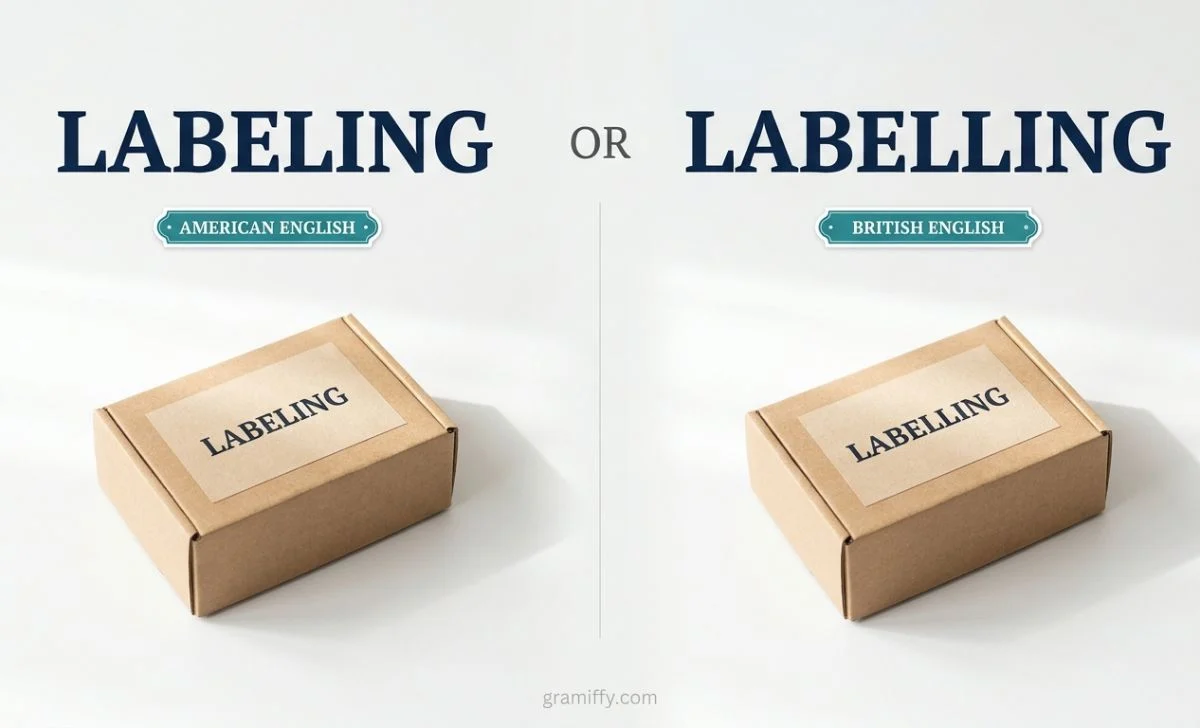
The answer depends mainly on your audience. American English generally uses labeling, while British and Australian English prefer labelling.
Both spellings have the same meaning and pronunciation, but choosing the right form can make your writing more natural for your readers.
In this guide, you will learn the difference between labelling and labeling, understand the spelling rule behind them, and discover which form to use in different countries and professional settings.
Labelling or Labeling: The Quick Answer
Both labelling and labeling are correct. The difference is regional spelling, not meaning.
- American English: Labeling
- British English: Labelling
- Australian English: Labelling
- Canadian English: Both forms occur; follow your organization’s preferred style.
- New Zealand English: Usage can vary; follow your publication’s style guide.
The same distinction applies to related words:
- American English: labeled, labeler, mislabeled
- British English: labelled, labeller, mislabelled
Remember: Use labeling for American readers and labelling for British and Australian readers. Whichever form you choose, use it consistently throughout your writing.
Labelling vs Labeling at a Glance
The following table shows how the spelling changes in American and British English.
| Word form | American English | British English |
|---|---|---|
| Base word | Label | Label |
| Present participle | Labeling | Labelling |
| Past tense | Labeled | Labelled |
| Person who applies labels | Labeler | Labeller |
| Incorrectly labeled | Mislabeled | Mislabelled |
| Without a label | Unlabeled | Unlabelled |
Notice that the base word label remains unchanged. The spelling difference appears when certain endings are added.
For example, Americans generally write labeling, while British writers use labelling. Both forms describe the same action.
What Is the Difference Between Labelling and Labeling?
The main difference is the spelling convention used in different varieties of English.
Meaning and pronunciation
Both words mean the same thing: applying a label, identifying something with a label, or describing the process of assigning labels.
For example:
- American English: We are labeling the boxes for shipment.
- British English: We are labelling the boxes for shipment.
Neither sentence is more correct than the other. The preferred spelling simply depends on the audience.
The pronunciation is also the same: LAY-buh-ling.
Why does one spelling have two Ls?
The difference comes from regional spelling conventions.
American English generally does not double the final L in words such as label when adding endings like -ing and -ed.
British English generally doubles the final L in these words, even when the final syllable is unstressed.
This explains why Americans write labeled and labeling, while British writers use labelled and labelling.
Why Do American and British English Spell the Word Differently?
The spelling difference becomes easier to understand when you look at the rules each variety follows.
The American English rule
American English usually keeps the final L in words such as label when adding an ending.
The stress in label falls on the first syllable: LA-bel. Because the final syllable is unstressed, American spelling generally does not double the L before endings such as -ing and -ed.
Examples include:
- Label → Labeling
- Label → Labeled
- Travel → Traveling
- Cancel → Canceled
- Model → Modeling
These spellings follow common American English conventions.
The British English rule
British English generally doubles the final L in words such as label before adding endings that begin with a vowel.
Examples include:
- Label → Labelling
- Label → Labelled
- Travel → Travelling
- Cancel → Cancelled
- Model → Modelling
This convention applies even when the final syllable is not stressed.
However, English spelling rules have exceptions. Not every word ending in L follows the same pattern in every variety of English.
Other words that follow the same pattern
Once you understand the difference between labeling and labelling, you can recognize the same pattern in many familiar words.
| American English | British English |
|---|---|
| Traveling | Travelling |
| Canceled | Cancelled |
| Modeling | Modelling |
| Leveling | Levelling |
| Signaling | Signalling |
| Labeled | Labelled |
| Unlabeled | Unlabelled |
For example, you can read more about this spelling pattern in our guide to signaling or signalling.
Quick tip: If you know that American English uses traveling while British English uses travelling, you already understand the basic pattern behind labeling and labelling.
How to Use Labelling and Labeling in a Sentence
Both spellings can appear in different grammatical roles. The regional spelling convention remains the same.
1. Labelling or labeling as a verb
When used as a verb, the word describes the action of applying or assigning a label.
Examples:
- American English: The workers are labeling the packages.
- British English: The workers are labelling the packages.
- American English: She is labeling each folder carefully.
- British English: She is labelling each folder carefully.
Both versions are grammatically correct. Choose the spelling that matches your audience.
2. Labelling or labeling as a noun
The word can also describe the process of applying labels or assigning categories.
Examples:
- American English: Food labeling requirements vary by product.
- British English: Food labelling requirements vary by product.
- American English: Data labeling is an important part of machine learning.
- British English: Data labelling is an important part of machine learning.
In these examples, the word describes an activity or process rather than an action performed at a particular moment.
3. Labelling or labeling as an adjective
The related forms mislabeled and mislabelled can describe something that has received an incorrect label.
Examples:
- American English: The mislabeled jar was removed from the shelf.
- British English: The mislabelled jar was removed from the shelf.
- American English: The company recalled several mislabeled products.
- British English: The company recalled several mislabelled products.
The meaning stays the same. Only the regional spelling changes.
Which Spelling Should You Use in Different Countries?
The best spelling depends on the English variety expected by your readers or organization.
United States: Use labeling
In American English, labeling and labeled are the standard forms.
Use these spellings in American business documents, educational materials, websites, and general writing.
Examples:
- Product labeling
- Food labeling laws
- Data labeling services
- A labeled diagram
American dictionaries and major American publishing styles generally favor the single-L forms.
United Kingdom: Use labelling
British English generally prefers labelling and labelled.
These forms are common in British publications, professional documents, and educational writing.
Examples:
- Product labelling
- Food labelling regulations
- Data labelling
- A labelled diagram
If your audience is primarily British, use the double-L forms throughout your article or document.
Australia: Use labelling
Australian English generally follows the British spelling convention.
For Australian readers, labelling and labelled are the preferred forms in standard writing.
For example:
The manufacturer is updating the labelling on its products.
When writing for an Australian organization, follow its house style if one is available.
Canada: Check your organization’s style guide
Canadian English combines British and American spelling conventions. Both labeling and labelling can appear in Canadian writing.
There is no need to assume that one form is universally correct for every Canadian publication.
If you are writing for a Canadian university, government agency, or business, check its style guide. If no specific preference exists, choose one spelling and use it consistently.
New Zealand: Follow local editorial preferences
New Zealand English shares many spelling conventions with British English, although usage can vary by word and publication.
For professional writing, check your organization’s preferred spelling. When no guidance is available, labelling is a reasonable choice for a British-style spelling approach.
Does the Spelling Change in Different Industries?
The spelling of labelling or labeling follows the same regional pattern across most fields. However, professional terminology and official documents may have their own established conventions.
Product and food labeling
Product labels provide information about a product, such as its ingredients, manufacturer, instructions, and warnings.
American documents generally use labeling, while British and Australian documents commonly use labelling.
Examples:
- American English: Food labeling requirements
- British English: Food labelling requirements
When preparing regulatory or legal documents, use the spelling and terminology adopted by the relevant authority.
Data labeling in artificial intelligence
In artificial intelligence, data labeling involves assigning tags or categories to data so that machine-learning systems can use it.
For example, a team might label photographs as containing cars, pedestrians, or traffic signs.
American technology companies commonly write data labeling, while British and Australian teams may prefer data labelling.
Both terms describe the same process.
Labeling theory in sociology
In sociology, labeling theory examines how the labels society assigns to people can influence their identities, behavior, and treatment by others.
American publications generally use labeling theory, while British publications may use labelling theory.
The spelling depends on the publication’s preferred English variety.
Isotopic labeling in science
In chemistry and related sciences, isotopic labeling involves using isotopes to trace atoms through chemical or biological processes.
The term may appear as isotopic labeling or isotopic labelling, depending on the publication and its editorial conventions.
When writing scientific material, follow the journal’s style requirements and preserve the spelling used in official terminology or source quotations where necessary.
Common Mistakes to Avoid
Although both labeling and labelling are correct, several related spelling mistakes are worth avoiding.
1. Mixing American and British spellings
Using labeling in one paragraph and labelled in another can make your writing look inconsistent.
Choose your preferred English variety before you begin writing.
For example, an American article should generally use labeling, labeled, and mislabeled throughout.
2. Misspelling the base word
The correct base word is label, not lable.
Incorrect: The company added a lable to the box.
Correct: The company added a label to the box.
Remember that the final E remains in the base word.
3. Dropping the E
Another common mistake is writing labling instead of labeling or labelling.
Incorrect: The staff are labling the packages.
Correct: The staff are labeling the packages.
Correct: The staff are labelling the packages.
Both correct forms retain the E in the base word.
4. Changing spelling inside a quotation
If you quote a British source in an American article, preserve the original spelling within the quotation unless you have a specific editorial reason to change it.
The same principle applies to book titles, company names, and official names.
5. Assuming the less familiar spelling is wrong
Readers sometimes assume that labelling is incorrect because they are accustomed to American English, or that labeling is wrong because they normally use British English.
Neither assumption is correct.
Both spellings are accepted. The important thing is to use the form appropriate for your audience.
Quick Quiz: Labelling or Labeling?
Test your understanding with these five questions.
1. Which spelling is standard in American English?
A. Labelling
B. Labeling
2. Which spelling is generally preferred in British English?
A. Labeled
B. Labelled
3. Which word is misspelled?
A. Label
B. Labelling
C. Lable
4. Which spelling is generally used in American English?
A. Mislabeled
B. Mislabelled
5. You are writing for a British audience. Which sentence should you choose?
A. The team is labeling the products.
B. The team is labelling the products.
Quiz answers
- B. Labeling — American English generally uses one L in the ending.
- B. Labelled — British English generally doubles the L.
- C. Lable — The correct base word is label.
- A. Mislabeled — This is the standard American spelling.
- B. The team is labelling the products. — This follows standard British spelling conventions.
FAQs
Is labelling correct in American English?
Yes. Labelling is an established spelling variant, but American English generally prefers labeling. For American publications, use the single-L form unless a specific style guide requires otherwise.
Is labeling wrong in British English?
No. Labeling is a recognized spelling, but labelling is the usual British form. When writing for a British audience, the double-L spelling is generally the better choice.
Do labelling and labeling have different meanings?
No. Both words have the same meaning. They describe the act or process of applying labels or assigning labels to information, objects, or categories.
Are labelling and labeling pronounced differently?
No. Both spellings have the same standard pronunciation: LAY-buh-ling. The difference is purely orthographic, meaning it concerns how the word is written.
Should I use labeling or labelling for SEO content?
Choose the spelling that matches your target audience and the search terms relevant to that audience. American-focused content will generally use labeling, while British- or Australian-focused content will generally use labelling.
Use the chosen form consistently in the title, headings, examples, and body text. Avoid repeatedly inserting both variants where doing so makes the article awkward to read.
Which spelling should I use for an international audience?
If most of your readers use American English, choose labeling. If your main audience uses British or Australian English, choose labelling.
For a mixed international audience, select a consistent spelling convention and make sure the rest of your writing follows it.
Final Thoughts
Both labelling and labeling are correct spellings of the same word. The difference comes down to regional English conventions.
Use labeling for American English and labelling for British and Australian English. In Canada and New Zealand, consider your organization’s style guide and your intended audience.
The same pattern appears in words such as traveling/travelling, canceled/cancelled, and signaling/signalling.
Once you understand this spelling difference, you can apply the same principle to many other words. Most importantly, choose one English variety and use it consistently throughout your writing.
Read More:

Hi, I’m Safdar Ali, an English language teacher with 26 years of teaching experience. My expertise is in English linguistics, grammar, and the differences between British and American English.
Through Gramiffy, I share practical, research-based guides to help students, writers, and English learners improve their language skills. My goal is to make English simple, accurate, and easy for everyone to understand.