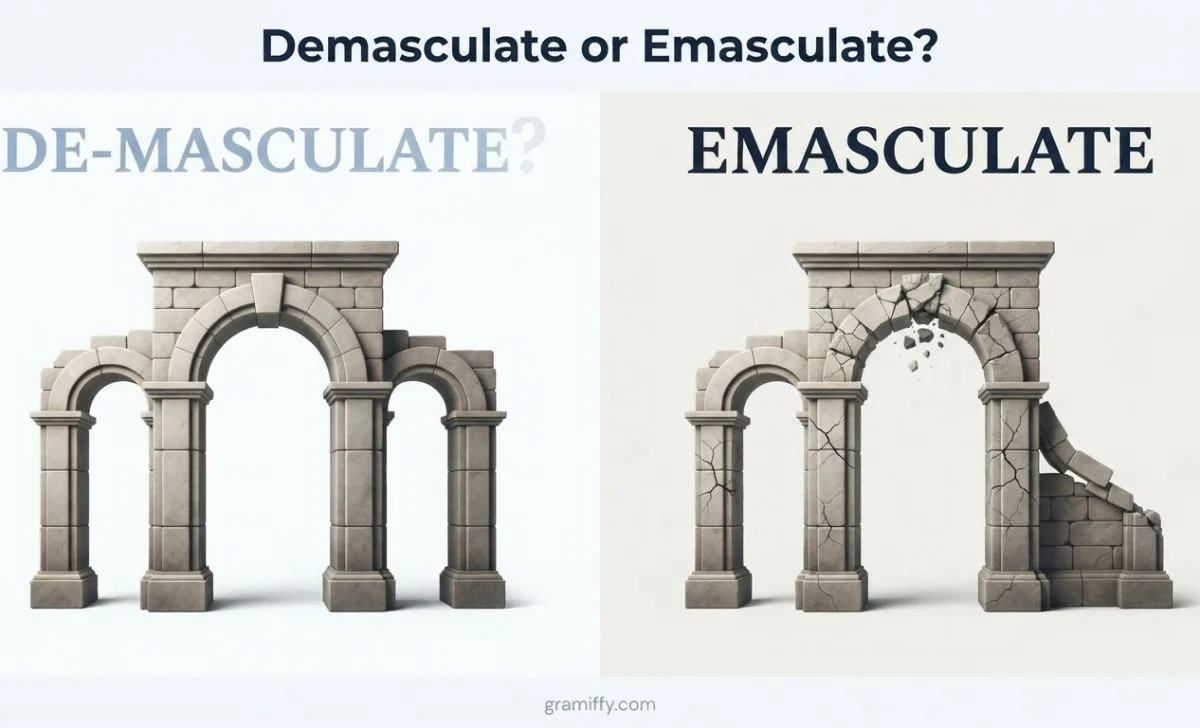
At first glance, demasculate looks completely believable. English uses de- in words such as deactivate, defrost, and devalue, so it seems logical that removing masculinity might produce demasculate.
But there is a problem: emasculate is the established English word, while demasculate is not the standard form you should use in normal writing.
Emasculate has been part of English for centuries and has several established meanings. It can mean to castrate, to weaken or deprive something of strength, or, in botany, to remove the stamens from a flower before controlled pollination.
That makes this spelling pair more interesting than a simple “right versus wrong” question. The unusual-looking e- in emasculate is not a typo, and the tempting de- in demasculate isn’t needed.
If you’ve written demasculate, wondered whether it was correct, or encountered it while editing someone else’s work, here’s the distinction you need.
Quick Answer: Demasculate or Emasculate?
Emasculate is the standard word.
Demasculate is not the standard English form to use in formal or general writing.
| Word | Standard English? | Meaning |
|---|---|---|
| Emasculate | Yes | To castrate, weaken, deprive of strength, or remove stamens from a flower |
| Demasculate | No standard modern use | Usually a mistaken formation based on emasculate |
Examples
The criticism emasculated his confidence.
The amendments emasculated the original bill.
The breeder emasculated the flowers before cross-pollination.
If you are unsure, choose emasculate.
Is “Demasculate” a Word?
Demasculate is not the standard word you should use for the meanings normally intended by writers who use it.
The established dictionary entry is emasculate, which has several recognized meanings.
Collins, for example, defines emasculate as meaning to make something weak or ineffective, to remove the testicles, and, in botany, to remove the stamens from a flower to prevent self-pollination.
This explains why demasculate can be confusing. Someone who has never encountered emasculate may naturally reconstruct it as de + masculate, especially because de- often carries a meaning of removal or reversal.
But English vocabulary doesn’t always work that neatly.
If you’re writing an article, report, email, academic paper, or other edited text, use emasculate unless you have a specific technical reason to use a different term.
Why Does “Demasculate” Sound So Natural?
The mistake has a logical-looking structure.
English has many words beginning with de- that suggest removal, reversal, or reduction:
- deactivate
- defrost
- devalue
- dehydrate
- deconstruct
- declutter
So it is easy to imagine:
de + masculate = remove masculinity
The problem is that emasculate already exists as the established word.
Its history goes back to Latin, rather than being a modern construction formed by simply adding de- to masculate. Collins traces emasculate to Latin ēmasculāre, from masculus meaning “male.”
In other words, the spelling may look unusual to a modern reader, but the e- is part of the word’s historical formation.
What Does “Emasculate” Mean?
Emasculate has more than one established meaning.
1. To Castrate
In its literal sense, emasculate can mean to remove the testicles of a male or otherwise deprive a male of reproductive power.
For example:
The animal was emasculated as part of the procedure.
Collins lists castrate and geld among the literal meanings of emasculate.
This is the most literal sense of the word and is particularly relevant in medical, veterinary, agricultural, and historical contexts.
2. To Weaken or Deprive of Strength
The figurative meaning is extremely important in modern writing.
Emasculate can mean to make something weaker, less effective, or less powerful.
For example:
The amendments emasculated the proposed legislation.
Here, nobody is talking about physical castration. The meaning is that the amendments removed much of the bill’s force or effectiveness.
Collins gives examples involving organizations, laws, and other things being weakened or made ineffective.
3. In Botany: To Remove a Flower’s Stamens
There is also a specialized botanical meaning.
In plant breeding, emasculate can mean removing the stamens from a flower to prevent self-pollination before controlled cross-pollination.
For example:
The breeder emasculated the flowers before applying pollen from another variety.
This is a technical use of the same word and has nothing to do with someone’s feelings or social status.
Can You Emasculate a Law or Policy?
Yes.
This is one of the most useful figurative applications of the word.
When emasculate is used figuratively, the object does not have to be a person.
You can write:
The amendments emasculated the bill.
The revisions emasculated the proposal.
Excessive restrictions emasculated the program.
In each case, emasculate means to weaken, reduce the force of, or make less effective. Collins explicitly includes the figurative sense of depriving something of vigor or effectiveness.
So the common assumption that emasculate can only describe a man is incorrect.
Does “Emasculate” Only Apply to Men?
No.
The word has a literal connection with male reproductive power, but its figurative meaning can apply to people, organizations, laws, policies, proposals, movements, writing, and other things.
Compare:
He felt emasculated by the criticism.
with:
The amendments emasculated the bill.
The first uses the word in relation to a person’s sense of strength or masculine identity.
The second uses it metaphorically to mean that the bill was weakened.
Because the word carries a strong historical association with masculinity and castration, it can sound loaded in some contexts. If you simply mean “weaken,” alternatives such as weaken, undermine, sap, or water down may be clearer.
Emasculate vs Demasculate: What’s the Difference?
The practical difference is straightforward:
| Emasculate | Demasculate | |
|---|---|---|
| Standard established word | Yes | No standard form |
| Common dictionaries | Yes | Not established in the same standard sense |
| Means “weaken” | Yes | No |
| Means “castrate” | Yes | No |
| Botanical use | Yes | No |
| Recommended in formal writing | Yes | No |
So:
❌ The criticism demasculated him.
✅ The criticism emasculated him.
And:
❌ The amendments demasculated the legislation.
✅ The amendments emasculated the legislation.
If your intended meaning is weaken, castrate, or the specialized botanical sense, emasculate is the established choice.
What About “Demasculinize”?
This is where the distinction gets more interesting.
If what you mean is to make something less masculine or reduce masculine characteristics, the word you may be looking for is demasculinize rather than demasculate.
That construction is different from simply adding de- to masculate.
In technical or scientific writing, terminology involving masculinization/demasculinization may be used when discussing changes in male-associated traits or characteristics. The exact term should be chosen according to the scientific context.
For ordinary English, however, don’t replace emasculate with demasculinize merely because demasculate looks wrong.
They serve different purposes.
A useful rule
To weaken something → emasculate
To describe a reduction of masculine characteristics → demasculinize, where appropriate
Demasculate → avoid in standard edited English
Why Is “Emasculate” Spelled With an E?
The spelling becomes easier to remember once you know its origin.
Collins traces emasculate to Latin ēmasculāre, from masculus, meaning “male.”
The word therefore isn’t simply:
de + masculate
That is a modern-looking analysis that makes the spelling demasculate seem logical.
Instead, emasculate is an inherited word with a much older Latin formation.
This is one reason spelling it from sound can be difficult. The initial e- isn’t something modern writers can reliably infer from the word’s current meaning.
Emasculate Pronunciation and Word Forms
The verb emasculate is pronounced approximately:
ih-MAS-kyuh-late
Its main forms are:
- emasculate — present/base form
- emasculated — past tense and past participle
- emasculating — present participle
- emasculation — noun
For example:
The policy was emasculated by the amendments.
The emasculation of the proposal changed its original purpose.
Collins lists emasculation, emasculator, emasculative, and emasculatory among its derived forms.
Common Mistakes and Quick Fixes
❌ The criticism demasculated him.
✅ The criticism emasculated him.
Use emasculated when you mean the criticism weakened his confidence or sense of strength.
❌ The amendments demasculated the bill.
✅ The amendments emasculated the bill.
Here, emasculated means the amendments weakened the bill.
❌ The policy was demasculated by the changes.
✅ The policy was emasculated by the changes.
The established figurative verb is emasculate.
❌ The researcher demasculated the flowers.
✅ The researcher emasculated the flowers.
In plant breeding, emasculate has a specific technical meaning: removing the stamens before controlled pollination.
Emasculate: Synonyms You Can Use
The best alternative depends on the meaning.
“weaken”
- weaken
- undermine
- diminish
- sap
- impair
- reduce
- cripple
- water down
- dilute
When you mean “castrate”
- castrate
- geld
- neuter
When you mean “reduce force or effectiveness”
- weaken
- undermine
- blunt
- diminish
- neutralize
- defang
Be careful, though: these words are not perfect substitutes in every sentence.
For example, water down works naturally with a proposal or law, while castrate has the literal reproductive meaning.
Self-Check Quiz
Choose the correct word.
- The amendments ______ the original proposal.
- Which spelling is standard: emasculate or demasculate?
- A plant breeder removes the stamens from a flower before controlled pollination. What verb describes this?
- What word can describe reducing masculine characteristics in a technical context?
- Correct this sentence: “The criticism demasculated him.”
- Can emasculate describe a law or proposal?
Answers
- emasculated — the amendments weakened the proposal.
- emasculate.
- emasculate — this is an established botanical use.
- demasculinize, where that technical meaning is intended.
- The criticism emasculated him.
- Yes. The figurative meaning can describe something being deprived of strength or effectiveness.
FAQs
Is “demasculate” a word?
It is not the standard English form you should use in ordinary formal writing. Emasculate is the established dictionary word for the relevant meanings.
What is the correct spelling: emasculate or demasculate?
The standard spelling is emasculate.
What does emasculate mean?
It can mean to castrate, to weaken or deprive something of strength or effectiveness, or, in botany, to remove the stamens from a flower to prevent self-pollination.
Why do people say “demasculate”?
The spelling is understandable because the prefix de- commonly suggests removal or reversal. But emasculate is an established word with a much older Latin origin.
Can you say “emasculate a law”?
Yes. In figurative use, emasculate can mean to weaken a law, proposal, organization, or other thing.
Is emasculate an offensive word?
Not inherently, but context matters. Its literal meaning is connected with castration, and its figurative use can invoke ideas about masculinity. In neutral writing, weaken or undermine may sometimes be clearer.
What is the difference between emasculate and demasculinize?
Emasculate can mean to weaken, castrate, or remove a flower’s stamens. Demasculinize is a different formation used when the intended meaning concerns reducing or removing masculine characteristics.
What is the noun form of emasculate?
The noun is emasculation.
The emasculation of the proposal caused controversy.
What is the adjective form of emasculate?
Emasculated can function as an adjective, as can the less common emasculative and emasculatory. Collins lists these derived forms.
The Takeaway
If you’re deciding between demasculate and emasculate, choose emasculate.
Emasculate is an established English verb with several meanings:
- to castrate
- to weaken or deprive of strength
- to remove the stamens from a flower in plant breeding
Demasculate may look logical because of the common prefix de-, but it isn’t the standard form to use in ordinary edited English.
So remember:
Weakens a person, law, proposal, or organization → emasculate
Removes the stamens from a flower → emasculate
Need a term specifically about reducing masculine characteristics → demasculinize, when that meaning fits
When in doubt, emasculate is the established word.
Read More:

Hi, I’m Safdar Ali, an English language teacher with 26 years of teaching experience. My expertise is in English linguistics, grammar, and the differences between British and American English.
Through Gramiffy, I share practical, research-based guides to help students, writers, and English learners improve their language skills. My goal is to make English simple, accurate, and easy for everyone to understand.