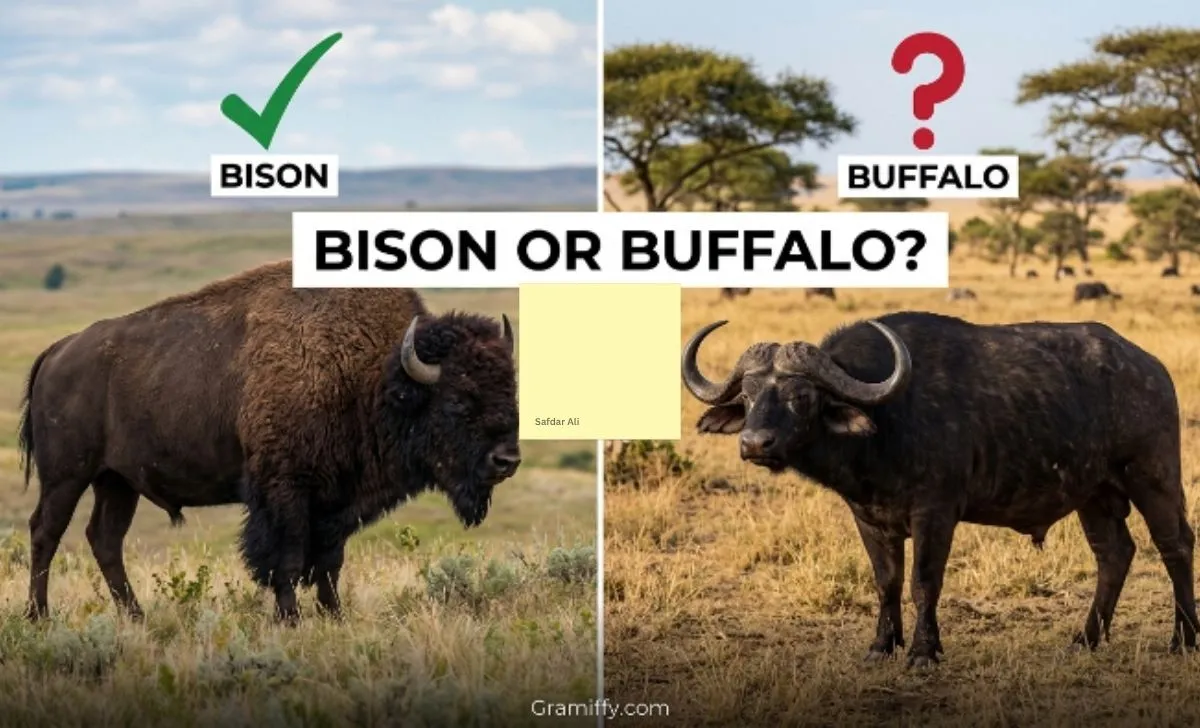
I still remember watching a wildlife documentary where a massive animal was roaming across an open grassland. It had thick fur, curved horns, and an enormous body.
Without hesitation, I called it a buffalo. A few moments later, the narrator explained that it was actually a bison. That small correction made me realize how confusing these two animals can be.
Many people search for “bison or buffalo” because the animals look similar and their names are often used interchangeably. In fact, the American bison is commonly called a buffalo, which adds even more confusion.
So, are they the same animal? What makes them different? In this guide, you’ll discover the key differences between bison and buffalo, including their appearance, habitat, size, behavior, history, and scientific classification.
Quick Answer:
A bison and a buffalo are not the same animal, although both belong to the Bovidae family.
Key Differences
- Bison live mainly in North America and Europe.
- Buffalo are native to Africa and Asia.
- Bison have a large shoulder hump.
- Buffalo have longer and wider horns.
- Bison have thick shaggy fur.
- Buffalo generally have smoother coats.
Simple Rule
If you see a large animal with a shoulder hump and thick fur, it is most likely a bison.
If you see an animal with long curved horns and no hump, it is probably a buffalo.
What Is a Bison?
A bison is a large herbivorous mammal belonging to the genus Bison. These animals once dominated the grasslands of North America and parts of Europe.
There are two living species:
- American Bison
- European Bison
The American Bison is the largest land mammal in North America and serves as the national mammal of the United States.
Characteristics of a Bison
- Thick shaggy fur
- Massive shoulder hump
- Large head
- Powerful muscles
- Short curved horns
- Adaptation to cold climates
Historically, tens of millions of bison roamed the Great Plains. However, excessive hunting during the nineteenth century nearly pushed them to extinction.
Today, conservation efforts have helped restore many bison populations throughout protected areas and national parks.
What Is a Buffalo?
Buffalo are large bovine animals that belong to different genera than bison. Unlike bison, buffalo are native to Africa and Asia.
The two best-known species are:
African Buffalo
The African buffalo lives across grasslands, savannahs, and forests throughout Africa.
Water Buffalo
The water buffalo is commonly domesticated throughout Asia and plays a crucial role in agriculture.
Characteristics of Buffalo
- Long curved horns
- Smooth coat
- No shoulder hump
- Strong grazing habits
- Adaptation to warm climates
Water buffalo are widely used for farming, transportation, and dairy production in many countries.
Why Do People Confuse Bison and Buffalo?
The confusion dates back hundreds of years.
When European explorers arrived in North America, they saw bison and mistakenly referred to them as buffalo because they resembled buffalo species from Africa and Asia.
The name became popular and remains common today.
Examples include:
- Buffalo ranch
- Buffalo burger
- Buffalo herd
- Buffalo hunt
Although these terms are widely used, the scientifically correct name for the North American animal is bison.
Bison vs Buffalo: Physical Differences
At first glance, these animals may appear similar, but several physical features make identification easy.
Shoulder Hump
The most obvious difference is the hump.
Bison have a large hump above their shoulders that supports powerful neck muscles.
Buffalo do not have this hump.
Fur
Bison possess thick fur that helps them survive cold winters across North American prairies.
Buffalo usually have thinner coats because they live in warmer regions.
Horns
Buffalo often have much larger and wider horns.
Bison horns are shorter and curve upward.
Head Shape
Bison have larger heads and broader shoulders.
Buffalo have a more balanced body shape.
Side-by-Side Comparison Table
| Feature | Bison | Buffalo |
|---|---|---|
| Habitat | North America & Europe | Africa & Asia |
| Shoulder Hump | Yes | No |
| Thick Fur | Yes | No |
| Horns | Shorter | Longer |
| Climate | Cold & Temperate | Warm & Tropical |
| Scientific Group | Genus Bison | Genus Bubalus/Syncerus |
| Domesticated | Rarely | Commonly |
| Body Shape | Front-Heavy | Balanced |
Which Is Bigger: A Bison or a Buffalo?
Many people assume buffalo are larger because of their impressive horns.
However, the American Bison is generally heavier.
Bison Size
Adult males can weigh:
- 1,000 to 2,200 pounds
- Up to 6 feet tall at the shoulder
Buffalo Size
Most buffalo species weigh:
- 800 to 2,000 pounds
Because of their hump and muscular build, bison often appear significantly larger.
In terms of overall body mass, bison usually win.
Where Do Bison Live?
Bison are native to North America and Europe.
Today, major populations can be found in:
- United States
- Canada
- Yellowstone National Park
- Wildlife reserves
- Protected grasslands
The Great Plains historically supported millions of bison before their numbers declined dramatically.
Yellowstone National Park remains one of the most famous locations to observe free-ranging bison.
Where Do Buffalo Live?
Buffalo thrive in warmer climates throughout Africa and Asia.
African Buffalo Habitat
African buffalo inhabit:
- Savannahs
- Grasslands
- Woodlands
- National parks
Water Buffalo Habitat
Water buffalo are common in:
- India
- Pakistan
- Nepal
- Thailand
- Southeast Asia
They are often found near rivers, wetlands, and agricultural areas.
Bison vs Buffalo Behavior
Although both animals are herbivores, their behavior differs.
Bison Behavior
Bison are highly social animals that live in herds.
They:
- Graze on grasses
- Migrate seasonally
- Survive harsh winters
- Can run surprisingly fast
Despite their size, bison can reach speeds of up to 35 miles per hour.
Buffalo Behavior
Buffalo also live in herds but often stay closer to water sources.
They:
- Thrive in warmer climates
- Show strong defensive instincts
- Form protective groups
- Spend long periods grazing
African buffalo are considered one of Africa’s most dangerous large animals because they aggressively defend themselves against predators.
Are Bison and Buffalo Related?
Yes.
Both belong to the Bovidae family, which also includes:
- Cattle
- Antelope
- Goats
- Sheep
However, they belong to different genera.
This means they share a distant evolutionary relationship but are not the same species.
Think of them as cousins rather than identical animals.
The Importance of Bison in North American History
For thousands of years, Indigenous peoples relied on bison for:
- Food
- Clothing
- Shelter
- Tools
The animal became deeply connected to culture, tradition, and survival.
During the nineteenth century, large-scale hunting nearly wiped out bison populations.
Fortunately, conservation programs helped prevent extinction.
Today, bison are considered one of North America’s greatest wildlife recovery success stories.
The Importance of Buffalo in Asia and Africa
Buffalo have a different relationship with humans.
Water buffalo are among the most important livestock animals in Asia.
They help with:
- Rice farming
- Transportation
- Milk production
- Agricultural work
Buffalo milk is used to produce many dairy products, including the famous mozzarella cheese.
In Africa, buffalo remain a key part of natural ecosystems and wildlife tourism.
Common Myths About Bison and Buffalo
Myth 1: They Are the Same Animal
False.
They belong to different genera and live on different continents.
Myth 2: Buffalo Live Naturally in North America
False.
The animal commonly called a buffalo in North America is actually a bison.
Myth 3: Bison Are Slow
False.
Bison can run much faster than most humans.
Myth 4: All Buffalo Are Wild
False.
Many water buffalo are domesticated and used in agriculture.
FAQs
Is a bison the same as a buffalo?
No. They are different animals with different physical characteristics and habitats.
Why do Americans call bison buffalo?
Early explorers mistakenly used the term buffalo, and the nickname remained popular.
Which is bigger, a bison or a buffalo?
Bison are generally heavier and more muscular.
Do bison live in Africa?
No. Bison are native to North America and Europe.
Can buffalo be domesticated?
Yes. Water buffalo are widely domesticated throughout Asia.
What is the easiest way to tell them apart?
Look for the shoulder hump. Bison have one; buffalo do not.
Conclusion
Although the terms are often used interchangeably, bison and buffalo are distinct animals with unique characteristics.
Bison are native to North America and Europe and are known for their massive shoulder hump, thick fur, and powerful build.
Buffalo, meanwhile, are found primarily in Africa and Asia and are recognized by their long horns, smoother coats, and adaptation to warmer climates.
The confusion largely comes from the historical habit of calling the American bison a buffalo. Once you understand the differences in appearance, habitat, size, and behavior, identifying them becomes much easier.
Whether you’re visiting Yellowstone National Park, studying wildlife biology, or simply watching a nature documentary, you’ll now know exactly whether you’re looking at a bison or a buffalo.
Read More Blogs :

I am Bryan A. Garner a lexicographer, and language expert passionate about clear and effective writing.
I contribute grammar, spelling, and usage guides on Gramiffy.com to help readers improve their English skills. Through my work, I aim to make language rules simple, practical, and easy to understand.