I was scrolling through TikTok one evening when I noticed two very different comments under the same video.
One person wrote, “He’s such a wannabe,” while another said, “Nah, he’s just a tryhard.” At first, both comments sounded similar. After all, both seemed to criticize someone for the way they acted online.
But the more I thought about it, the more I realized these words don’t mean the same thing at all.
Today, terms like wannabe, tryhard, poser, and attention seeker appear everywhere—from gaming communities and YouTube channels to Instagram, TikTok, and everyday conversations.
Because these words are often used interchangeably, many people search for “wannabe or tryhard” to understand the real difference.
Is a wannabe simply someone who admires another person? Is a tryhard just an ambitious individual? Are these words insults, or do they have more nuanced meanings?
In this guide, you’ll learn exactly what wannabe and tryhard mean, where the terms came from, how they differ, common mistakes people make, and which word fits different situations.
Quick Answer
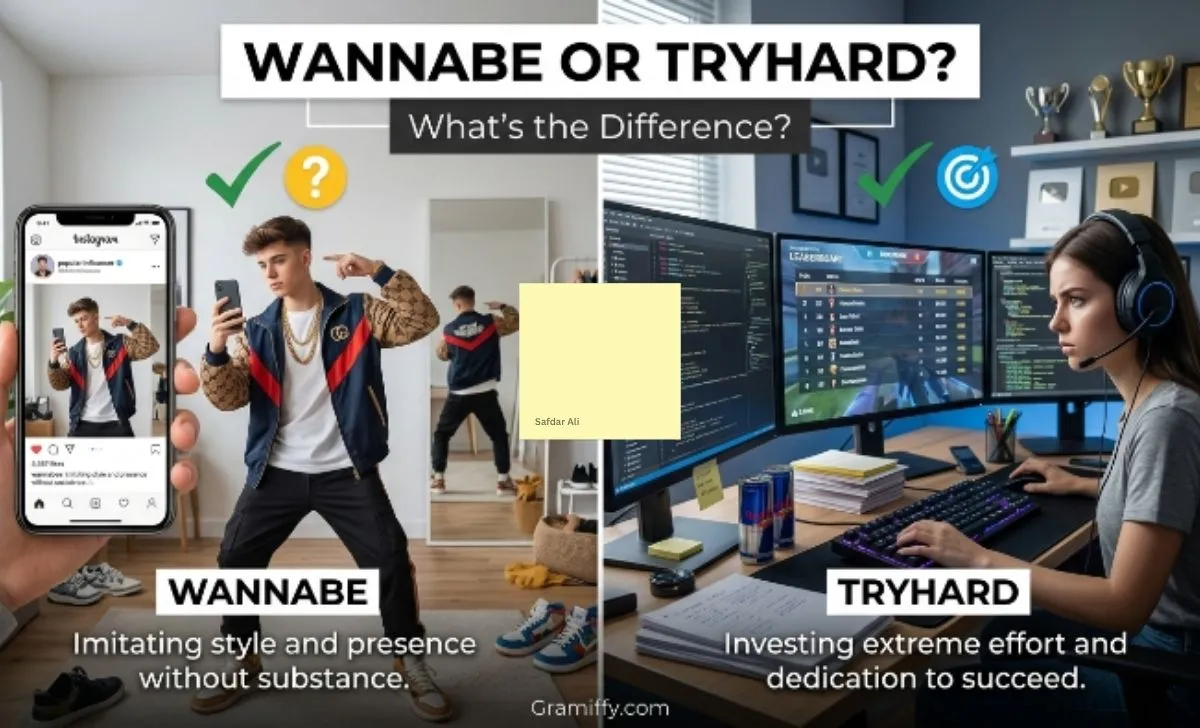
A wannabe is someone who wants to be like another person and often imitates their style, personality, image, or lifestyle.
A tryhard is someone who puts excessive effort into gaining success, recognition, approval, or attention.
Simple Examples
✅ He copies his favorite YouTuber’s clothing, hairstyle, and speech patterns.
He’s a wannabe.
✅ She treats every casual online game like a professional tournament.
People may call her a tryhard.
Quick Rule
- Wannabe = imitation
- Tryhard = excessive effort
This is the easiest way to remember the difference.
What Does Wannabe Mean?
The word wannabe comes from the phrase “want to be.”
A wannabe is someone who strongly desires to become like another person or belong to a particular group.
The focus is not on effort.
The focus is on imitation.
Common Examples of Wannabes
- Celebrity wannabe
- Influencer wannabe
- Rapper wannabe
- Actor wannabe
- Fashion wannabe
- Entrepreneur wannabe
Example Sentences
“He dresses exactly like his favorite influencer.”
“Many young musicians start as rockstar wannabes.”
“She became known as a celebrity wannabe on social media.”
Not every admirer is a wannabe. The term usually suggests excessive copying rather than simple admiration.
What Does Tryhard Mean?
A tryhard is someone who appears to put too much effort into achieving something.
The term became popular in gaming communities but is now used in many situations.
Common Examples of Tryhards
- Competitive gamers
- Overachieving students
- Attention-seeking influencers
- Highly competitive athletes
- Employees constantly seeking recognition
Example Sentences
“Everyone was playing casually, but he treated the match like a championship.”
“Some people call ambitious coworkers tryhards.”
“She spends hours editing every social media post.”
The key idea is visible effort that others perceive as excessive.
The Origin of Wannabe and Tryhard
Origin of Wannabe
The word became popular during the 1980s and 1990s in American pop culture.
People often used it to describe individuals who wanted to become celebrities, musicians, athletes, or famous personalities.
The term eventually expanded to describe anyone who imitates another person.
Origin of Tryhard
Tryhard originated in online gaming culture.
Competitive players used it to describe people who took casual games too seriously.
As internet culture grew, the word spread to:
- Social media
- Sports
- School environments
- Workplaces
- Online communities
Today, it is recognized as common internet slang.
Wannabe vs Tryhard: The Biggest Differences
| Feature | Wannabe | Tryhard |
|---|---|---|
| Main Focus | Copying others | Excessive effort |
| Goal | Become like someone | Gain success or recognition |
| Common Context | Celebrities, influencers | Gaming, sports, work |
| Related To | Identity | Performance |
| Internet Slang | Yes | Yes |
| Usually Negative | Often | Often |
Easy Way to Remember
A wannabe wants to be someone else.
A tryhard wants to prove something.
Why Do People Become Wannabes or Tryhards?
This is one of the most searched questions related to these terms.
Desire for Acceptance
Many people want to fit in with a group or community.
Social Media Influence
Platforms like TikTok, Instagram, and YouTube encourage people to copy successful creators.
Need for Validation
Likes, comments, and followers can make people seek approval from others.
Competition
Some individuals naturally become highly competitive and are labeled tryhards.
Lack of Confidence
People may imitate others because they haven’t yet developed their own identity.
Wannabe vs Fan: What’s the Difference?
Many people mistakenly think fans are wannabes.
They’re not.
Fan
A fan admires someone.
Wannabe
A wannabe imitates someone.
Example
“I enjoy listening to Taylor Swift.”
You’re a fan.
“I dress, talk, and behave exactly like Taylor Swift.”
Some people might call that wannabe behavior.
Admiration and imitation are not the same thing.
Wannabe vs Poser: What’s the Difference?
Another commonly searched comparison is wannabe vs poser.
Wannabe
A person who wants to become something.
Poser
A person who pretends to be something they are not.
Example
A skateboard wannabe wants to become a skater.
A skateboard poser pretends to be a skater without actually participating in the activity.
Although similar, the meanings are different.
Is Tryhard an Insult?
Usually, yes.
However, context matters.
In gaming communities, tryhard is often used as criticism.
Examples:
- “Stop being such a tryhard.”
- “It’s just a casual game.”
However, some people use it jokingly.
Others view it as a compliment because it implies dedication and effort.
The meaning depends heavily on tone and context.
Is Wannabe an Insult?
In most situations, yes.
Calling someone a wannabe usually suggests:
- Lack of originality
- Excessive imitation
- Desire for social status
- Insecurity
However, it can also be used humorously among friends.
Wannabe or Tryhard in Gaming Culture
Gaming communities helped popularize the term tryhard.
Wannabe
- Copies professional streamers
- Uses identical gaming setups
- Mimics esports players
Tryhard
- Takes casual games seriously
- Focuses heavily on winning
- Studies game strategies obsessively
Because gaming culture is global, searches for “wannabe or tryhard” continue to increase.
Wannabe or Tryhard on Social Media
Social media has created new opportunities for both behaviors.
Influencer Wannabe
Examples include:
- Copying TikTok creators
- Mimicking Instagram influencers
- Following social media trends blindly
Social Media Tryhard
Examples include:
- Posting constantly for attention
- Seeking validation through likes
- Over-editing content
- Chasing viral trends obsessively
This is why both terms are commonly associated with influencer culture.
British English vs American English Usage
There is no spelling difference.
| Term | American English | British English |
|---|---|---|
| Wannabe | Wannabe | Wannabe |
| Tryhard | Tryhard | Tryhard |
Unlike words such as color and colour, these terms remain the same worldwide.
Common Mistakes with Wannabe or Tryhard
Mistake 1
❌ Every fan is a wannabe.
✅ Fans admire people. Wannabes imitate them.
Mistake 2
❌ Every hardworking person is a tryhard.
✅ Hard work alone doesn’t make someone a tryhard.
Mistake 3
❌ Wannabe and tryhard mean the same thing.
✅ One focuses on imitation. The other focuses on effort.
Mistake 4
❌ Tryhard is always negative.
✅ Sometimes it’s used playfully or even as a compliment.
Wannabe or Tryhard in Everyday Examples
Social Media
“He’s a fitness influencer wannabe.”
“People call him a tryhard because he posts motivational content every hour.”
Workplace
“He’s an entrepreneur wannabe.”
“She’s considered a tryhard because she competes for every promotion.”
School
“Many teenagers go through a wannabe phase.”
“Some students are unfairly labeled tryhards simply because they study hard.”
Gaming
“That streamer has many wannabes copying his style.”
“The lobby was full of tryhards.”
Google Trends and Popular Usage
Searches for wannabe or tryhard are especially common among:
- Gamers
- Students
- Social media users
- Content creators
- English learners
The terms frequently appear on:
- TikTok
- YouTube
- Twitch
- Discord
As online culture continues to grow, these words remain relevant in everyday communication.
FAQs
Is a wannabe the same as a tryhard?
No. A wannabe imitates others, while a tryhard focuses on excessive effort.
Can someone be both a wannabe and a tryhard?
Yes. A person can imitate others while also trying extremely hard to gain attention.
Is tryhard always an insult?
No. Sometimes it is used jokingly or even positively.
Is wannabe always negative?
Usually, but context can make it humorous.
Why do gamers use the word tryhard?
The term originated in gaming communities to describe overly competitive players.
What’s the difference between a fan and a wannabe?
Fans admire people. Wannabes imitate them.
Which word is more common online?
Tryhard is more common in gaming, while wannabe appears more often in celebrity and influencer discussions.
Conclusion
Understanding wannabe or tryhard becomes much easier when you focus on the core difference. A wannabe is someone who wants to be like another person and often imitates their appearance, behavior, or lifestyle.
A tryhard, on the other hand, is someone who appears to put excessive effort into gaining attention, success, recognition, or approval.
Although both words are common internet slang and are often used negatively, they describe very different behaviors. One is about imitation, while the other is about effort.
Social media, influencer culture, gaming communities, and online platforms have made these terms more popular than ever, which is why many people confuse them.
The next time you see someone copying a celebrity, influencer, or public figure, “wannabe” may be the right word. If someone is overly competitive or trying too hard to stand out, “tryhard” is probably the better choice.
Knowing the difference will help you communicate more clearly and understand modern internet culture with confidence.
Read More Blogs :

I am Constance Hale, an, editor, and writing expert dedicated to helping people write with clarity and confidence. Through my articles on Gramiffy.com, I simplify grammar, spelling, and language usage for readers of all levels. My goal is to make English writing more engaging, accurate, and enjoyable.