Bougie and boujee are both used in modern English, but they are not quite the same in origin or style. Both describe someone or something associated with luxury, wealth, or an upscale lifestyle, often with a slightly playful or mocking tone.
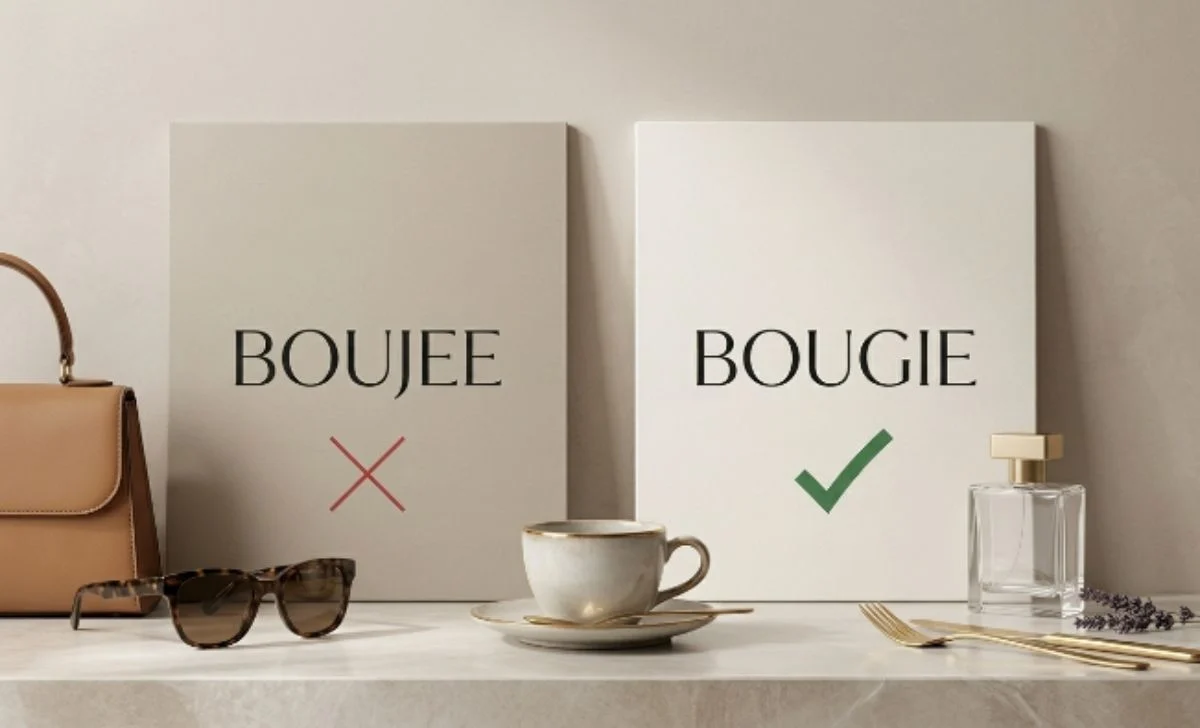
If you’re wondering “Is it bougie or boujee?”, the short answer is: bougie is the older and more established spelling, while boujee is a popular informal variant.
The difference becomes clearer when you look at where the words came from and how people use them today.
Quick Answer
Bougie is the traditional and more established spelling.
Boujee is a popular informal spelling that became especially common in contemporary slang and popular culture.
| Word | Status | Typical meaning |
|---|---|---|
| Bougie | Established informal word | Fancy, upscale, pretentious, or associated with wealth |
| Boujee | Informal variant | Usually the same meaning, often with a more playful or exaggerated tone |
Examples
That restaurant is so bougie.
She loves boujee brunch spots.
Both can work in casual writing, but bougie is generally the safer choice when you want the established spelling.
What Does Bougie Mean?
Bougie describes something that seems luxurious, expensive, sophisticated, or associated with an affluent lifestyle.
It can be positive, negative, or humorous depending on context.
Positive use
This little hotel is surprisingly bougie.
Here, the speaker may mean that the hotel feels stylish and luxurious.
Teasing use
You brought a silk robe to a camping trip? That’s pretty bougie.
Here, the word suggests someone is being unnecessarily fancy.
Negative or critical use
The café has become too bougie for my taste.
In this sentence, the speaker is criticizing its upscale or pretentious atmosphere.
What Does Boujee Mean?
Boujee generally carries the same basic meaning as bougie.
It can describe someone or something that appears:
- wealthy
- luxurious
- fancy
- stylish
- upscale
- sophisticated
- materialistic
- pretentious
The spelling boujee often feels more playful and internet-friendly.
They booked a boujee hotel for the weekend.
Her new apartment is very boujee.
The meaning depends heavily on tone and context.
Bougie vs Boujee: The Real Difference
The two forms overlap heavily in modern usage, but there is a useful distinction.
Bougie is closer to the original form and is the more established spelling.
Boujee is a newer slang spelling that reflects how the word sounds and is often associated with contemporary pop culture and social media.
Think of it this way:
Bougie = established spelling
Boujee = playful modern variant
Neither should automatically be treated as a simple spelling mistake.
Where Did Bougie Come From?
The story begins with bourgeois, a French word associated with the middle class or the bourgeoisie.
In English, bourgeois developed social and cultural meanings connected with middle-class values, wealth, status, and conventional tastes.
Bougie emerged as an informal shortened form of bourgeois.
The word later became strongly associated with people or lifestyles perceived as wealthy, materialistic, fashionable, or overly concerned with status.
So when someone calls something bougie, they are often commenting on more than its price. They may be describing the social image it creates.
Why Is It Spelled Boujee?
Boujee is a stylized spelling that reflects pronunciation and modern slang usage.
The extra e gives the word a more phonetic and playful appearance.
The spelling became especially visible through popular culture, music, social media, memes, and casual online communication.
Because slang changes quickly, boujee can feel more contemporary than bougie.
Is Bougie a French Word?
The modern English slang word bougie is related to bourgeois, but it should not simply be treated as standard French bourgeois with an English spelling.
English speakers developed bougie as an informal slang form.
There is also a French word bougie meaning candle, which is unrelated to the modern English slang sense.
That distinction is important because the same spelling can have different meanings across languages.
How Do You Pronounce Bougie?
Bougie is commonly pronounced:
BOO-zhee
IPA:
/ˈbuːʒi/
The middle sound is the zh sound found in words such as measure.
How about boujee?
Boujee is generally pronounced the same way:
BOO-zhee
So:
bougie → BOO-zhee
boujee → BOO-zhee
The spelling differs, but the pronunciation is usually the same.
Bougie as a Noun, Adjective, or Slang Term
In modern informal English, bougie is most often used as an adjective.
That’s a bougie restaurant.
She has a bougie taste in furniture.
It can also be used informally as a noun to describe a person perceived as bougie.
He’s such a bougie.
This noun use is casual and should generally be avoided in formal writing.
Bougie vs Boujee in American and British English
Both spellings are primarily associated with informal modern English, and neither represents a standard American-versus-British spelling difference.
| Variety | Common form |
|---|---|
| American English | bougie, boujee |
| British English | bougie, boujee |
| Canadian English | bougie, boujee |
| Australian English | bougie, boujee |
Usage can vary by community and generation rather than by country.
Which Spelling Should You Use?
Use bougie if you want the more established spelling.
Use boujee when you deliberately want a casual, playful, contemporary tone.
For casual social media
Either can work:
This brunch is so boujee.
For general writing
Bougie is usually the better choice:
The neighborhood has developed a reputation for being bougie.
For formal writing
Neither is ideal unless you are discussing slang or quoting someone’s language.
Instead, consider:
- luxurious
- upscale
- affluent
- pretentious
- sophisticated
- expensive
Choose the word that expresses your intended meaning without relying on slang.
Bougie vs Boujee Examples
Food
We went to a bougie restaurant downtown.
Their boujee brunch included champagne and designer desserts.
Fashion
She has a bougie sense of style.
He bought a boujee designer jacket.
Lifestyle
They live a very bougie lifestyle.
Her vacation looked incredibly boujee on Instagram.
Humor
Bringing a crystal glass to a picnic is a little bougie.
The word often works best when the speaker is being playful.
Common Mistakes
Mistake 1: Assuming boujee is always wrong
❌ Boujee is never a word.
That’s too simplistic.
Boujee is a recognized informal variant in contemporary English usage.
Mistake 2: Assuming bougie and boujee have completely different meanings
They generally overlap.
bougie = upscale, fancy, status-conscious
boujee = usually the same idea, with a more playful slang feel
Mistake 3: Using either word in formal academic writing
These are informal terms.
Instead of:
The hotel is extremely bougie.
Formal writing might use:
The hotel has an upscale and luxurious atmosphere.
Mistake 4: Confusing bougie with bourgeois
They are related, but they are not interchangeable in every sentence.
Bourgeois has broader historical, social, economic, and political meanings.
Bougie is modern informal slang.
Bougie Synonyms
Depending on the context, synonyms include:
- upscale
- luxurious
- fancy
- stylish
- affluent
- high-end
- sophisticated
- posh
- extravagant
- pretentious
The best synonym depends on whether the word is being used positively or negatively.
For example:
a bougie restaurant
could mean:
an upscale restaurant
But:
He’s acting bougie.
could mean:
He’s acting pretentious or overly concerned with status.
Bougie Antonyms
Possible contextual opposites include:
- simple
- modest
- basic
- casual
- inexpensive
- humble
- down-to-earth
- unpretentious
Again, there is no single perfect antonym because bougie can have several shades of meaning.
Bougie vs Bourgeois
These words are related but not identical.
| Bougie | Bourgeois |
|---|---|
| Modern informal slang | More formal word |
| Often means fancy or upscale | Relates to the middle class or bourgeoisie |
| Common in casual speech | Common in social, economic, political, and literary contexts |
| Often humorous or critical | Often analytical or descriptive |
Example:
That café is so bougie.
But:
The novel examines bourgeois values.
The second sentence has a much more formal and specific meaning.
A Simple Memory Trick
Think:
Bougie = fancy
Boujee = fancy, but with extra slang style
The easiest practical rule is:
If you’re unsure, choose “bougie.”
It is the more established spelling and will look natural in most casual contexts.
Practice Exercise
Choose bougie, boujee, bourgeois, or a more formal alternative.
1.
That new restaurant is incredibly _____.
2.
Her _____ apartment has marble floors and designer furniture.
3.
The professor discussed _____ social values.
4.
For a formal report, “luxurious” is better than _____.
5.
Which spelling is the more established English slang form: bougie or boujee?
Answers
- bougie / boujee
- bougie / boujee
- bourgeois
- bougie / boujee
- bougie
Google People Also Ask
Is it bougie or boujee?
Both are used. Bougie is the more established spelling, while boujee is a popular informal variant.
Is boujee a real word?
Yes. Boujee is used as an informal slang spelling, particularly in contemporary popular culture and online communication.
What does bougie mean?
Bougie usually means fancy, upscale, luxurious, affluent, or concerned with status. It can be positive, humorous, or critical.
What does boujee mean?
Boujee generally has the same meaning as bougie and often carries a playful or exaggerated slang tone.
How do you pronounce bougie?
Bougie is commonly pronounced BOO-zhee, /ˈbuːʒi/.
Is bougie a French word?
The modern English slang bougie is derived from bourgeois, although French bougie also independently means “candle.”
Is bougie positive or negative?
It can be either. Someone may use bougie to praise something as stylish and luxurious or criticize it as pretentious or excessive.
FAQs
Is bougie the correct spelling?
Yes. Bougie is the more established spelling of the modern English slang term.
Is boujee wrong?
No. Boujee is a widely used informal variant. It is especially common in casual and internet-based communication.
Which is more popular, bougie or boujee?
Usage varies by context, platform, generation, and community. Bougie has the stronger connection to the established slang form, while boujee has a distinctly playful modern style.
Can I use bougie in formal writing?
Usually, no. It is informal slang. In formal writing, use a precise alternative such as upscale, luxurious, affluent, or pretentious.
What is the opposite of bougie?
Depending on context, words such as simple, modest, basic, humble, or unpretentious can express the opposite idea.
Does bougie mean rich?
Not exactly. It can describe something associated with wealth or luxury, but it often focuses on the appearance, lifestyle, taste, or attitude associated with being affluent.
Conclusion
So, bougie or boujee?
Both spellings are used in modern informal English, but bougie is the more established form.
Bougie means fancy, upscale, luxurious, or sometimes pretentious.
Boujee usually means the same thing, but its spelling gives it a more playful, contemporary slang feel.
Bougie = established informal spelling
Boujee = popular playful variant
For casual conversation, social media, and informal writing, either can work. For more polished writing, bougie is the safer choice—or replace it with a precise word such as upscale, luxurious, or pretentious.
Read More:

Hi, I’m Safdar Ali, an English language teacher with 26 years of teaching experience. My expertise is in English linguistics, grammar, and the differences between British and American English.
Through Gramiffy, I share practical, research-based guides to help students, writers, and English learners improve their language skills. My goal is to make English simple, accurate, and easy for everyone to understand.