Is it half day, half-day, or halfday? This small spelling question causes a surprising amount of confusion.
The good news is that the answer is mostly about how the phrase functions in a sentence.
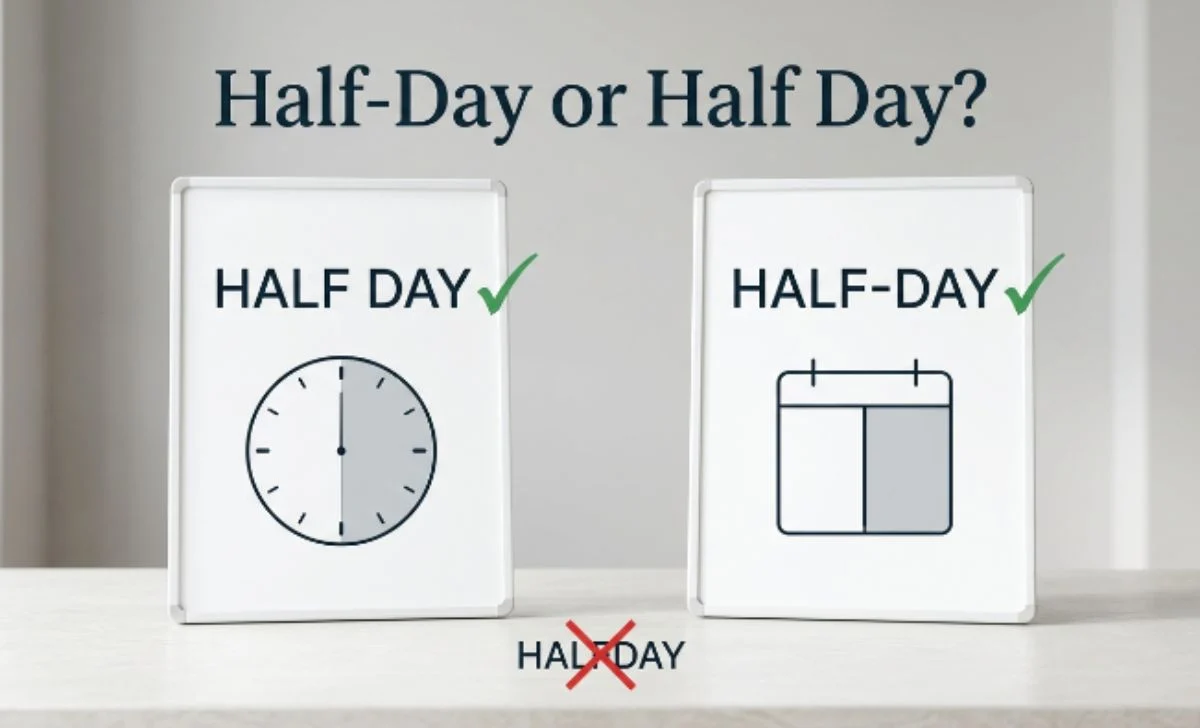
Half day is normally written as two words when it is a noun phrase, while half-day is commonly hyphenated when it works as a compound adjective before another noun.
Halfday as one word is generally not the standard form in ordinary English.
For example, you can say:
I took a half day off work.
But:
I attended a half-day workshop.
The difference is grammatical, not simply a matter of preference.
Quick Answer
- Half day — usually correct when used as a noun phrase.
- Half-day — usually correct when used as an adjective before a noun.
- Halfday — generally not standard in ordinary English.
| Form | Correct? | Typical use | Example |
|---|---|---|---|
| half day | Yes | Noun phrase | I took a half day off. |
| half-day | Yes | Compound adjective | It was a half-day course. |
| halfday | Usually no | Avoid in standard writing | ❌ a halfday course |
What Does Half Day Mean?
Half day means a period of time lasting approximately half of a normal working or school day.
It is normally written as two words when it functions as a noun phrase.
I only worked a half day today.
She took a half day off.
The students have a half day on Friday.
Here, half modifies the noun day, so there is no need for a hyphen.
When Should You Use Half-Day?
Use half-day when the two words work together as a compound adjective before a noun.
Examples:
We attended a half-day workshop.
The company organized a half-day training session.
She booked a half-day tour.
They offer half-day classes.
The hyphen helps show that half-day functions as one adjective modifying the noun that follows.
Half Day vs Half-Day
The easiest rule is based on position.
Before a noun: usually half-day
a half-day course
a half-day seminar
a half-day trip
As a noun phrase: usually half day
The course lasts half a day.
I worked a half day.
We spent half a day there.
There is an important detail here: half a day is often more natural than half day when you are talking about a duration.
I worked for half a day.
sounds more natural than:
I worked for half day.
However, half day is common in expressions such as:
half-day leave
or:
I took a half day off.
Is Halfday a Word?
In standard modern English, halfday is generally not the form you should use.
Avoid:
❌ I booked a halfday tour.
Use:
✅ I booked a half-day tour.
Also avoid:
❌ I took a halfday off.
Use:
✅ I took a half day off.
Some specialized names, product names, or organization-specific terms may use unusual spellings, but that does not make halfday the standard spelling.
Half-Day as an Adjective
The hyphen is especially useful when half-day appears directly before a noun.
a half-day meeting
a half-day course
a half-day workshop
a half-day appointment
a half-day event
Without the hyphen, the relationship between the words can be less clear.
Compare:
We attended a half-day workshop.
The hyphen clearly shows that half-day describes workshop.
Half Day as a Noun
When the phrase refers to the period itself, write it as two words.
I only need a half day.
He took a half day from work.
The school has a half day tomorrow.
You may also use the more complete phrase:
I only need half a day.
This version is especially natural when describing duration.
Half Day vs Half a Day
These expressions are closely related but are not always interchangeable.
Half a day
This is the most natural form when talking about a duration.
The journey took half a day.
We spent half a day exploring the city.
A half day
This can refer to a half-day period as a unit.
I need a half day to finish the work.
Half-day
Use the hyphen when it modifies a following noun.
We booked a half-day tour.
Pronunciation
Half day and half-day are pronounced the same.
A simple pronunciation guide is:
haf day
The l in half is silent in standard pronunciation.
IPA:
/ˌhæf ˈdeɪ/
The hyphen changes the written grammatical relationship, not the pronunciation.
American vs British English
There is no major American-British spelling difference between half day and half-day.
Both varieties use the same basic distinction between a noun phrase and a compound modifier.
| Usage | American English | British English |
|---|---|---|
| Noun phrase | half day | half day |
| Compound adjective | half-day | half-day |
| One-word form | Generally avoided | Generally avoided |
The exact phrasing can vary by context, but the hyphenation principle remains broadly the same.
Word Origin
The expression combines two ordinary English words:
- half — meaning one of two equal parts
- day — a period of 24 hours or, in work and school contexts, the normal daytime period
The compound half-day developed naturally as a way to describe something lasting half of a normal day.
Hyphens in English often help readers identify compound modifiers, which is why half-day is useful before nouns.
Grammar Rules for Half Day and Half-Day
1: Use half-day before a noun when it acts as one modifier
a half-day course
a half-day holiday
2: Use half day as a noun phrase
I took a half day off.
Rule 3: Use half a day when expressing duration
The work took half a day.
Rule 4: Do not normally write halfday
❌ halfday
✅ half-day
or:
✅ half day
depending on its grammatical role.
Rule 5: Don’t add a hyphen unnecessarily
You do not normally need:
❌ I stayed for a half-day.
Better:
✅ I stayed for half a day.
The hyphen is most useful when the phrase functions as a compound adjective.
Half-Day Examples in Everyday English
Work
I have a half-day meeting tomorrow.
I took a half day off work.
School
Friday is a half day at school.
The students attended a half-day workshop.
Travel
We booked a half-day tour of the city.
The excursion lasted half a day.
Training
The company arranged a half-day training session.
Appointments
The doctor will be available for a half-day clinic.
These examples show why the spelling changes with grammatical function.
Common Mistakes
Mistake 1: Writing halfday
❌ We attended a halfday seminar.
✅ We attended a half-day seminar.
Mistake 2: Hyphenating every use
❌ I worked a half-day.
Better:
✅ I worked a half day.
Or more naturally:
✅ I worked for half a day.
Mistake 3: Leaving out “a”
❌ The trip lasted half day.
✅ The trip lasted half a day.
Mistake 4: Confusing half-day with half a day
❌ The half a day workshop was useful.
✅ The half-day workshop was useful.
When the phrase directly modifies workshop, the compound adjective is half-day.
Half-Day Synonyms
Depending on context, alternatives include:
- part-day
- morning session
- afternoon session
- short session
- partial day
- limited-day session
For example:
a half-day workshop
could sometimes be described as:
a morning workshop
if it specifically takes place in the morning.
Antonyms and Contrasting Terms
There is no perfect grammatical antonym for half-day, but useful contrasts include:
- full day
- whole day
- all day
- full-day
Compare:
a half-day course
with:
a full-day course
And:
I worked a half day.
with:
I worked a full day.
A Simple Memory Trick
Remember this:
Before a noun → half-day
As a noun phrase → half day
Examples:
half-day course
half-day workshop
but:
a half day off
And when talking about duration:
half a day
This three-part rule covers most everyday situations.
Practice Exercise
Choose half day, half-day, half a day, or halfday.
1.
We attended a _____ workshop.
2.
I took a _____ off work.
3.
The journey lasted _____.
4.
She booked a _____ tour.
5.
He worked for _____.
6.
We have a _____ training session tomorrow.
Answers
- half-day
- half day
- half a day
- half-day
- half a day
- half-day
Google People Also Ask
Is it half day or half-day?
Both can be correct. Use half day as a noun phrase and half-day when it functions as a compound adjective before a noun.
Is halfday one word?
Halfday is generally not the standard form in modern English. Use half day or half-day, depending on the sentence.
Is it half day off or half-day off?
Half day off is normally written without a hyphen.
I took a half day off.
Is it half-day course or half day course?
Half-day course is the standard choice because half-day acts as a compound adjective before course.
Is half a day hyphenated?
No. Write:
half a day
not:
❌ half-a-day
Is half-day British or American?
Both British and American English use half-day as a compound modifier. It is not a major regional spelling difference.
FAQs
Which is correct: halfday or half-day?
Half-day is correct when the phrase is a compound adjective, such as half-day workshop. Halfday is generally not standard.
Which is correct: half day or half-day?
Both can be correct. The choice depends on grammar.
a half day off
a half-day course
Should I write “half a day” or “half day”?
When describing duration, half a day is usually the most natural form.
The project took half a day.
Do you hyphenate half-day?
Yes, when half-day functions as a compound adjective before a noun.
a half-day seminar
Is “half-day” an adjective?
Yes. In expressions such as half-day course, it functions as a compound adjective modifying course.
What is the opposite of half-day?
The most natural contrasting term is full-day or full day, depending on how it is used.
a half-day course
a full-day course
Final Verdict
The correct choice depends on how you use the phrase:
Half day = noun phrase
Half-day = compound adjective
Halfday = generally incorrect
Use:
I took a half day off.
But:
I attended a half-day workshop.
And when you’re simply describing duration:
The trip lasted half a day.
The easiest rule to remember is “before a noun, hyphenate; as a noun phrase, use two words.”
Read More:

Hi, I’m Safdar Ali, an English language teacher with 26 years of teaching experience. My expertise is in English linguistics, grammar, and the differences between British and American English.
Through Gramiffy, I share practical, research-based guides to help students, writers, and English learners improve their language skills. My goal is to make English simple, accurate, and easy for everyone to understand.