English is full of words that can confuse even experienced writers. Some words sound alike but have different meanings, while others look similar and create spelling uncertainty.
One common spelling question people search for online is “cryer or crier.”
If you’ve ever wondered whether cryer is a real word, whether crier is the correct spelling, or what the difference between the two is, you’re not alone.
Many students, writers, bloggers, and English learners make this mistake because both spellings seem logical at first glance.
The confusion usually comes from the verb cry. Since many English nouns are formed by adding -er to a verb, people often assume that someone who cries should be called a cryer.
However, English spelling rules are not always predictable, and historical language development plays a major role in determining which forms become standard.
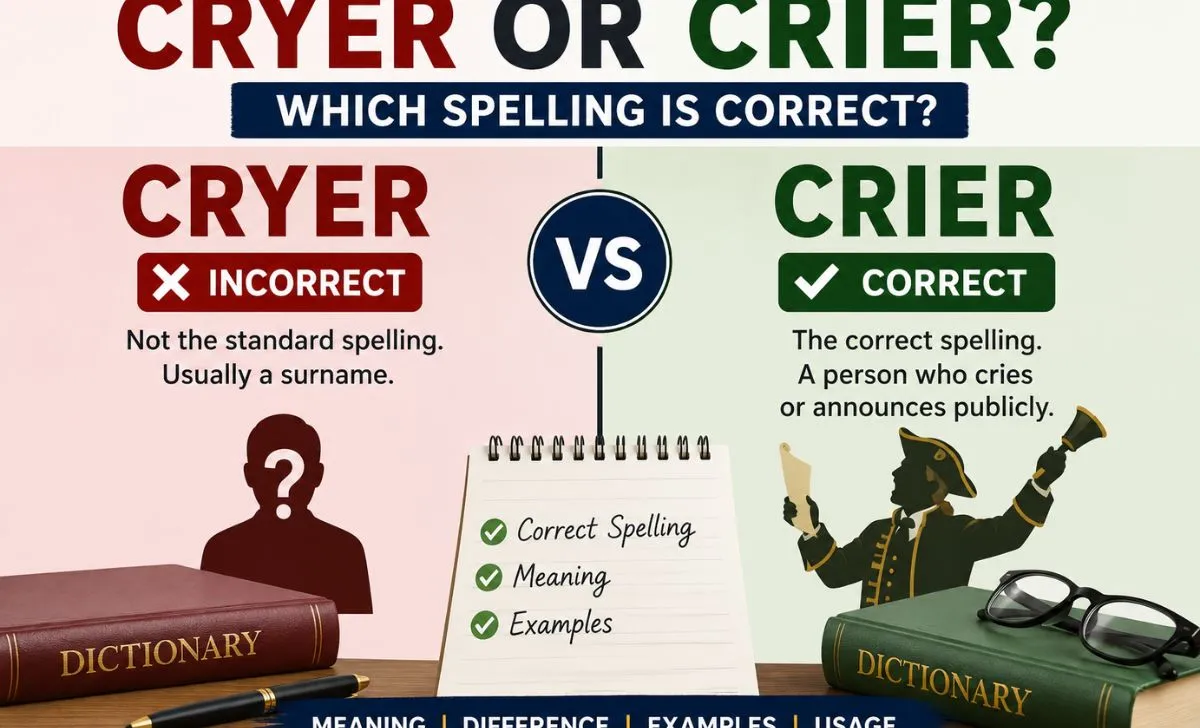
In modern English, crier is the accepted spelling recognized by major dictionaries and grammar authorities.
While cryer occasionally appears as a surname or rare historical variation, it is generally not the correct spelling when referring to someone who cries or announces information publicly.
This comprehensive guide will explain everything you need to know about cryer vs crier, including definitions, origins, grammar rules, examples, pronunciation, common mistakes, historical background, dictionary explanations, and practical writing tips.
Quick Answer
If you need a fast answer, here it is:
✅ Crier is the correct spelling.
❌ Cryer is usually incorrect in standard English.
Correct Examples
- The baby is a loud crier.
- She has always been a crier during emotional movies.
- The town crier announced the king’s message.
Incorrect Examples
- The baby is a loud cryer.
- The town cryer announced the news.
Whenever you’re referring to someone who cries or publicly announces information, crier is the correct word.
What Does Crier Mean?
The word crier is a noun with several related meanings.
1. A Person Who Cries Easily
The most common modern meaning refers to someone who cries frequently or becomes emotional easily.
Examples:
- I’m a crier whenever I watch sad movies.
- She’s always been a crier.
- He’s not usually a crier.
2. A Public Announcer
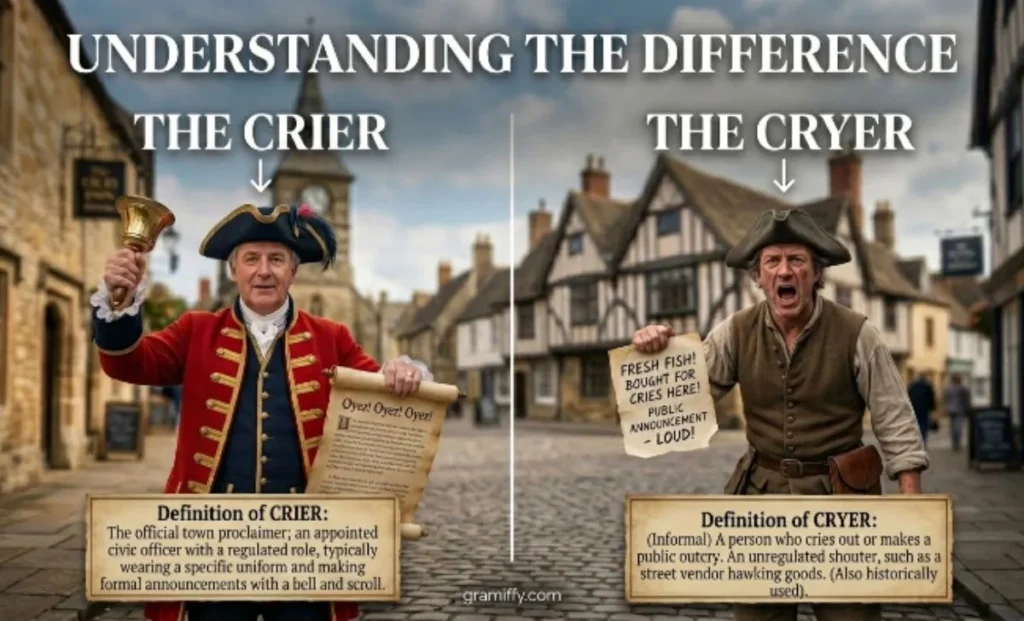
Historically, a crier was a person responsible for making public announcements.
Examples:
- The town crier gathered residents in the market square.
- The royal crier delivered the king’s proclamation.
- Citizens listened carefully to the crier.
3. Someone Who Calls Out Loudly
The word can also describe a person who loudly announces information.
Examples:
- Market criers attracted customers.
- Street criers promoted local events.
All of these meanings use the spelling crier.
Is Cryer a Real Word?
Many people search:
- Is cryer a word?
- Is cryer accepted in dictionaries?
- Can I use cryer instead of crier?
The answer requires some explanation.
Yes, Cryer Exists
The spelling Cryer appears as:
- A surname
- A family name
- A proper noun
- A rare historical spelling
For example:
- Jon Cryer is a famous actor.
- The Cryer family attended the event.
In these cases, Cryer is a name rather than a common noun.
No, It Is Not the Standard Common Noun
When referring to a person who cries or announces information publicly, dictionaries overwhelmingly prefer crier.
Therefore:
✅ crier = correct
❌ cryer = usually incorrect
Difference Between Cryer and Crier
The easiest way to understand the distinction is through comparison.
| Feature | Crier | Cryer |
|---|---|---|
| Standard English spelling | Yes | No |
| Dictionary-approved | Yes | Rarely |
| Means someone who cries | Yes | No |
| Means public announcer | Yes | No |
| Accepted in formal writing | Yes | No |
| Common modern usage | Yes | Limited |
| Often considered a misspelling | No | Yes |
For nearly all writing situations, crier is the correct choice.
Why Do People Spell Crier as Cryer?
There are several reasons this spelling mistake is so common.
The Verb “Cry”
People naturally assume:
cry + er = cryer
While this seems logical, English often follows historical spelling patterns rather than perfectly consistent rules.
Similar Pronunciation
The pronunciation of crier sounds almost identical to what many people imagine cryer would sound like.
Because pronunciation provides few clues, spelling mistakes occur frequently.
Lack of Familiarity
Most people rarely encounter the word crier in everyday conversation.
As a result, they rely on intuition rather than memory.
Typing Errors
Fast typing, autocorrect issues, and insufficient proofreading can also lead to the spelling cryer.
Origin of the Word Crier
Understanding a word’s history often explains its spelling.
The word crier comes from Old French.
The French verb crier meant:
- to cry out
- to proclaim
- to announce publicly
This word entered Middle English and eventually became the noun crier.
Over centuries, the spelling remained stable and became the accepted form used throughout English-speaking countries.
Language scholars in the fields of Linguistics and English Grammar have traced the term through historical texts, showing that crier has been standard for hundreds of years.
The History of the Town Crier

One of the most famous uses of the word is town crier.
Before newspapers, radio, television, and the internet existed, communities needed another way to spread information.
Why Town Criers Existed
Many people in earlier centuries could not read.
Governments therefore needed trusted individuals to communicate:
- New laws
- Royal decrees
- Public notices
- Tax announcements
- Emergency warnings
- Market information
Town criers fulfilled this role.
How They Worked
A town crier would:
- Walk through public spaces
- Ring a bell
- Gather residents
- Read announcements aloud
This system allowed important information to reach the public quickly.
Famous Opening Phrase
Many town criers began announcements with:
“Hear ye! Hear ye!”
This phrase remains closely associated with historical public announcements.
What Does a Town Crier Do?
Although modern communication technology has replaced the practical need for town criers, some communities continue the tradition.
Modern town criers often:
- Welcome visitors
- Participate in parades
- Open festivals
- Represent local heritage
- Reenact historical events
They frequently wear traditional clothing and carry ceremonial bells.
The phrase town crier remains one of the most recognizable uses of the word.
Town Criers Around the World
Although people often associate town criers with England, similar roles existed in many countries.
England
Town criers announced royal proclamations and community news.
Scotland
Scottish towns employed criers to communicate important information.
Colonial America
Public announcers informed settlers about local events and government decisions.
Canada
Some Canadian communities continue to maintain ceremonial town crier traditions.
Australia and New Zealand
Town crier competitions and historical demonstrations still occur today.
These traditions help preserve an important part of communication history.
Crier Meaning in Modern English
Today, the word is most commonly used in emotional contexts.
Emotional Meaning
Examples:
- He’s a crier during weddings.
- She’s always been a crier.
- I’m not much of a crier.
Historical Meaning
Examples:
- The town crier announced the festival.
- The royal crier delivered important news.
Both meanings remain correct and widely understood.
Crier in Literature and Historical Writing
The word crier appears throughout English literature.
Historical novels frequently include town criers because they help create authentic settings.
Writers use criers to:
- Introduce important news
- Establish historical atmosphere
- Represent authority
- Show community communication
Because town criers played a significant role in daily life for centuries, they naturally became common literary characters.
Many historical accounts, government records, and educational materials also reference criers.
Crier in a Sentence
Examples are one of the best ways to understand correct usage.
Emotional Meaning
- She’s always been a crier.
- I’m a crier when animals are involved.
- He’s not usually a crier.
- The touching speech made every crier emotional.
- Even strong people can be criers sometimes.
Public Announcer Meaning
- The town crier rang his bell.
- The royal crier delivered the king’s message.
- Citizens gathered around the crier.
- The crier announced the beginning of the festival.
- Everyone listened carefully to the crier.
Cryer in a Sentence
Most uses of cryer are incorrect.
Correct Surname Examples
- Jon Cryer appeared in the television series.
- The Cryer family hosted the event.
- Mr. Cryer gave an excellent presentation.
Incorrect Examples
- The baby was a loud cryer.
- The town cryer announced the news.
These should use crier instead.
What Do Major Dictionaries Say?
Dictionary evidence strongly supports crier.
Merriam-Webster
Defines crier as:
- one who cries
- one who publicly proclaims
Oxford English Dictionary
Recognizes crier as the standard spelling.
Cambridge Dictionary
Uses crier in official definitions and examples.
Collins Dictionary
Accepts crier for both emotional and public-announcement meanings.
The consistency across these authorities removes any doubt about the preferred spelling.
Why Crier Is Correct According to English Grammar
Many learners ask:
“Why isn’t the noun cryer?”
The answer lies in historical language development.
English noun formation does not always follow simple rules.
Examples:
| Verb | Noun |
|---|---|
| Lie | Liar |
| Occupy | Occupier |
| Supply | Supplier |
| Cry | Crier |
Because spelling patterns developed over centuries, they are not always predictable.
The accepted noun form became crier, not cryer.
British English vs American English
Some spelling differences depend on region.
Examples include:
| British English | American English |
|---|---|
| Jewellery | Jewelry |
| Analysing | Analyzing |
| Modelling | Modeling |
| Colour | Color |
However, crier is not one of these differences.
British English
Uses crier.
American English
Uses crier.
Canadian English
Uses crier.
Australian English
Uses crier.
No major variety of English prefers cryer.
Synonyms of Crier
Learning synonyms improves vocabulary.
Emotional Meaning
- Weeper
- Sobber
- Mourner
- Emotional person
- Tearful individual
Public Announcement Meaning
- Herald
- Messenger
- Announcer
- Proclaimer
- Broadcaster
These words may share similar meanings depending on context.
Antonyms of Crier
Possible antonyms include:
Emotional Context
- Stoic
- Non-crier
- Reserved person
- Unemotional individual
These terms describe people who rarely show emotion through tears.
Crier vs Crying vs Cried
Many English learners confuse these related forms.
Cry
Verb
Example:
- The baby may cry tonight.
Crying
Present participle
Example:
- The child is crying.
Cried
Past tense
Example:
- She cried after hearing the news.
Crier
Noun
Example:
- She has always been a crier.
Understanding these differences helps improve grammar accuracy.
Common Grammar Mistakes Involving Crier
Mistake 1
Incorrect:
- He is a loud cryer.
Correct:
- He is a loud crier.
Mistake 2
Incorrect:
- She is a crying.
Correct:
- She is a crier.
Mistake 3
Incorrect:
- He crier every day.
Correct:
- He cries every day.
Avoiding these mistakes will improve writing quality.
Why English Learners Struggle With Cryer or Crier
English spelling can be challenging because pronunciation and spelling do not always match.
Consider these examples:
- Their
- There
- They’re
Or:
- Council
- Counsel
Similarly:
- Cryer
- Crier
Because the words sound nearly identical, learners often rely on guesswork.
Regular reading and dictionary use help reinforce correct spelling.
How Dictionaries Determine Correct Spellings
Many people wonder who decides which spelling becomes standard.
Dictionary publishers analyze:
- Books
- Newspapers
- Academic writing
- Historical documents
- Modern communication
- Language trends
Organizations such as Merriam-Webster, Oxford English Dictionary, Cambridge Dictionary, and Collins Dictionary study massive collections of English texts.
Because these sources consistently use crier, it remains the accepted spelling.
Crier in Modern Media
Although town criers are less common today, the word still appears in:
- Historical documentaries
- Educational programs
- Museum exhibits
- Historical fiction
- Fantasy novels
- Cultural celebrations
Writers use town criers to help audiences understand how information spread before modern media.
Fun Facts About Town Criers
They Needed Powerful Voices
Without microphones, town criers had to project their voices over large crowds.
Bells Were Essential
Most town criers carried bells to attract attention.
They Represented Authority
In many places, harming a town crier was considered a serious offense.
Competitions Still Exist
Modern town crier competitions are held in several countries.
The Tradition Lives On
Many communities continue to celebrate town crier heritage through festivals and ceremonies.
Why Correct Spelling Matters
Some people underestimate the importance of spelling.
However, correct spelling affects:
Professionalism
Accurate writing creates a stronger impression.
Academic Success
Teachers expect correct language usage.
Reader Trust
Fewer mistakes increase credibility.
Communication
Correct spelling reduces confusion.
Search Engine Optimization
Proper spelling helps search engines understand content accurately.
Using crier instead of cryer ensures clarity and professionalism.
Expert Tips for Remembering the Correct Spelling
Remember “Town Crier”
This famous phrase reinforces the correct spelling.
Trust Dictionaries
Major dictionaries consistently use crier.
Read Historical Content
Repeated exposure improves memory.
Practice Writing
Examples:
- I am a crier.
- She is not a crier.
- The town crier announced the event.
The more frequently you see the word, the easier it becomes to remember.
FAQs
Is Cryer a Word?
Yes, primarily as a surname or rare historical variation.
Which Is Correct: Cryer or Crier?
Crier is correct.
What Does Crier Mean?
It can mean:
- Someone who cries.
- A public announcer.
- A town crier.
Is Cryer Accepted by Dictionaries?
Not as the standard common noun.
Why Do People Write Cryer?
Because it appears logical based on the spelling of cry.
What Is a Town Crier?
A public official who announced information before modern communication systems existed.
How Do You Pronounce Crier?
CRY-er.
Can Cryer Replace Crier?
No.
Is Crier Formal or Informal?
Both, depending on context.
What Is the Plural of Crier?
Criers.
Is Crier Used Worldwide?
Yes.
Is Crier Still Used Today?
Absolutely.
Can Someone Be Called a Crier?
Yes, especially if they cry easily.
Is Crier a Positive or Negative Word?
Usually neutral.
What Part of Speech Is Crier?
It is a noun.
Final Verdict: Cryer or Crier?
When comparing cryer or crier, the correct choice is clear: crier.
Major language authorities, including Merriam-Webster, Oxford English Dictionary, Cambridge Dictionary, and Collins Dictionary, recognize crier as the standard spelling.
Whether you’re referring to someone who cries easily, a public announcer, or a historical town crier, crier is the word you should use.
While cryer may occasionally appear as a surname or rare historical variation, it is not the preferred spelling in modern English.
Using crier ensures your writing remains accurate, professional, and grammatically correct.
The next time someone asks, “Is it cryer or crier?”, you’ll know the answer with confidence:
✅ Crier = Correct
❌ Cryer = Usually Incorrect
Read More :

I am Bryan A. Garner a lexicographer, and language expert passionate about clear and effective writing.
I contribute grammar, spelling, and usage guides on Gramiffy.com to help readers improve their English skills. Through my work, I aim to make language rules simple, practical, and easy to understand.