Have you ever written council when you actually meant counsel? These two words look almost identical, sound similar, and are easy to mix up—but their meanings are completely different.
One refers to a group of people who make decisions or govern, while the other can mean advice, guidance, or a lawyer. That small difference can change the meaning of an entire sentence. So, how can you instantly tell council and counsel apart?
In this guide, we’ll break down their meanings, pronunciation, origins, grammar, real-world examples, common mistakes, and simple memory tricks so you never confuse these two words again.
Council or Counsel – Quick Answer
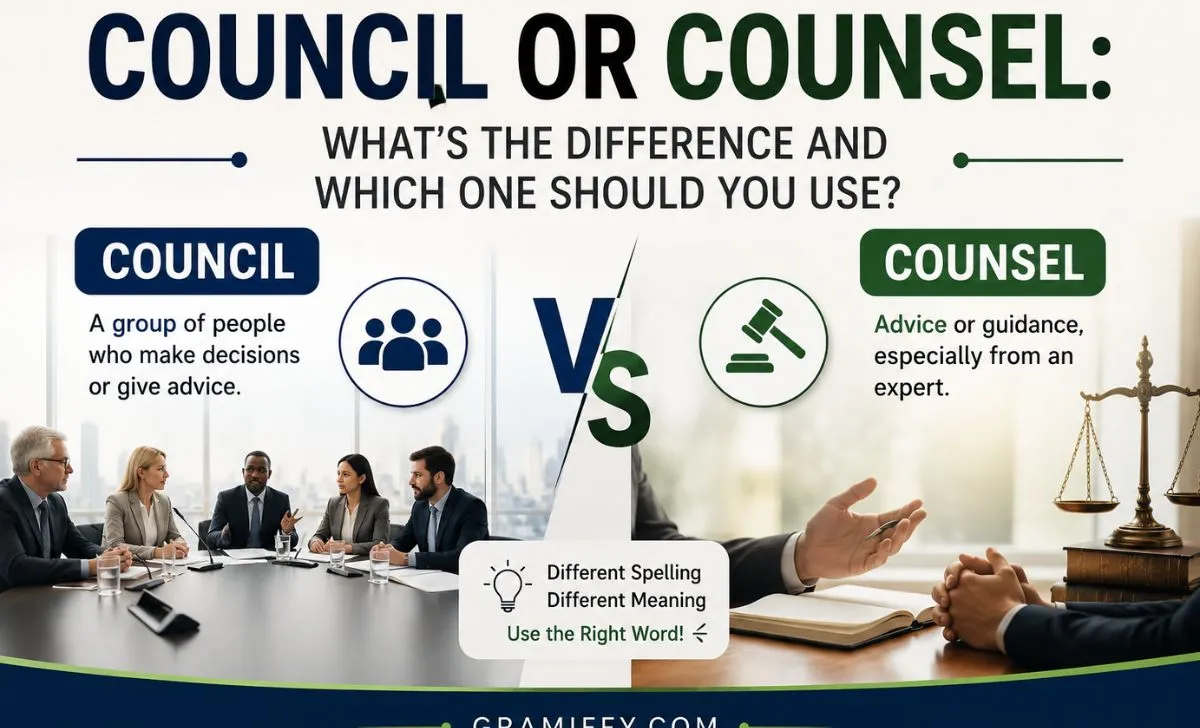
Council is a noun that refers to a group of people who meet to make decisions, give advice, or govern an organization or community.
Counsel usually means advice or guidance. It can also refer to a lawyer or legal advisor. Additionally, it can function as a verb meaning “to advise.”
Simple Rule
- Council = Group
- Counsel = Advice or Lawyer
What Does Council Mean?
The word council refers to a committee, board, or group of individuals that comes together to discuss issues, make decisions, or govern an organization.
A council often exists within governments, schools, businesses, and nonprofit organizations.
Common Types of Councils
- City council
- Municipal council
- Student council
- Advisory council
- Community council
- Executive council
Council Examples
- The city council voted on the new transportation plan.
- She serves on the student council at her school.
- The advisory council recommended several policy changes.
- The municipal council discussed local infrastructure improvements.
In most cases, if you’re talking about a group of people making decisions, council is the correct word.
What Does Counsel Mean?
The word counsel has multiple meanings.
1. Counsel as Advice
It refers to guidance, recommendations, or professional advice.
Examples
- I appreciate your counsel on this matter.
- His counsel helped me make a better decision.
- She asked for financial counsel before investing.
2. Counsel as a Lawyer
In legal contexts, counsel refers to an attorney or legal representative.
Examples
- The defendant met with legal counsel.
- The company retained outside counsel.
- Counsel presented evidence to the court.
3. Counsel as a Verb
It can also mean to advise or guide someone.
Examples
- Teachers often counsel students about career choices.
- The doctor counseled the patient regarding treatment options.
- Parents should counsel their children wisely.
Council vs Counsel: Side-by-Side Comparison
| Feature | Council | Counsel |
|---|---|---|
| Meaning | Group of people | Advice, guidance, or lawyer |
| Part of Speech | Noun | Noun and Verb |
| Common Context | Government, committees, organizations | Legal, professional advice, guidance |
| Example | City council approved the proposal | Legal counsel reviewed the contract |
This comparison makes it easier to remember the difference between council and counsel.
The Origin of Council
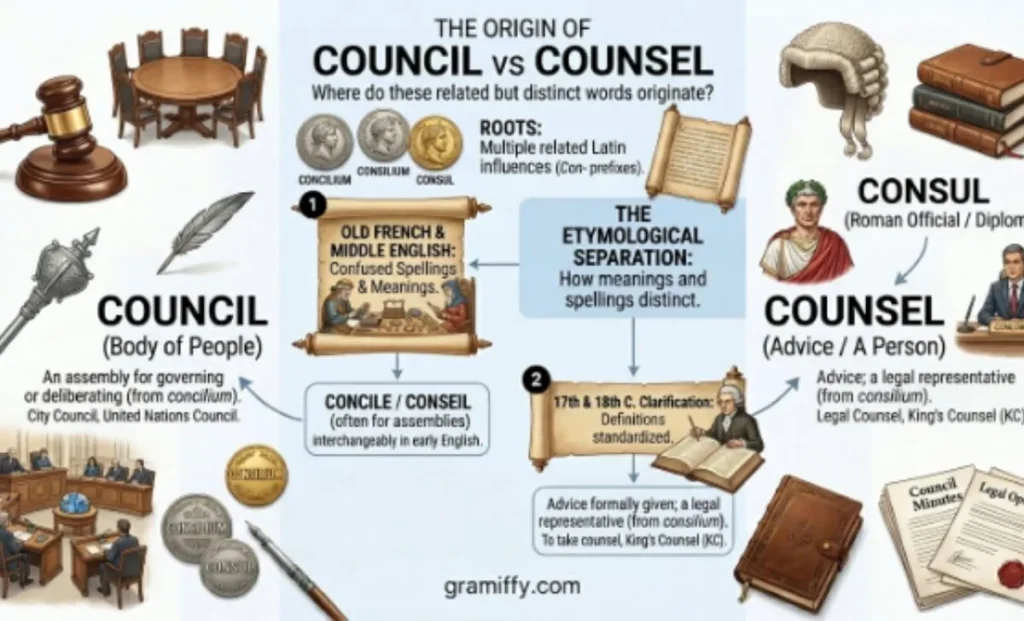
The word council comes from the Latin word concilium, meaning an assembly, gathering, or meeting.
Historically, councils were groups formed to discuss political, religious, or community matters. Over time, the term became associated with governing bodies and decision-making committees.
Today, councils play important roles in local government, education, and organizational leadership.
The Origin of Counsel
The word counsel originates from the Latin term consilium, meaning advice, deliberation, or plan.
The meaning evolved into guidance, wisdom, and professional legal advice.
Because legal professionals regularly provide advice, the term eventually became associated with attorneys and legal representatives.
This historical connection explains why counsel can mean both advice and lawyer.
Why Are Council and Counsel So Confusing?
The confusion exists because these words are nearly identical in pronunciation.
Both sound similar in everyday speech, making it difficult for writers to determine which spelling is correct.
Other reasons include:
- Similar spelling
- Related historical origins
- Frequent appearance in professional writing
- Use in legal and governmental contexts
As a result, many people accidentally write legal council when they mean legal counsel.
Council and Counsel Pronunciation
In standard English pronunciation, council and counsel sound extremely similar.
Council
Pronounced roughly as:
KOWN-suhl
Counsel
Pronounced roughly as:
KOWN-suhl
Because pronunciation offers little help, understanding the meaning of each word becomes essential.
How to Remember the Difference Between Council and Counsel
A simple memory trick can prevent mistakes.
Council = Committee
Notice that council contains the letters “cil.”
Think:
Council = Committee
Both involve groups of people working together.
Counsel = Advice
Think of counsel as:
Counsel = Consultation
Both involve guidance, recommendations, and professional advice.
This trick helps many writers choose the correct spelling quickly.
Common Mistakes People Make
Incorrect
❌ The city counsel approved the proposal.
Correct
✅ The city council approved the proposal.
Incorrect
❌ She hired legal council.
Correct
✅ She hired legal counsel.
Incorrect
❌ The council advised him to reconsider.
Correct
✅ The counsel advised him to reconsider.
Incorrect
❌ He sought council from his mentor.
Correct
✅ He sought counsel from his mentor.
Understanding the context is usually enough to identify the correct word.
Council in a Sentence
Here are several examples showing proper use of council.
- The city council met on Tuesday evening.
- She was elected to the student council.
- The council approved the annual budget.
- Our community council supports local projects.
- The advisory council reviewed the proposal.
In each example, council refers to a group of people.
Counsel in a Sentence
These examples demonstrate proper use of counsel.
Advice Meaning
- I value your counsel greatly.
- The counselor offered helpful counsel.
- Good counsel can prevent costly mistakes.
Lawyer Meaning
- The defendant requested legal counsel.
- Corporate counsel reviewed the agreement.
- Defense counsel questioned the witness.
Verb Meaning
- The therapist counseled the family.
- Experts counseled caution during the crisis.
- Teachers counsel students regularly.
Legal Counsel vs Legal Council
One of the most searched questions is:
Is It Legal Counsel or Legal Council?
The correct phrase is:
✅ Legal Counsel
Legal counsel refers to a lawyer, attorney, or legal advisor.
Examples
- The company consulted legal counsel.
- Legal counsel reviewed the contract.
- The defendant spoke with legal counsel.
Incorrect Usage
❌ Legal council
Unless you’re referring to an actual governing legal committee, “legal council” is generally incorrect.
City Council vs City Counsel
Another common question involves local government.
Correct Form
✅ City Council
A city council is a governing body responsible for making decisions about local laws, budgets, and policies.
Examples
- The city council passed a new ordinance.
- Residents attended the city council meeting.
- The city council discussed public transportation.
Incorrect Form
❌ City Counsel
This would usually be wrong because a city government body is called a council, not counsel.
Council and Counsel in Professional Writing
Using the wrong word can affect your credibility.
Business Writing
Correct:
- The advisory council reviewed the report.
- Management sought expert counsel.
Academic Writing
Correct:
- The student council organized the event.
- Researchers provided valuable counsel.
Legal Writing
Correct:
- Defense counsel filed a motion.
- Outside counsel reviewed the agreement.
Careful proofreading helps eliminate these mistakes.
Frequently Asked Questions
What Is the Difference Between Council and Counsel?
A council is a group of people that meets to discuss or govern. Counsel means advice, guidance, or a lawyer.
Is Counsel Another Word for Advice?
Yes. Counsel often means guidance, recommendations, or professional advice.
Is Counsel a Lawyer?
Yes. In legal settings, counsel can refer to an attorney or legal representative.
Is Council a Government Body?
Yes. A city council or municipal council is a governing group responsible for local decisions.
Can Counsel Be Used as a Verb?
Yes. To counsel someone means to advise, guide, or support them.
Why Do Council and Counsel Sound the Same?
They developed from related Latin roots and evolved into words with similar pronunciation but different meanings.
How Do You Remember the Difference?
Think:
- Council = Committee
- Counsel = Consultation
This memory trick works well in most situations.
Final Thoughts
Understanding the difference between council or counsel is essential for clear and professional writing.
Remember:
- Council refers to a group, committee, board, or governing body.
- Counsel means advice, guidance, or a lawyer and can also function as a verb meaning to advise.
Whenever you’re unsure, ask yourself a simple question:
Am I talking about a group of people or advice?
If it’s a group, use council.
If it’s advice, guidance, or a lawyer, use counsel.
Mastering this commonly confused word pair will improve your grammar, strengthen your writing, and help you avoid one of the most frequent English language mistakes.
Read More Blogs :