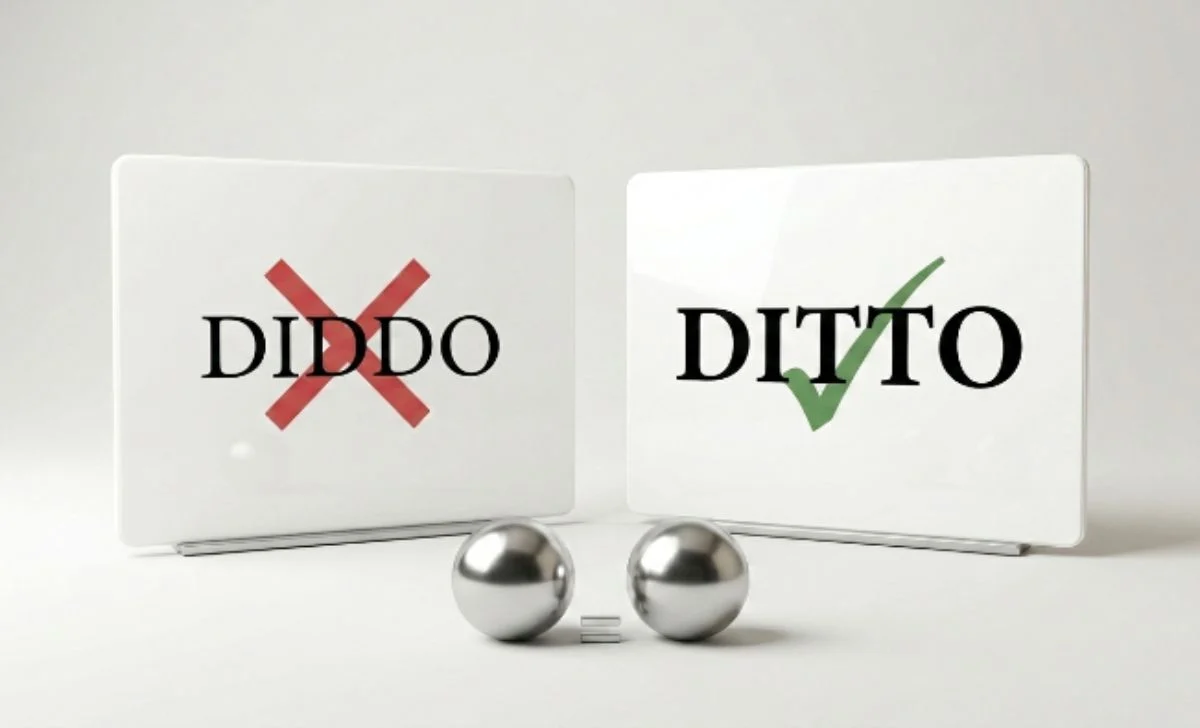
Two little letters can make a surprisingly big difference: diddo or ditto? If you’ve ever written one and paused because it just didn’t look right, there’s a good reason for the confusion.
The word is pronounced in a way that can easily lead your fingers toward the wrong spelling. But when you mean “the same,” “same here,” or “as previously mentioned,” the correct spelling is ditto.
Ditto = correct
Diddo = incorrect
From casual replies like “Ditto!” to its older use for repeating information, this small word has an interesting history and several uses.
Let’s uncover the meaning, pronunciation, origin, grammar, examples, common mistakes, and the easiest trick for remembering ditto forever.
Quick Answer: Is It Diddo or Ditto?
The correct spelling is:
Ditto ✅
The incorrect spelling is:
Diddo ❌
Example:
“I love this restaurant.”
“Ditto!”
Here, ditto means:
“I feel the same way.”
| Spelling | Correct? | Meaning |
|---|---|---|
| ditto | Yes | The same; repeat the previous statement |
| diddo | No | Common misspelling of ditto |
What Does Ditto Mean?
Ditto means the same thing or as previously stated.
It is often used when you want to avoid repeating exactly what someone else has said.
For example:
“I think this movie is excellent.”
“Ditto.”
The second speaker means:
“I think the same thing.”
It can also mean that something should be repeated.
For example:
The instructions said, “Use one teaspoon; ditto for the second mixture.”
In informal conversation, ditto is often simply a quick way of saying:
“Same here.”
Diddo vs. Ditto: At a Glance
| Feature | Diddo | Ditto |
|---|---|---|
| Standard spelling | No | Yes |
| Dictionary word | No, as the standard form | Yes |
| Pronunciation | — | /ˈdɪtoʊ/ |
| Meaning | — | The same; repeat |
| Common use | Misspelling | Standard word |
If you’re writing an email, article, essay, or professional document, use ditto.
How Do You Pronounce Ditto?
Ditto is pronounced:
DIT-oh
IPA:
/ˈdɪtoʊ/
The first syllable sounds like dit, and the second sounds like oh.
This pronunciation may explain why people sometimes spell it incorrectly as diddo.
However:
ditto is the correct spelling.
Why Do People Write “Diddo”?
The mistake probably comes from the way the word sounds in rapid speech.
When people hear:
DIT-oh
they may incorrectly imagine:
DID-do
English has many words whose pronunciation does not make their spelling immediately obvious.
The double t in ditto is important:
D-I-T-T-O
Not:
D-I-D-D-O
A simple memory trick can help you remember the difference.
Word Origin of Ditto
Ditto comes from Italian detto, meaning “said” or “the said.”
It entered English through commercial and accounting use, where ditto was used to indicate that the same information applied to the next line.
Over time, the word developed a broader meaning:
the same as previously mentioned
This explains why ditto is still used when repeating something already stated.
Ditto as a Noun
Ditto can function as a noun.
Example:
I ordered the same meal as Sarah, so I got a ditto.
It can refer to something that is the same as something previously mentioned.
Another example:
The first design was approved, and the second was a ditto.
This use is less common in everyday speech than the interjection or adverbial use.
Ditto as a Verb
Ditto can also be used as a verb meaning to repeat or copy something.
Example:
He simply dittoed the manager’s comments.
Another example:
She dittoed the previous instructions.
The verb is much less common than the noun or informal conversational use.
Ditto as an Informal Response
One of the most common modern uses is as a short response.
“I’m exhausted.”
“Ditto.”
Meaning:
“I’m exhausted too.”
Another example:
“I can’t wait for the weekend.”
“Ditto!”
Here, ditto is conversational and informal.
Grammar and Usage
Ditto can work in several grammatical roles depending on context.
As an adverb-like response
“I agree.”
“Ditto.”
Noun
The second item is a ditto of the first.
As a verb
The assistant dittoed the information.
The most common modern use is the short response:
Ditto.
Ditto vs. Same
In casual conversation, ditto and same can have similar meanings.
“I love this song.”
“Ditto.”
or:
“I love this song.”
“Same.”
Both can communicate agreement.
However, ditto has a slightly more traditional or playful feel, while same is extremely common in modern informal speech.
Ditto vs. Likewise
Likewise can also mean that something applies in the same way.
Compare:
“Nice to meet you.”
“Likewise.”
But:
“I hate waking up early.”
“Ditto.”
Likewise often means “the same to you” or “in the same way,” while ditto more directly means “the same thing.”
Synonyms for Ditto
Depending on context, synonyms include:
- same
- likewise
- similarly
- identical
- same here
- me too
- as above
- repeat
- the same thing
Not every synonym works in every sentence.
For example:
“I agree.”
“Same here.”
is natural.
“I agree.”
“Identical.”
would not normally communicate the same conversational meaning.
Antonyms and Contrasting Expressions
Because ditto means “the same,” contrasting expressions include:
- different
- opposite
- otherwise
- unlike
- contrary
- not the same
Example:
“I feel the same way.”
“Ditto.”
Opposite idea:
“I feel differently.”
American vs. British English
Ditto is used in both American and British English.
There is no standard spelling difference.
| Variety | Spelling | Meaning |
|---|---|---|
| American English | ditto | The same |
| British English | ditto | The same |
| Canadian English | ditto | The same |
| Australian English | ditto | The same |
So unlike color/colour or organize/organise, this word does not change depending on the English variety.
Common Mistakes
Mistake 1: Writing “diddo”
❌ Diddo
✅ Ditto
This is the main spelling error.
Mistake 2: Writing “ditto” with one t
❌ dito
✅ ditto
The standard spelling contains two t’s.
Mistake 3: Confusing meaning
Ditto does not normally mean “different” or “opposite.”
It means:
the same
Mistake 4: Using it in very formal writing
Although ditto is a legitimate English word, the conversational use can sound informal.
Instead of:
Ditto for the second paragraph.
formal writing may prefer:
The same applies to the second paragraph.
Choose the wording according to your audience.
Everyday Examples of Ditto
“I love chocolate.”
“Ditto!”
“She wants to travel abroad.”
“Ditto.”
“I agree with your opinion.”
“Ditto.”
The second column contains the same information; ditto for the third.
His comments simply dittoed what had already been said.
“Ditto” in Conversation
Imagine two friends discussing a difficult exam.
First Friend:
That exam was really difficult.
Friend 2:
Ditto.
Friend 2 means:
“I agree. I had the same experience.”
Another example:
Person A:
I’m tired today.
Person B:
Ditto.
This is why ditto is often associated with agreement or shared feelings.
A Simple Memory Trick
Remember:
DITTO has TWO T’s.
Think:
DI + TTO
You can also connect it with its meaning:
Ditto = the same
So:
Same = ditto
And:
Diddo = don’t do it
This little phrase can help you avoid the common spelling mistake.
Practice Exercise
Choose the correct answer.
1. Which spelling is correct?
A. diddo
B. ditto
2. What does “ditto” usually mean?
A. Different
B. The same
C. Never
D. Opposite
3. Complete the conversation:
“I really enjoyed the movie.”
“_____!”
A. Diddo
B. Ditto
4. How many T’s are in the correct spelling?
A. One
B. Two
5. Is “ditto” used in both British and American English?
A. Yes
B. No
Answers
- ditto
- the same
- ditto
- two
- Yes
People Also Ask
Is it diddo or ditto?
Ditto is the correct spelling. Diddo is a common misspelling.
What does ditto mean?
Ditto means “the same,” “same here,” or “repeat what was previously mentioned.”
How do you spell ditto?
It is spelled:
D-I-T-T-O
Why do people spell ditto as diddo?
The mistake likely comes from the pronunciation of ditto, which can make the spelling less obvious.
Is ditto a real word?
Yes. Ditto is a standard English word with a long history.
Is ditto formal or informal?
It depends on how it is used. Ditto is perfectly legitimate, but using it as a short response such as “Ditto!” is generally informal or conversational.
Is ditto rude?
No. Ditto is not inherently rude. Tone and context determine how it sounds.
Is ditto the same as “same”?
In casual conversation, they can mean the same thing. Both can express agreement or a shared opinion.
FAQs
Is “diddo” ever correct?
Not as the standard spelling of the English word meaning “the same.” Use ditto.
Does ditto have two T’s?
Yes.
ditto
contains two t’s.
What is the plural of ditto?
The plural can be dittos.
Example:
The document contains several dittos.
Can ditto be used as a verb?
Yes, although this use is less common. The verb ditto means to repeat or copy.
What is the origin of ditto?
It comes from Italian detto, meaning “said” or “the said.”
Can I use “ditto” in an essay?
You can, but consider the tone. In formal academic writing, clearer expressions such as similarly, the same applies, or likewise may be preferable.
What is the opposite of ditto?
There is no single exact antonym in every context, but different, unlike, and opposite can express contrasting ideas.
Conclusion
If you’re choosing between diddo or ditto, there is a clear winner:
DITTO ✅
Diddo ❌ is a common misspelling.
Ditto means “the same,” “same here,” or “as previously stated.” It can be used in everyday conversation, informal writing, and contexts where repeated information needs to be indicated.
The easiest way to remember the spelling is:
DITTO has TWO T’s.
So the next time someone says:
“I completely agree!”
You can simply reply:
“Ditto!”
Read More:

Hi, I’m Safdar Ali, an English language teacher with 26 years of teaching experience. My expertise is in English linguistics, grammar, and the differences between British and American English.
Through Gramiffy, I share practical, research-based guides to help students, writers, and English learners improve their language skills. My goal is to make English simple, accurate, and easy for everyone to understand.