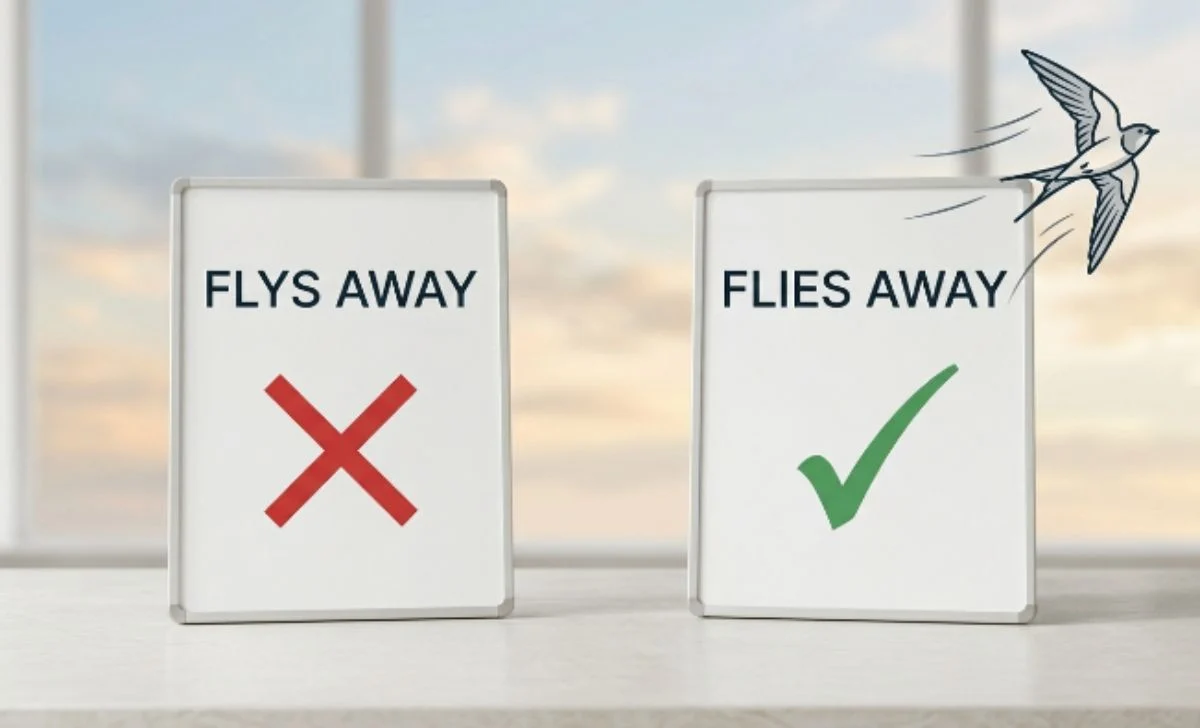
Is it flies away or flys away? If you are describing something that moves through the air and leaves, the correct phrase is flies away.
Flys away is not the standard spelling in modern English. The confusion comes from the spelling rule for verbs ending in -y. When fly changes to the third-person singular form, the y changes to -ies.
So:
fly → flies
And:
flies away ✅
flys away ❌
This rule is simple once you know when English changes y to i.
Quick Answer
Flies away is correct.
Flys away is incorrect in standard English.
| Form | Correct? | Example |
|---|---|---|
| flies away | Yes | The bird flies away. |
| flys away | No | ❌ The bird flys away. |
| fly away | Yes | Birds fly away. |
The key is the subject.
The bird flies away.
But:
The birds fly away.
What Does “Flies Away” Mean?
Flies away means that a person, bird, insect, aircraft, or other flying object moves through the air and goes away from a place.
Examples:
The bird flies away when I open the door.
A butterfly flies away from the flower.
The plane flies away into the clouds.
The phrase can also be used figuratively.
Time flies away when you’re having fun.
Here, flies away does not mean that time literally flies. It means that time seems to pass very quickly.
Why Is “Flies” Correct?
The base verb is:
fly
When the subject is he, she, it, or another singular noun, English normally changes the verb to its third-person singular form:
fly → flies
This happens because fly ends in a consonant + y.
The y changes to i, and -es is added:
fly → fl + ies → flies
The same pattern appears in other verbs:
- cry → cries
- try → tries
- carry → carries
- hurry → hurries
- study → studies
So:
The bird flies away.
not:
❌ The bird flys away.
When Do You Use “Fly Away”?
Fly away is the base form and is correct with certain subjects and grammatical structures.
With plural subjects
The birds fly away every morning.
After modal verbs
The birds may fly away.
They will fly away soon.
After “to”
The birds want to fly away.
In commands
Fly away before the storm arrives.
So fly away and flies away are both correct phrases. They simply appear in different grammatical situations.
Flies Away vs Fly Away
| Phrase | When to use it | Example |
|---|---|---|
| flies away | Third-person singular present | The eagle flies away. |
| fly away | Base form/plural subjects | The eagles fly away. |
| flew away | Simple past | The eagle flew away. |
| flying away | Present participle | The eagle is flying away. |
This distinction is more important than simply memorizing that flys is wrong.
Pronunciation
Flies and fly’s may look different in writing, but flies is pronounced:
flyz
IPA:
/flaɪz/
Flies away sounds like:
flyz uh-WAY
The plural noun flies is also pronounced /flaɪz/, although its meaning comes from context.
Singular and Plural Forms
The word flies can be confusing because it has several grammatical roles.
Fly as a verb
Singular third-person:
The bird flies away.
Plural subject:
The birds fly away.
Fly as a noun
Singular:
I saw a fly.
Plural:
I saw several flies.
Notice that flies can therefore mean either:
- the third-person singular form of fly, or
- the plural of the noun fly.
Context tells you which meaning is intended.
American and British English
There is no American-British spelling difference here.
Both American and British English use:
fly → flies
and:
fly away → flies away
| English variety | Correct form |
|---|---|
| American English | flies away |
| British English | flies away |
| Canadian English | flies away |
| Australian English | flies away |
Flys away is not the standard spelling in either variety.
The Grammar Rule Behind “Flies”
A useful spelling rule is:
Consonant + y → change y to i and add -es
When a verb ends in a consonant followed by y, the third-person singular form usually changes y to i and adds -es.
Examples:
fly → flies
try → tries
cry → cries
study → studies
carry → carries
But there is an important exception.
Vowel + y → simply add -s
If the letter before y is a vowel, the y usually stays.
Examples:
play → plays
enjoy → enjoys
stay → stays
So:
The child plays outside.
not:
❌ The child plaies outside.
This explains why flies, not flys, is correct.
Everyday Examples
Birds
The bird flies away when it hears a loud noise.
Insects
The butterfly flies away before I can take a picture.
Planes
The airplane flies away into the distance.
Balloons
The balloon flies away in the wind.
Figurative meaning
My worries fly away when I listen to music.
The afternoon flies away when I’m busy.
Common Mistakes
Mistake 1: Writing “flys away”
❌ The bird flys away.
✅ The bird flies away.
Mistake 2: Using “flies” with a plural subject
❌ The birds flies away.
✅ The birds fly away.
Mistake 3: Using “flies” after a modal
❌ The bird will flies away.
✅ The bird will fly away.
After will, use the base form fly.
Mistake 4: Using “flies” after “to”
❌ The bird wants to flies away.
✅ The bird wants to fly away.
Mistake 5: Confusing flies the verb with flies the noun
The bird flies away.
Here, flies is a verb.
There are many flies in the kitchen.
Here, flies is the plural noun.
A Simple Memory Trick
Remember:
FLY + HE/SHE/IT = FLIES
Think of the spelling pattern:
cry → cries
try → tries
fly → flies
If the verb ends in consonant + y, the y changes to ies.
So:
flys ❌
flies ✅
A quick rule:
“Consonant + Y? Change Y to I.”
Practice Exercise
Choose fly, flies, or flys.
1.
The bird _____ away every morning.
2.
The birds _____ away when the storm begins.
3.
The butterfly may _____ away.
4.
She watches the plane _____ away.
5.
The eagle _____ over the mountains.
6.
He wants to _____ away from the city.
Answers
- flies
- fly
- fly
- fly
- flies
- fly
Google People Also Ask
Is it flies away or flys away?
Flies away is correct. Flys away is not the standard spelling.
Why is it flies and not flys?
Because fly ends in a consonant + y. In the third-person singular form, the y changes to i and -es is added: fly → flies.
Is “fly away” correct?
Yes. Fly away is the base form and is correct with plural subjects, modal verbs, infinitives, and commands.
What is the past tense of fly away?
The past tense is flew away.
The bird flew away yesterday.
What is the present participle of fly?
The present participle is flying.
The bird is flying away.
Is flys a word?
Flys is not the standard third-person singular form of the verb fly. In ordinary English, use flies.
Is flies a verb or noun?
It can be either. Flies is the third-person singular form of fly, and it is also the plural of the noun fly.
FAQs
Which is correct: flies away or flys away?
Flies away is correct.
Is “the bird flys away” correct?
No.
Correct:
The bird flies away.
Is “the birds flies away” correct?
No. Because birds is plural, use the base form:
The birds fly away.
Is “will flies away” correct?
No. After will, use the base verb:
It will fly away.
Is “flies” singular or plural?
As a verb, flies is singular:
The bird flies.
As a noun, flies is plural:
Two flies landed on the table.
What is the difference between fly and flies?
Fly is the base form, while flies is the third-person singular present form.
Birds fly.
A bird flies.
What is the past tense of flies?
The past tense of fly is flew.
The bird flew away.
Conclusion
If you’re choosing between flies away and flys away, always use flies away for the third-person singular present tense.
❌ The bird flys away.
✅ The bird flies away.
But remember that fly away is also correct when the grammar calls for the base form:
The birds fly away.
The bird will fly away.
The bird wants to fly away.
The key spelling rule is simple:
consonant + y → ies
So:
fly → flies
Once you remember that pattern, flies away becomes easy to spell correctly.
Read More:

Hi, I’m Safdar Ali, an English language teacher with 26 years of teaching experience. My expertise is in English linguistics, grammar, and the differences between British and American English.
Through Gramiffy, I share practical, research-based guides to help students, writers, and English learners improve their language skills. My goal is to make English simple, accurate, and easy for everyone to understand.