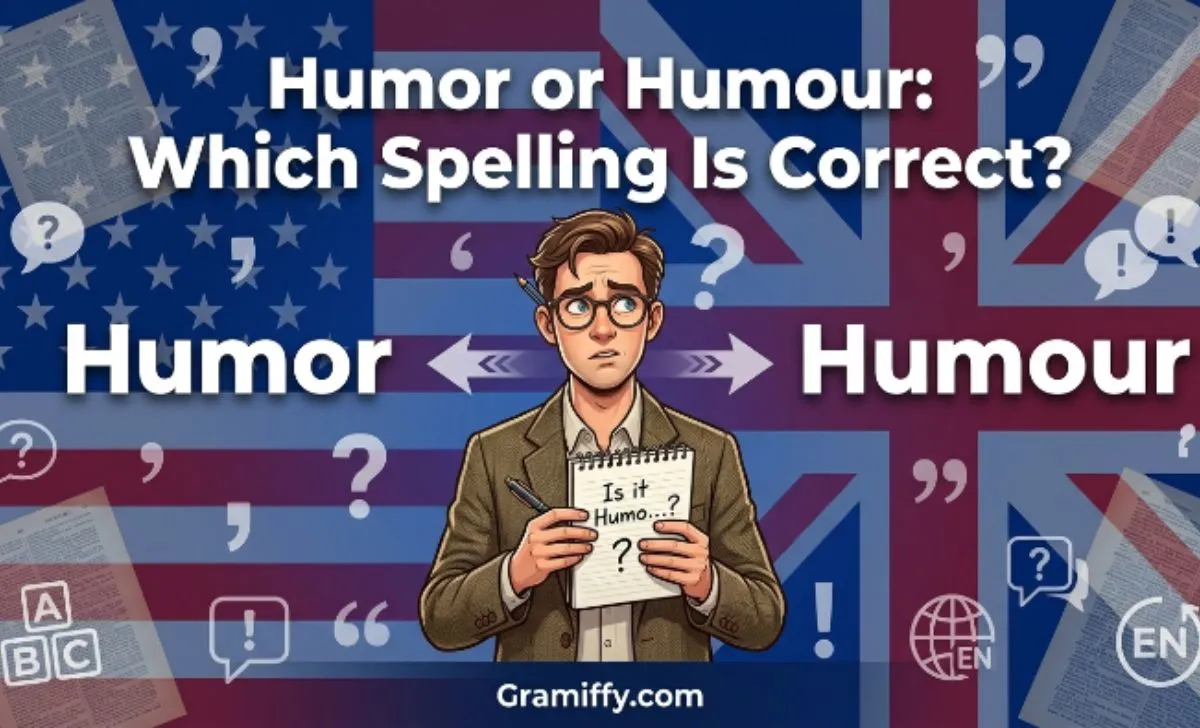
Have you ever typed humor and then wondered whether it should actually be humour?
This is one of the most searched spelling questions in the English language. Students, writers, bloggers, business professionals, and English learners often see both spellings online and become unsure which one is correct.
The confusion happens because English has different spelling standards across countries. In the United States, the word is usually written as humor. In the United Kingdom and many Commonwealth countries, it is written as humour.
Because both versions appear in books, newspapers, dictionaries, websites, and social media posts, many people search for answers before publishing content or submitting academic work.
The good news is simple: both spellings are correct. The difference depends on whether you are following American English or British English conventions.
In this guide, you’ll learn the exact difference between humor and humour, their history, regional usage, examples, grammar rules, dictionary preferences, and which spelling is best for your audience.
Quick Answer
Humor and humour have the same meaning.
The only difference is the spelling.
| Spelling | English Version |
|---|---|
| Humor | American English |
| Humour | British English |
Examples
American English:
- Her sense of humor makes everyone laugh.
- The article uses clever humor.
British English:
- Her sense of humour makes everyone laugh.
- The article uses clever humour.
There is no difference in pronunciation or meaning.
The Origin of Humor or Humour
The word comes from the Latin word humor, meaning moisture or fluid.
Ancient physicians believed the human body contained four fluids, known as the four humors, that controlled emotions and personality.
These four humors were:
- Blood
- Phlegm
- Yellow bile
- Black bile
Over time, the word evolved from describing bodily fluids to describing a person’s mood, temperament, and eventually something amusing or funny.
During the development of modern English, Britain preserved the spelling humour.
Later, American lexicographer Noah Webster promoted simplified spellings in American English. His spelling reforms influenced words such as:
- Colour → Color
- Honour → Honor
- Labour → Labor
- Humour → Humor
This is why both spellings exist today.
British English vs American English Spelling
The difference between humor and humour follows a larger spelling pattern found throughout English.
Common British and American Variations
| British English | American English |
|---|---|
| Humour | Humor |
| Colour | Color |
| Honour | Honor |
| Favourite | Favorite |
| Labour | Labor |
| Neighbour | Neighbor |
| Behaviour | Behavior |
Why Are They Different?
British English generally keeps the traditional -our ending.
American English often removes the letter u to create shorter spellings.
These changes became widely accepted after dictionaries such as the Merriam-Webster Dictionary adopted American spelling conventions.
Meanwhile, British publishers and the Oxford English Dictionary continued using traditional spellings.
Humor vs Humour: Side-by-Side Comparison
| Feature | Humor | Humour |
|---|---|---|
| Meaning | Funny quality | Funny quality |
| Correct Spelling | Yes | Yes |
| American English | Standard | Less common |
| British English | Less common | Standard |
| Canadian English | Sometimes used | More common |
| Australian English | Rare | Common |
| New Zealand English | Rare | Common |
| Formal Writing | Accepted | Accepted |
| Academic Writing | Accepted in US | Accepted in UK |
Which Spelling Should You Use?
The best spelling depends entirely on your audience.
Use Humor If:
- Your readers are in the United States.
- You follow American style guides.
- You publish on US-focused websites.
- You write for American businesses.
Example
“The author’s humor makes the book enjoyable.”
Use Humour If:
- Your readers are in the United Kingdom.
- Your audience is in Canada.
- Your audience is in Australia.
- Your audience is in New Zealand.
- You follow British English standards.
Exaple
“The author’s humour makes the book enjoyable.”
For Global Audiences
Choose one spelling and use it consistently.
Google does not penalize either spelling. However, consistency improves readability and professionalism.
Humor or Humour in Major Dictionaries
Leading dictionaries recognize both spellings.
| Dictionary | Preferred Form |
|---|---|
| Merriam-Webster | Humor |
| American Heritage Dictionary | Humor |
| Oxford English Dictionary | Humour |
| Cambridge Dictionary | Humor & Humour |
| Collins Dictionary | Humor & Humour |
This confirms that neither spelling is incorrect.
Common Mistakes with Humor or Humour
Many writers make avoidable errors.
Mistake #1: Mixing Spellings
❌ The article discusses humor and British humour.
✅ The article discusses humor.
✅ The article discusses humour.
Mistake #2: Assuming One Is Wrong
❌ Humour is incorrect.
✅ Humour is the British spelling.
Mistake #3: Using the Wrong Regional Style
A UK publication should generally use humour.
A US publication should generally use humor.
Mistake #4: Ignoring Style Guide Requirements
Academic institutions, publishers, and businesses often require a specific English style.
Always check their guidelines before publishing.
Humor or Humour in Everyday Examples
In Emails
American:
“I enjoyed your sense of humor during the meeting.”
British:
“I enjoyed your sense of humour during the meeting.”
In Social Media Posts
American:
“Your humor made my day!”
British:
“Your humour made my day!”
In News Articles
American:
“The comedian is known for sharp humor.”
British:
“The comedian is known for sharp humour.”
In Academic Writing
American:
“Researchers examined the role of humor in communication.”
British:
“Researchers examined the role of humour in communication.”
Humor or Humour in Literature and Media
Writers around the world use both spellings based on regional conventions.
American newspapers, magazines, and websites overwhelmingly prefer humor.
British newspapers and publishers overwhelmingly prefer humour.
The spelling choice reflects editorial style rather than meaning.
Humor or Humour – Google Trends & Global Usage
Search behavior shows clear geographic preferences.
| Country | Preferred Search |
|---|---|
| United States | Humor |
| United Kingdom | Humour |
| Canada | Humour |
| Australia | Humour |
| New Zealand | Humour |
| International Audience | Mixed |
Key Trend
- Humor dominates US searches.
- Humour dominates UK searches.
- Both receive significant monthly search volume.
- Both spellings are understood globally.
FAQs
Is humor or humour correct?
Both are correct. Humor is American English, while humour is British English.
What is the difference between humor and humour?
There is no difference in meaning. The only difference is regional spelling.
Is humour wrong in America?
No. Americans understand it, but humor is preferred.
Is humor wrong in the UK?
No. British readers understand it, but humour is the standard spelling.
Which spelling should I use in academic writing?
Follow the style guide required by your institution or publisher.
Why did Americans remove the letter U?
American spelling reforms promoted simpler spellings for many words ending in -our.
Does Google prefer humor or humour?
No. Google ranks content based on quality, relevance, and user intent, not on whether you use humor or humour.
Conclusion
The answer to humor or humour is surprisingly simple: both spellings are correct. The choice depends on your audience and the version of English you follow.
Use humor when writing for American readers and humour when writing for audiences in the United Kingdom, Canada, Australia, New Zealand, and other Commonwealth countries. The meaning, pronunciation, and grammar remain exactly the same.
Understanding this distinction helps writers maintain consistency, follow style guides, and communicate more professionally. It also prevents one of the most common spelling mistakes seen in international content.
Whether you choose humor or humour, remember that neither spelling is better than the other. The right choice is the one that matches your audience’s expectations.
By following the guidance in this article, you can confidently use the correct spelling every time and avoid confusion in both formal and informal writing.
Read More Blogs :

I am Constance Hale, an, editor, and writing expert dedicated to helping people write with clarity and confidence. Through my articles on Gramiffy.com, I simplify grammar, spelling, and language usage for readers of all levels. My goal is to make English writing more engaging, accurate, and enjoyable.