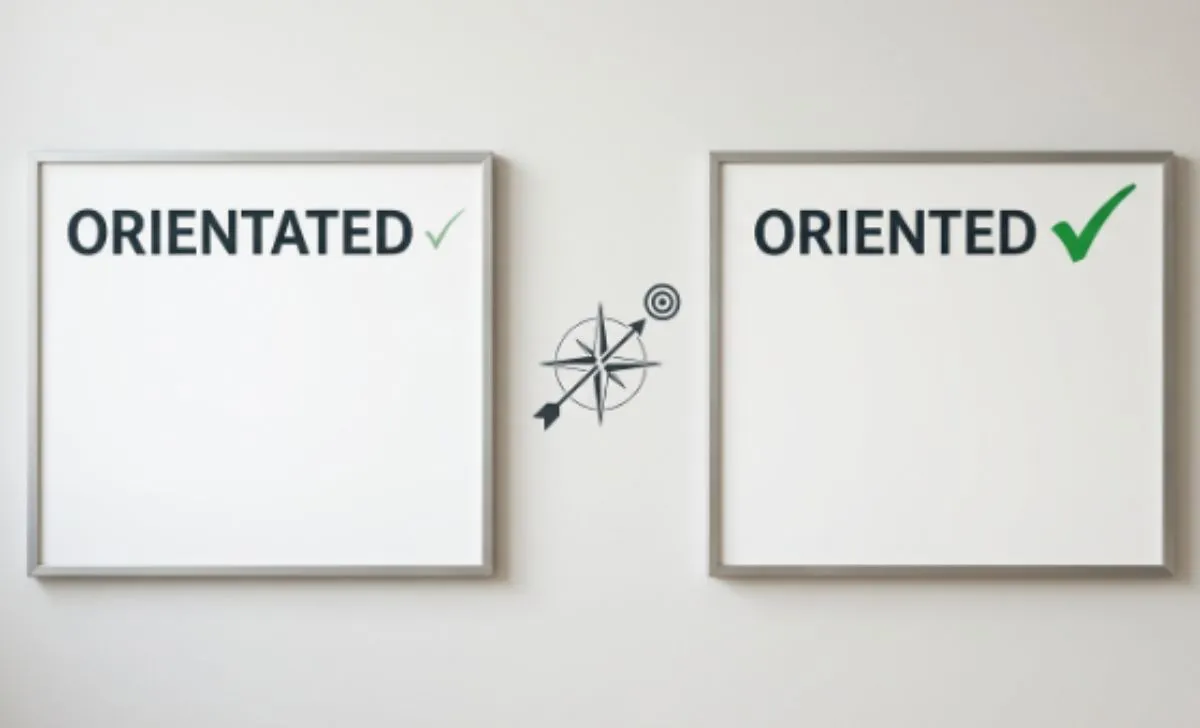
Orientated and oriented are both real English words, but their use depends partly on regional English and context. That is what makes this pair more confusing than it first appears.
In American English, oriented is overwhelmingly the more common choice. In British English, orientated is also standard and remains widely used, although oriented is perfectly acceptable there too.
So the simple answer is:
Oriented = correct and widely preferred, especially in American English
Orientated = also correct, especially common in British English
Neither spelling is simply a mistake.
The Short Answer: Orientated or Oriented?
Use oriented when you want the most widely accepted and internationally familiar form.
Use orientated when following British English usage or when it fits the style of your organization or publication.
| Word | Correct? | Common usage | Example |
|---|---|---|---|
| oriented | Yes | Very common in American English and widely used elsewhere | The program is oriented toward beginners. |
| orientated | Yes | Particularly common in British English | The course is orientated toward practical skills. |
Which one should you choose?
For general online writing, business content, academic writing, and international audiences, oriented is usually the safer choice.
What Does Oriented Mean?
Oriented is the past tense and past participle of orient.
It can mean directed toward something, positioned in a particular direction, or focused on a particular goal, person, or activity.
Examples:
- The building is oriented toward the river.
- The course is oriented toward practical skills.
- She is strongly oriented toward customer service.
- The company is customer-oriented.
The word can describe both physical direction and a figurative focus.
Physical direction
The windows are oriented toward the south.
Here, oriented means positioned in a particular direction.
Focus or purpose
The program is oriented toward young professionals.
Here, it means designed or focused toward a particular group.
What Does Orientated Mean?
Orientated has essentially the same meaning as oriented.
It is the regular -ed form of orientate, a verb that developed from orient.
Examples:
- The training is orientated toward new employees.
- The building is orientated toward the coast.
- The project is orientated toward improving efficiency.
The word is particularly familiar in British English.
So if you see orientated in British writing, it is not automatically a spelling error.
Why Are There Two Forms?
The confusion comes from two verbs:
orient → oriented
and
orientate → orientated
Both verbs exist.
Orient is the older and more widely used verb internationally. Orientate developed later, especially in British English.
This means both forms have a legitimate place in English.
The important point is that orientated is not simply a misspelling of oriented.
Orientated vs Oriented at a Glance
| Feature | Oriented | Orientated |
|---|---|---|
| Base verb | orient | orientate |
| Form | oriented | orientated |
| Correct English? | Yes | Yes |
| American English | Very common | Less common |
| British English | Common | Common |
| Meaning | Directed/focused | Directed/focused |
| Best general choice | Yes | Depends on style |
| Hyphenated form | customer-oriented | customer-orientated |
The meaning is usually identical. The main difference is usage preference.
American vs British English
This is where the distinction becomes most useful.
American English
Oriented is strongly preferred.
For example:
The company is customer-oriented.
The course is career-oriented.
The research is solution-oriented.
Orientated exists, but it is much less common in American usage.
British English
Both oriented and orientated are accepted.
For example:
The training is customer-oriented.
or:
The training is customer-orientated.
British writers may use orientated more often than American writers.
Comparison
| Phrase | American English | British English |
|---|---|---|
| oriented | Very common | Common |
| orientated | Less common | Common |
| customer-oriented | Preferred | Common |
| customer-orientated | Less common | Common |
| goal-oriented | Preferred | Common |
| goal-orientated | Less common | Common |
If your website targets a global audience, oriented is generally the cleaner choice.
Oriented or Orientated in Formal Writing?
For formal writing, oriented is often the better option because it is concise, widely recognized, and common across different varieties of English.
For example:
The study is oriented toward identifying practical solutions.
This sounds natural in academic and professional writing.
You can also write:
The study is orientated toward identifying practical solutions.
That is grammatically valid, particularly in British English.
The choice is therefore more about style and regional convention than correctness.
Which One Is More Common?
Oriented is considerably more common overall, particularly in American English and international business English.
You will frequently see compounds such as:
- customer-oriented
- results-oriented
- goal-oriented
- solution-oriented
- detail-oriented
- career-oriented
- research-oriented
- service-oriented
These forms are especially common in business, technology, education, marketing, and professional writing.
Orientated is more strongly associated with British usage.
Common Expressions With Oriented
Customer-oriented
We are a customer-oriented company.
Meaning: focused on customers’ needs.
Goal-oriented
She is highly goal-oriented.
Meaning: focused on achieving goals.
Results-oriented
The organization takes a results-oriented approach.
Meaning: focused on producing results.
Detail-oriented
He is extremely detail-oriented.
Meaning: careful about small details.
Career-oriented
The program is designed for career-oriented students.
Meaning: focused on career development.
Solution-oriented
We need a more solution-oriented approach.
Meaning: focused on finding solutions.
These expressions strongly favor oriented in general international usage.
Grammar: How to Use Oriented Correctly
Oriented can function as a verb form or adjective.
As a verb form
The engineer oriented the antenna toward the satellite.
Here, oriented is the past tense of orient.
As an adjective
The program is oriented toward practical training.
Here, oriented describes the program.
Common structure
oriented toward + noun/gerund
The course is oriented toward professional development.
The research is oriented toward finding new treatments.
You may also see:
oriented to
The system is oriented to customer needs.
Both structures occur, although oriented toward is especially common in American English.
How to Use Orientated in a Sentence
Orientated works in the same general grammatical positions.
Examples
1
The course is orientated toward practical skills.
2
The building was orientated toward the sea.
3
The organization is orientated toward long-term growth.
These sentences are grammatically acceptable.
However, if your audience expects American English, oriented will generally sound more natural.
Real-Life Examples
Business
Oriented:
Our company is customer-oriented.
Orientated:
Our company is customer-orientated.
Both are possible, but the first is more internationally familiar.
Education
The program is oriented toward practical learning.
British alternative:
The program is orientated toward practical learning.
Technology
The platform is user-oriented.
You may also encounter:
The platform is user-orientated.
Workplace
We are looking for a results-oriented employee.
British English can also use:
We are looking for a results-orientated employee.
Physical direction
The house is oriented toward the mountains.
British alternative:
The house is orientated toward the mountains.
Oriented vs Orientated in Job Descriptions
This distinction appears frequently in professional writing.
You will often see:
- customer-oriented
- team-oriented
- detail-oriented
- results-oriented
- goal-oriented
- service-oriented
For a job advertisement aimed at an international or American audience, oriented is usually the better choice.
For example:
We are seeking a detail-oriented marketing specialist.
This is more natural than:
We are seeking a detail-orientated marketing specialist.
The second is not necessarily wrong, but it may sound more distinctly British.
Word Origin
The word orient comes from Latin oriens, meaning rising, particularly referring to the rising sun in the east.
From this idea, orient became associated with determining direction and later with helping someone understand their position or surroundings.
The verb orientate developed later as an extended form of orient, especially in British English.
This explains why both forms exist today.
The underlying idea remains the same:
orient = determine direction or position
From there, the figurative meaning developed:
oriented toward a goal = directed or focused toward that goal
Is Orientated a British Word?
Yes.
Orientated is a standard word in British English and is not inherently incorrect.
For example:
The course is orientated toward professional development.
A British writer can use this form naturally.
However, oriented is also standard British English, so British writers are not required to use orientated.
Is Oriented More Correct Than Orientated?
Not exactly.
Oriented is more common and often preferred, particularly in American English.
Orientated is also a legitimate form, particularly in British English.
Therefore:
oriented = correct
orientated = also correct
Calling orientated simply “wrong” would be inaccurate.
Common Mistakes
Mistake 1: Calling orientated incorrect
❌ Orientated is always wrong.
That is not true.
It is a legitimate form, especially in British English.
Mistake 2: Assuming they have different meanings
In most contexts:
oriented = orientated
They usually mean directed toward or focused on something.
Mistake 3: Mixing regional styles
A writer may use:
customer-orientated
and then consistently use strongly American vocabulary elsewhere.
This is not grammatically wrong, but maintaining one variety of English can make professional content more consistent.
Mistake 4: Using “orientated” when “oriented” sounds more natural
For an American or global audience:
customer-oriented
usually sounds more natural than:
customer-orientated
Synonyms for Oriented and Orientated
Because the two forms usually have the same meaning, they share similar synonyms.
Depending on context:
- directed
- focused
- aimed
- targeted
- aligned
- positioned
- adjusted
- geared
- centered
- designed
Examples:
The course is oriented toward beginners.
→ The course is designed for beginners.
The company is customer-oriented.
→ The company is customer-focused.
Antonyms
Possible opposites depend on context.
For oriented toward a goal:
- unfocused
- directionless
- aimless
- misaligned
- disorganized
For physically oriented:
- misaligned
- incorrectly positioned
- misdirected
There is no single universal antonym because oriented has several meanings.
A Simple Memory Trick
Remember:
ORIENTED = the shorter, more universal choice
If you are unsure which form to use, especially for:
- American English
- international websites
- business writing
- academic writing
- SEO content
- professional communication
choose oriented.
One more trick
Think:
orient → oriented
It follows the familiar verb pattern directly.
orientate → orientated
is the alternative British form.
Practice Exercise
Choose oriented or orientated.
1.
The company is customer-_____.
2.
The course is _____ toward practical skills.
3.
The building was _____ toward the south.
4.
She is highly goal-_____.
5.
The British training program was _____ toward new employees.
Answers
- oriented / orientated
- oriented / orientated
- oriented / orientated
- oriented / orientated
- oriented / orientated
Both forms can be grammatically correct. The best choice depends mainly on regional preference and style.
People Also Ask
Is it oriented or orientated?
Both are correct. Oriented is more common, especially in American English, while orientated is particularly common in British English.
Is orientated grammatically correct?
Yes. Orientated is a legitimate English word and is widely used in British English.
Is oriented more common than orientated?
Yes. Oriented is generally more common, particularly in American English and international professional writing.
Which is better: customer-oriented or customer-orientated?
Both are correct. Customer-oriented is generally the safer choice for American and international audiences.
Is orientated British or American?
Orientated is especially associated with British English. American English strongly favors oriented.
What is the difference between oriented and orientated?
There is usually no meaningful difference in meaning. Both can mean directed, positioned, or focused toward something.
Is “goal orientated” correct?
Yes, particularly in British English. Goal-oriented is more common internationally and especially in American English.
Should I use oriented in academic writing?
Generally, yes, especially if you are writing for an international or American audience. But orientated is also acceptable in British academic English.
FAQs
Can I use orientated in American English?
You can, but it is much less common. Oriented is the normal choice in American English.
Can British English use oriented?
Absolutely. Oriented is fully acceptable in British English.
Does orientated mean something different from oriented?
Usually, no. The two forms generally have the same meaning.
Is “oriented towards” correct?
Yes.
The program is oriented towards young professionals.
Oriented toward is also common, especially in American English.
Is “oriented to” correct?
Yes.
The software is oriented to the needs of small businesses.
However, oriented toward is often more natural when describing direction or focus.
Is customer-orientated wrong?
No. It is a legitimate form, particularly in British English.
Is detail-orientated correct?
Yes. Detail-orientated is accepted, especially in British usage. Detail-oriented is more common internationally.
Which form should an SEO writer use?
For a broad international audience, oriented is generally the safest and most familiar choice. If the content specifically targets British English, orientated can be used naturally.
Final Thoughts
Orientated and oriented are both correct.
The difference is mainly one of usage and regional preference, not meaning.
Oriented — more common, especially in American English and international writing.
Orientated — also correct, particularly common in British English.
If you are writing for a global audience and want the form most readers will recognize immediately, choose oriented.
Customer-oriented.
Goal-oriented.
Results-oriented.
Detail-oriented.
But if you’re following British English conventions, customer-orientated, goal-orientated, and results-orientated are perfectly acceptable.
Read More:

Hi, I’m Safdar Ali, an English language teacher with 26 years of teaching experience. My expertise is in English linguistics, grammar, and the differences between British and American English.
Through Gramiffy, I share practical, research-based guides to help students, writers, and English learners improve their language skills. My goal is to make English simple, accurate, and easy for everyone to understand.