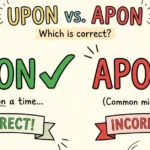
You are writing an email and type, “Apon arrival, please call me.” Something looks wrong, but both spellings sound almost identical. So, should you write upon or apon?
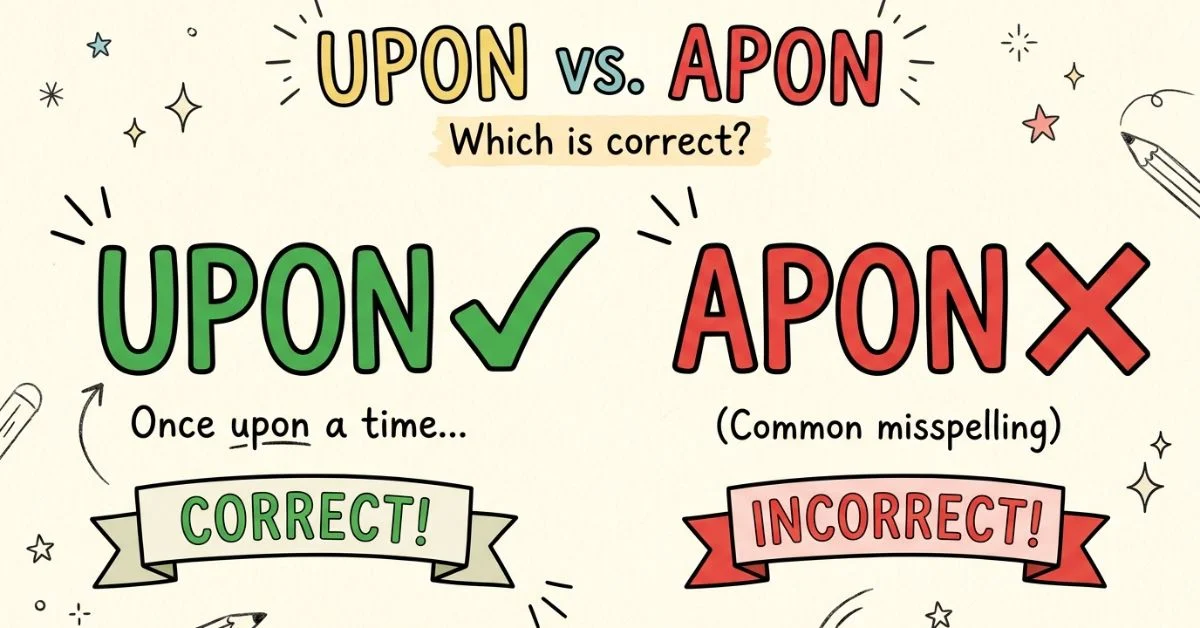
The correct spelling in modern standard English is upon. It is a preposition that can mean on, after, or when something happens, depending on the sentence.
Apon is not the standard spelling of this English word, although similar forms may appear in historical texts or as names. Here is how to use upon correctly and avoid common mistakes.
Upon or Apon: Which Is Correct?
Upon is the correct spelling in modern standard English. Apon is generally a misspelling when someone intends to write the English preposition upon.
| Word | Correct in modern English? | Usage |
|---|---|---|
| Upon | Yes | The package arrived upon request. |
| Apon | No, not as the standard preposition | Write “upon request,” not “apon request.” |
The confusion often comes from pronunciation. The first syllable of upon is unstressed, so its vowel may sound similar to a short “uh.” When people spell words based on how they sound, they may mistakenly choose a instead of u.
For example:
- Incorrect: Apon arrival, please check in at reception.
- Correct: Upon arrival, please check in at reception.
The same rule applies to emails, school assignments, business reports, applications, and everyday writing.
What Does Upon Mean?
Upon is a preposition with several related meanings. Depending on the context, it can describe physical position, the time an event happens, or the basis on which someone acts.
Upon meaning “on”
When describing where something rests, upon can mean the same as on.
Examples:
- The keys were lying upon the kitchen counter.
- A thin layer of dust settled upon the old books.
- The child placed her backpack upon the bench.
In everyday conversation, on would usually sound more natural. Upon often gives a sentence a more formal or literary tone.
Upon meaning “after” or “when”
Upon can indicate that something happens immediately after another event or when a particular event occurs.
Examples:
- Upon arrival, please collect your room key.
- Upon receiving the payment, we will dispatch your order.
- Upon finishing her exam, Maya called her parents.
You can often rewrite these sentences using when or after.
For example, “Upon receiving the payment” means “After receiving the payment.” The exact wording depends on the context.
Upon meaning “based on” or “in response to”
The word also appears when an action depends on something or responds to it.
Examples:
- The manager acted upon the customer’s complaint.
- Our decision depends upon the final budget.
- The committee based its recommendation upon the available evidence.
In many of these sentences, on can replace upon without changing the basic meaning.
Upon vs. On: What Is the Difference?
Upon and on overlap in meaning, but they do not always sound equally natural.
On is generally the simpler choice for everyday English. Upon is often more formal, traditional, or literary.
| Context | Example with upon | More conversational alternative |
|---|---|---|
| Physical position | The cup rested upon the shelf. | The cup rested on the shelf. |
| Arrival | Upon arrival, call me. | When you arrive, call me. |
| Receiving something | Upon receiving your email, I replied. | After receiving your email, I replied. |
| Dependence | The outcome depends upon the weather. | The outcome depends on the weather. |
| Formal instructions | Payment is due upon delivery. | Payment is due when the item is delivered. |
Some expressions have an established form that should not be changed casually.
For example, “once upon a time” is the familiar opening of a traditional story. “Once on a time” is not the standard expression.
The best approach is to choose upon when it fits the sentence naturally, especially in established phrases or formal writing. Do not use it simply to make every sentence sound more sophisticated.
Upon vs. Up On: Are They the Same?
No. Upon is one word, while up on is a two-word expression. They can describe different things, so the correct choice depends on how the words function in a sentence.
When to use upon
Use upon when it acts as a preposition meaning on, after, or when.
Examples:
- The decision was made upon careful review.
- Upon entering the room, he noticed the open window.
- The responsibility rests upon the team.
When to use up on
Use up on when up and on perform separate jobs in the sentence.
Examples:
- The cat climbed up on the kitchen counter.
- He walked up on the stage to accept his award.
- The children were already up on the roof when their father arrived.
A useful way to check is to look at the sentence’s meaning. If up describes movement or position separately from on, the two-word form may be appropriate.
Compare:
- The cat jumped upon the table.
- The cat climbed up on the table.
Both sentences can be grammatical, but the second emphasizes the upward movement.
Common Expressions That Use Upon
Many everyday and formal expressions contain upon. Learning them as complete phrases can help you use the word naturally.
| Expression | Meaning | Example |
|---|---|---|
| Once upon a time | At the beginning of a traditional story | Once upon a time, a farmer lived near a forest. |
| Upon arrival | When or after arriving | Upon arrival, show your identification. |
| Upon request | If someone asks for it | Receipts are available upon request. |
| Upon completion | When something is finished | You will receive a certificate upon completion. |
| Depend upon | Rely on someone or something | We depend upon our team for support. |
| Act upon | Take action based on something | The doctor acted upon the test results. |
| Frowned upon | Considered unacceptable or disapproved of | Cheating is frowned upon at school. |
| Upon us | Approaching or affecting us soon | Winter is almost upon us. |
| Come upon | Find or encounter unexpectedly | She came upon an old photograph in a drawer. |
| Based upon | Founded on something | The film is based upon a true story. |
Notice that upon does not always mean the physical position “on.” Its meaning changes with the expression. That is why learning common phrases can be more useful than memorizing one definition.
Is Apon Ever a Correct Word?
In modern standard English, apon is generally not accepted as an alternative spelling of upon. If you mean the preposition, write upon.
However, the broader question needs a little care. English spelling has changed over time, and older texts may contain historical spelling variants. In addition, Apon may appear as a personal name, place name, or term in another language.
These uses do not make apon the standard spelling of the modern English preposition.
For contemporary writing, the practical rule is simple:
- Use upon in ordinary English sentences.
- Preserve Apon when it is genuinely part of a person’s name, title, or other proper noun.
- When reading historical material, consider the period and context before judging an unfamiliar spelling.
This distinction avoids the misleading claim that the letter sequence apon can never occur anywhere.
Common Mistakes With Upon
A few recurring errors are easy to correct once you understand the word’s meaning.
Mistake 1: Writing apon instead of upon
Incorrect: Apon receiving your application, we will contact you.
Correct: Upon receiving your application, we will contact you.
Mistake 2: Using upon when on sounds more natural
Awkward: I left my phone upon the sofa before leaving for work.
More natural: I left my phone on the sofa before leaving for work.
The first sentence may be grammatically possible, but the second is more natural in everyday conversation.
Mistake 3: Confusing upon with up on
Incorrect for the intended meaning: The children climbed upon the roof, meaning they moved upward onto it.
Clearer: The children climbed up on the roof.
Upon may work in some contexts, but up on makes the movement more explicit in this example.
Mistake 4: Assuming upon always means on
In “upon arrival,” the word refers to the time of arrival. Replacing it with on may change the sentence or make it sound unnatural.
Understanding the whole phrase is more reliable than substituting words mechanically.
FAQs
Is it upon or apon?
Upon is the correct spelling of the English preposition in modern standard English. Apon is generally a spelling error when used in its place.
What does upon mean in simple English?
Upon can mean on, after, or when something happens. For example, “Upon arrival, call me” means “When you arrive, call me.”
Is apon an actual word?
Apon may appear in historical texts, names, or other language contexts. However, it is not the standard modern English spelling of the preposition upon.
Is upon the same as on?
Sometimes. Both can describe physical position or dependence, as in “on the table” and “upon the table.” However, upon also appears in expressions such as “once upon a time” and “upon arrival,” where replacing it with on does not work naturally.
What is the difference between upon and up on?
Upon is one word and functions as a preposition. Up on consists of two words that can describe upward movement or position, as in “The cat climbed up on the counter.”
Is upon too formal for everyday writing?
Not always, but upon often sounds more formal than on. In casual conversation, “Put the book on the table” sounds more natural than “Put the book upon the table.”
Is “upon arrival” correct?
Yes. Upon arrival means when or shortly after someone arrives. For example, “Upon arrival, please report to the front desk.”
Is “once apon a time” correct?
No. The standard expression is “once upon a time.” It is commonly used to begin fairy tales and traditional stories.
Should I write depend on or depend upon?
Both are correct in standard English. “Depend on” is more common in everyday conversation, while “depend upon” can sound more formal. Choose the version that fits your sentence and tone.
Final Answer:
The correct spelling is upon when you mean the modern English preposition. It can refer to position, timing, dependence, or an action that follows an event.
Apon is generally a misspelling in this context, although it may appear in historical material or as a proper name.
For everyday writing, remember three common examples: upon arrival, upon request, and once upon a time.
If you are unsure whether to use upon or on, choose the simpler word when both express the same meaning naturally.

I am Constance Hale, an, editor, and writing expert dedicated to helping people write with clarity and confidence. Through my articles on Gramiffy.com, I simplify grammar, spelling, and language usage for readers of all levels. My goal is to make English writing more engaging, accurate, and enjoyable.