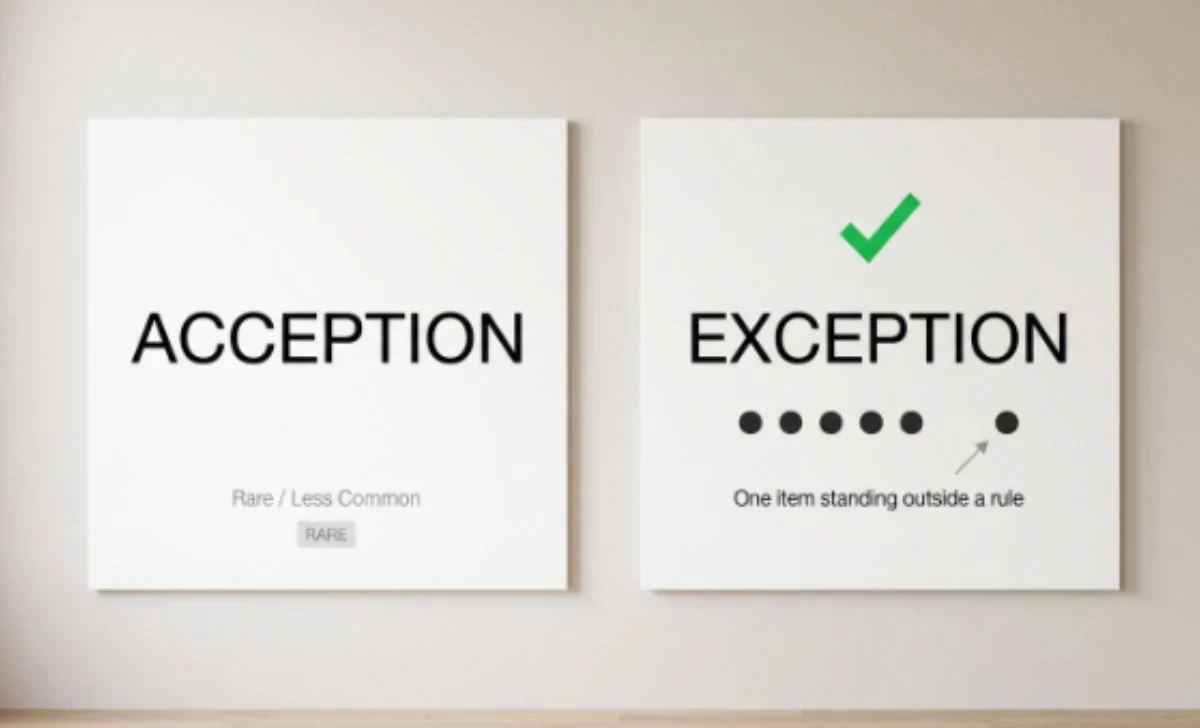
Acception and exception look similar, but they are not interchangeable. In modern English, exception is the word you will usually need.
It means something that does not follow a general rule, or a person or thing that is excluded from a statement or requirement.
Acception is a real but uncommon word. It has been used to mean acceptance, favorable reception, or the act of accepting, but it is rare in modern English and is usually not the word you want.
The practical rule is simple:
Exception = something excluded from a rule
Acception = a rare word related to acceptance
Quick Answer: Acception or Exception?
If you mean a case that does not follow a rule, use exception.
Everyone must attend, with one exception.
If you mean acceptance or favorable reception, acception can technically be used, but it is uncommon.
The proposal received favorable acception.
In ordinary modern writing, acceptance would sound much more natural in the second sentence.
| Word | Meaning | Common today? | Example |
|---|---|---|---|
| exception | Something excluded from a rule | Very common | There was one exception to the rule. |
| acception | Acceptance or favorable reception; also a specialized sense of taking a word in a particular meaning | Rare | The term has a different acception in this context. |
What Does Exception Mean?
Exception is a noun used when someone or something does not follow a general rule, statement, pattern, or requirement.
Examples:
- Everyone passed the test, with one exception.
- This rule has several exceptions.
- There are no exceptions to the policy.
- The law applies to everyone without exception.
Exception can also mean exclusion
Children under five are an exception to the admission rule.
This means children under five are excluded from the normal requirement.
Exception in everyday language
I usually drink tea, but today I’m making an exception.
The speaker normally follows one pattern but is doing something different this time.
What Does Acception Mean?
Acception is a legitimate English word, but it is rare in modern everyday English.
Historically and in specialized contexts, it can refer to:
- acceptance
- favorable reception
- the act of accepting something
- a particular sense or meaning in which a word is understood
For example:
The word has a different acception in legal writing.
However, most modern readers would find interpretation, meaning, or sense more natural here.
Similarly, if you mean general acceptance:
The proposal gained acceptance.
is much more natural than:
The proposal gained acception.
This is why acception can be technically correct but still be a poor word choice for normal writing.
Exception vs Acception: The Real Difference
The two words have different functions.
Exception
Think:
exception = outside the rule
Everyone is invited, with one exception.
Acception
Think:
acception = acceptance or a particular sense
The word has a different acception in this field.
For most everyday sentences, exception is the word you are looking for.
Exception vs Acception Comparison Table
| Feature | Exception | Acception |
|---|---|---|
| Part of speech | Noun | Noun |
| Main modern meaning | Something that does not follow a rule | Acceptance; specialized sense/meaning |
| Frequency | Very common | Rare |
| Everyday English | Yes | Usually no |
| Common phrase | an exception to the rule | rare/specialized usage |
| Related word | except | accept |
| Example | This is an exception. | The term has a different acception. |
A useful spelling clue is the first part:
accept → acception
except → exception
But be careful: the relationship is useful for remembering the spelling, not for assuming that acception is simply the noun form of accept in normal modern English. Acceptance is the usual noun.
Exception in a Sentence
Here are the most common ways to use exception.
An exception to the rule
There is one exception to the rule.
This is one of the most common expressions.
Make an exception
I normally don’t work weekends, but I’ll make an exception.
Without exception
All employees must follow the policy without exception.
With the exception of
Everyone attended with the exception of John.
This means John did not attend.
Take exception to
Take exception to means to object to something.
She took exception to his comments.
This is a more formal expression.
What Does “Exception to the Rule” Mean?
An exception to the rule is a situation that does not follow a general rule.
For example:
The store is open every day, with the exception of Sunday.
The general rule is that the store is open every day. Sunday does not follow that rule.
Another example:
Students must submit their assignments by Friday, with one exception for students with approved extensions.
The approved students are outside the normal requirement.
Acception vs Acceptance
This is an important distinction because people sometimes use acception when they actually mean acceptance.
Acceptance
Acceptance is the normal modern word for:
- approval
- willingness to receive something
- recognition
- agreement
- being accepted
Examples:
The plan received widespread acceptance.
She finally came to acceptance of the situation.
Acception
Acception is much rarer and has specialized or historical uses.
Therefore:
❌ The proposal received public acception.
✅ The proposal received public acceptance.
Unless you have a specific reason to use the rare term, choose acceptance.
Pronunciation
Exception
IPA: /ɪkˈsepʃən/
Approximate pronunciation:
ik-SEP-shun
Acception
IPA: /ækˈsepʃən/
Approximate pronunciation:
ak-SEP-shun
The words sound similar, but the first vowel differs.
American vs British English
There is no major American-British spelling difference between exception and acception.
Exception is standard in both American and British English.
Acception is also recognized in both, but its use is rare and specialized.
| Word | American English | British English |
|---|---|---|
| exception | ✓ Very common | ✓ Very common |
| acception | ✓ Rare | ✓ Rare |
| acceptance | ✓ Standard | ✓ Standard |
For everyday communication, academic writing, business content, and general web writing, exception or acceptance will usually be the appropriate choice.
Word Origin: Exception
Exception comes through Middle English and Old French from Latin exceptio, related to excipere, meaning “to take out” or “exclude.”
That origin fits the modern meaning perfectly:
exception = something taken out of a general rule
This is also connected to except.
For example:
Everyone came except Sarah.
Sarah was the exception.
Word Origin: Acception
Acception comes from Latin acceptio, related to accipere, meaning “to receive” or “accept.”
This explains its historical connection with acceptance.
The word has also developed specialized meanings in discussions of language and interpretation, where acception can refer to a particular sense in which a word or expression is understood.
That specialized use is one reason you may encounter acception in older, philosophical, theological, or linguistic texts.
Grammar Rules You Should Know
Use “exception” as a noun
This is an exception.
There are several exceptions.
Use “except” when excluding something
Everyone came except David.
Do not confuse:
except = excluding
exception = the thing or case excluded
Use “acceptance” for ordinary acceptance
The proposal received acceptance.
Not normally:
The proposal received acception.
“Exception to” is a common structure
an exception to the rule
an exception to the policy
an exception to the requirement
Common Mistakes
Mistake 1: Writing acception when you mean exception
❌ There is one acception to this rule.
✅ There is one exception to this rule.
Mistake 2: Using exception when you mean acceptance
❌ The new policy received widespread exception.
If you mean approval:
✅ The new policy received widespread acceptance.
Mistake 3: Confusing except and exception
❌ Everyone came exception John.
✅ Everyone came except John.
Mistake 4: Writing “acceptation” instead of “acceptance”
Acceptation is another real but uncommon word with specialized meanings. In normal modern English, acceptance is usually the natural choice.
Synonyms for Exception
Depending on context, synonyms include:
- exclusion
- deviation
- anomaly
- irregularity
- special case
- departure
- exemption
- qualification
Example:
This is an exception to the rule.
Possible alternatives:
This is a special case.
or:
This is an exemption from the rule.
These words are related but are not always interchangeable.
Exception vs exemption
An exception is something that does not follow a general rule.
An exemption is a formal release from a requirement or obligation.
The rule has an exception.
The student received an exemption from the requirement.
Synonyms for Acception
Because acception has several specialized meanings, the best synonym depends on context.
Possible alternatives include:
- acceptance
- reception
- approval
- interpretation
- sense
- meaning
- understanding
In modern general writing, however, one of these alternatives will usually be clearer than acception.
Antonyms
Exception
Depending on context:
- rule
- norm
- inclusion
- conformity
- standard
- regularity
Acception
Depending on the meaning:
- rejection
- refusal
- nonacceptance
If acception means a particular sense or interpretation, its opposite is context-dependent.
Everyday Examples
School
All students must wear the uniform, with no exceptions.
Work
Employees can work remotely, with a few exceptions.
Shopping
The discount applies to all products except gift cards.
Gift cards are an exception.
Personal conversation
I don’t usually eat dessert, but I’ll make an exception today.
Law
The statute contains several exceptions.
Language
The word has a different acception in this historical text.
The final example is specialized; sense or meaning would normally be clearer for a general audience.
A Simple Memory Trick
Here’s the easiest way to remember the spelling:
EXCEPTION → EXCEPT
Both start with EXC.
Think:
except → exception
If something is excepted from a rule, it is an exception.
ACCEPTANCE → ACCEPT
If you mean receiving or approving something, think:
accept → acceptance
This is much more useful in everyday English than acception.
The three-word shortcut
Except → exception
Accept → acceptance
Acception → rare/specialized
Practice Exercise
Choose exception, acception, or acceptance.
1.
Everyone must follow the rule without _____.
2.
The proposal received widespread public _____.
3.
There is one _____ to the policy.
4.
Everyone attended with the _____ of Mark.
5.
The term has a different _____ in this historical text.
6.
The new law contains several _____.
Answers
- exception
- acceptance
- exception
- exception
- acception
- exceptions
The key lesson is that acception can be correct in specialized contexts, but acceptance is normally the better modern word when you mean approval or being received favorably.
People Also Ask
Is it acception or exception?
Both are English words, but they have different meanings. Exception is common and means something excluded from a rule. Acception is rare and usually relates to acceptance or a particular sense of a word.
Which is correct: acception or exception to the rule?
The correct phrase is:
exception to the rule
There is an exception to the rule.
Is acception a real word?
Yes. Acception is a real but uncommon word with historical and specialized meanings.
Is acception the same as acceptance?
Not exactly. Acceptance is the normal modern word for approval or willingness to receive something. Acception is rare and can have specialized meanings.
What is the difference between accept and except?
Accept means to receive, agree to, or approve something.
Except means to exclude something.
I accept your offer.
Everyone came except John.
What is the noun form of except?
The noun is exception.
There is an exception to the rule.
What is the noun form of accept?
The usual noun is acceptance.
The proposal received acceptance.
Can I use acception in formal writing?
You can when the specialized meaning is genuinely intended. Otherwise, acceptance, meaning, or sense will usually be clearer.
FAQs
Is “exception” always related to rules?
No. Exception can also refer to something unusual or excluded from a general statement.
He is an exception to the usual pattern.
What does “with the exception of” mean?
It means excluding a particular person or thing.
Everyone attended with the exception of Sarah.
This means Sarah did not attend.
What does “make an exception” mean?
It means to temporarily allow something that would normally not be allowed.
I don’t normally work weekends, but I’ll make an exception.
What does “take exception to” mean?
It means to object to or be offended by something.
She took exception to his remarks.
Is “exception” a noun or adjective?
Exception is a noun.
This is an exception.
Is “acception” commonly used?
No. It is uncommon in modern everyday English. Most writers should use acceptance, meaning, or sense, depending on the intended meaning.
Final Verdict
If you’re deciding between acception and exception, the context matters.
When something is excluded from a rule or is different from the general case:
This is an exception to the rule.
Use acceptance when you mean approval or receiving something favorably:
The proposal gained widespread acceptance.
Use acception only when its rare or specialized meaning is specifically intended.
The easiest memory rule is:
EXCEPT → EXCEPTION
ACCEPT → ACCEPTANCE
ACCEPTION → RARE/SPECIALIZED
For everyday English, exception is the word you are most likely looking for.
Read More:

Hi, I’m Safdar Ali, an English language teacher with 26 years of teaching experience. My expertise is in English linguistics, grammar, and the differences between British and American English.
Through Gramiffy, I share practical, research-based guides to help students, writers, and English learners improve their language skills. My goal is to make English simple, accurate, and easy for everyone to understand.