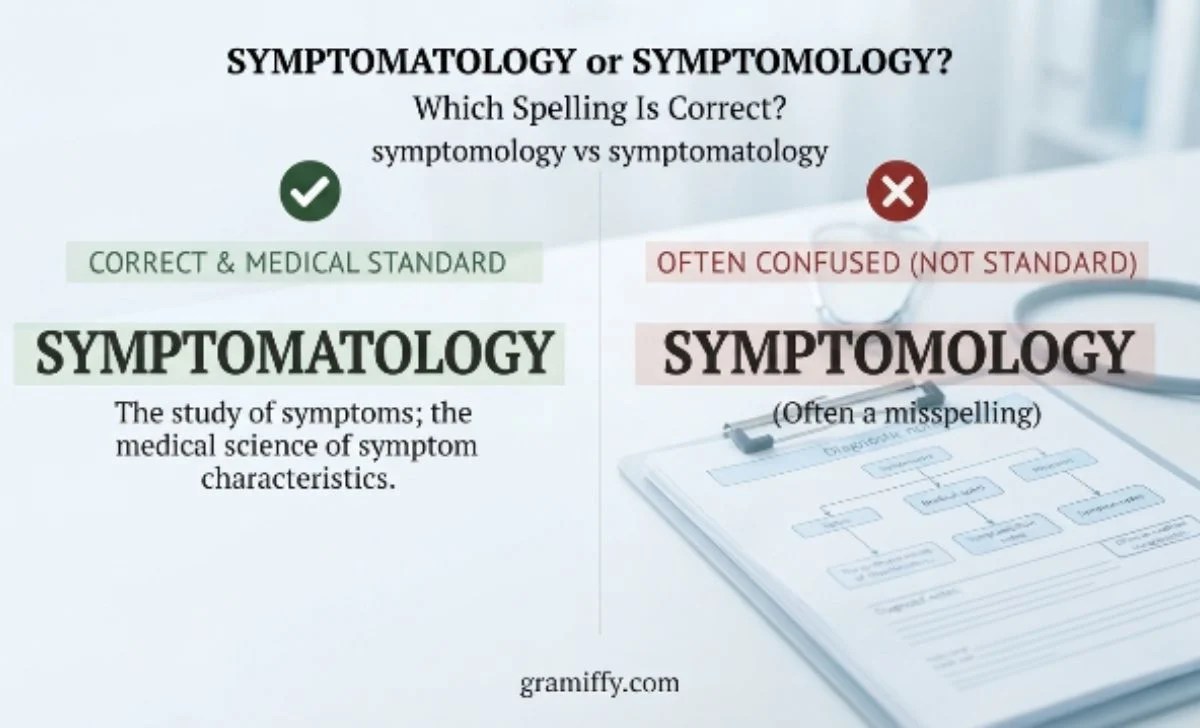
Short answer: use symptomatology. It is the standard form in medicine, research and formal writing.
Symptomology is a shorter variant that turns up in real usage, but it is informal and best avoided in professional or academic work.
Quick rule: If the reader is a doctor, editor, professor or journal, write symptomatology. If you can, write symptoms instead.
In this guide
- What each word means
- Do they mean different things?
- Is “symptomology” a real word?
- Why people mix them up
- Which to use, by situation
- Related word forms
- When to skip both words
- Example sentences
- Quiz
- FAQ
What Do Symptomatology and Symptomology Mean?
Symptomatology has two closely related senses. Merriam-Webster defines it as the symptom complex of a disease, and also as a branch of medical science concerned with symptoms of diseases.
- The set of symptoms: “The symptomatology of influenza includes fever, fatigue and cough.”
- The study of symptoms: “She specialises in the symptomatology of rare neurological conditions.”
Symptomology is used for the same ideas. Wiktionary labels it an informal word for symptomatology. A medical dictionary entry defines it as the science of the symptoms of disease, their production, and the indications they furnish. That is the same sense as symptomatology.
Do They Mean Different Things?
Some websites say they do. One claims symptomatology is the systematic study of symptoms while symptomology refers to the symptoms themselves.
Another says symptomology is a looser description of symptoms, but concedes the distinction is not always followed in medical literature.
The dictionary evidence doesn’t back a real split. The medical dictionary definition above gives symptomology the same meaning as symptomatology.
Treat them as two spellings of one concept, one standard and one informal, not two different words.
Is “Symptomology” a Real Word?
Yes, it exists and people use it, but it is not the preferred form. Here is what different references show.
| Source | What it shows |
|---|---|
| Merriam-Webster | Has a full entry for symptomatology. |
| Dictionary.com | Lists symptomatology, traced to New Latin symptōmatologia, dated 1790-1800. |
| Collins | Includes “symptomological” as an adjective meaning relating to symptomology. |
| Medical dictionary (Free Dictionary) | Has an entry for symptomology with real-world examples. |
| Wiktionary | Labels symptomology informal. |
Real usage: the variant appears in more than casual blog posts. Examples include a plant-virus study on urdbean, a pain-treatment paper, and a literary-criticism article titled “A Symptomological Reading”.
Novelists use it too, and Wiktionary quotes a 2021 novel that speaks of “the abstract language of symptomology”.
So “only amateurs use it” is an overstatement. Professional style guides and editors still prefer symptomatology, and that is the safer choice.
Why Do People Mix Them Up?
1. Shorter feels natural. Speakers tend to trim long technical words, and symptomology is easier to say than symptomatology.
2. Similar endings. In fast speech the two words sound almost identical.
3. The pattern looks right. English has many “-ology” words, so symptom + ology seems logical.
4. Repetition online. Once a variant spreads, more writers copy it.
Why the longer form is standard. The word comes from Greek. Dictionary.com traces it to Late Latin symptōmat- (the stem of symptōma) + -o- + -logia. The “-at-“ is part of that stem, and symptomology drops it.
Other Greek “-ma” words behave differently: trauma becomes traumatology, with no “-at-“. Neither rule is universal in English, so you have to memorise the accepted form.
Memory trick: the adjective is symptomatic, so the noun keeps the same “at”: symptomatology.
Which One Should You Use?
| Situation | Use |
|---|---|
| Medical records, clinical notes, nursing | Symptomatology |
| Academic papers, theses, journals | Symptomatology |
| Professional or technical articles | Symptomatology |
| Health blogs for general readers | Symptomatology, or just “symptoms” |
| Quoting someone who said symptomology | Keep the original wording |
| Writing about language itself | Either, clearly labelled |
| Fiction dialogue | Either, to match the character’s voice |
Scrabble and word games: Symptomology is not valid in the US TWL list or the Merriam-Webster list, but is valid in the international Collins Scrabble Words list. Check which dictionary your game uses before you play it.
Related Word Forms
| Word | Part of speech | Note |
|---|---|---|
| Symptomatology | Noun | Standard |
| Symptomology | Noun | Informal variant |
| Symptomatic | Adjective | Showing symptoms: “symptomatic patients” |
| Symptomatologic / symptomatological | Adjective | Relating to symptomatology |
| Symptomological | Adjective | Listed by Collins as relating to symptomology. |
Symptomatic is a different word from both. It describes something that shows symptoms, while symptomatology names the collection or study of them.
When to Skip Both Words
Both words can sound stiff. One source advises that for general readers, simply saying “symptoms” often works even better.
A medical dictionary entry also cautions against using the long word as a jargon substitute for medical history or symptoms.
- ❌ “The patient’s symptomatology was unpleasant.”
- ✅ “The patient’s symptoms were unpleasant.”
Keep symptomatology for when you mean the overall pattern or the study of symptoms, for example: “The symptomatology differs between adults and children.”
Example Sentences
Correct (standard)
- The symptomatology of measles usually starts with fever and a cough.
- Clinicians compared the symptomatology of the two conditions.
- Her symptomatology improved after treatment.
Informal or nonstandard (avoid in formal writing)
- The disease’s symptomology was unclear. → Use symptomatology.
- We studied migraine symptomology. → Use symptomatology.
Better still
- We studied migraine symptoms.
Quick Quiz
Choose the best word for a formal medical report.
- The nurse recorded the patient’s ______ on admission.
- A study of the ______ of long COVID appeared in the journal.
- The novelist had a character speak of “the strange ______ of grief”. (Informal voice.)
- Which adjective means “showing symptoms”? symptomatic / symptomological
- Plain-language health blog: “Here are the ______ of dehydration.” Best choice?
Answers
- Symptomatology (or simply “symptoms”)
- Symptomatology
- Either works. Symptomology suits informal dialogue.
- Symptomatic
- Symptoms
FAQs
Is symptomology a real word?
Yes, it appears in some dictionaries and in real writing, but it is informal. Symptomatology is the standard form.
Is it symptomology or symptomatology?
Symptomatology, especially in medical, academic and professional writing.
Do symptomology and symptomatology mean the same thing?
In dictionary usage, yes. Claims of a strict meaning difference are not supported by the definitions above.
Is symptomology valid in Scrabble?
It depends on the word list. It is not valid in the US TWL list, but valid in Collins Scrabble Words.
How do I pronounce symptomatology?
Roughly “simp-tuh-muh-TOL-uh-jee”.
Should I say “symptoms” instead?
Often, yes. If you only mean the symptoms themselves, the plain word is clearer.
Conclusion
Use symptomatology whenever accuracy or professionalism matters.
Symptomology is understood and does appear in print, but readers and editors are more likely to see it as a slip. If you want the clearest option, write symptoms.
Read More:

Hi, I’m Safdar Ali, an English language teacher with 26 years of teaching experience. My expertise is in English linguistics, grammar, and the differences between British and American English.
Through Gramiffy, I share practical, research-based guides to help students, writers, and English learners improve their language skills. My goal is to make English simple, accurate, and easy for everyone to understand.