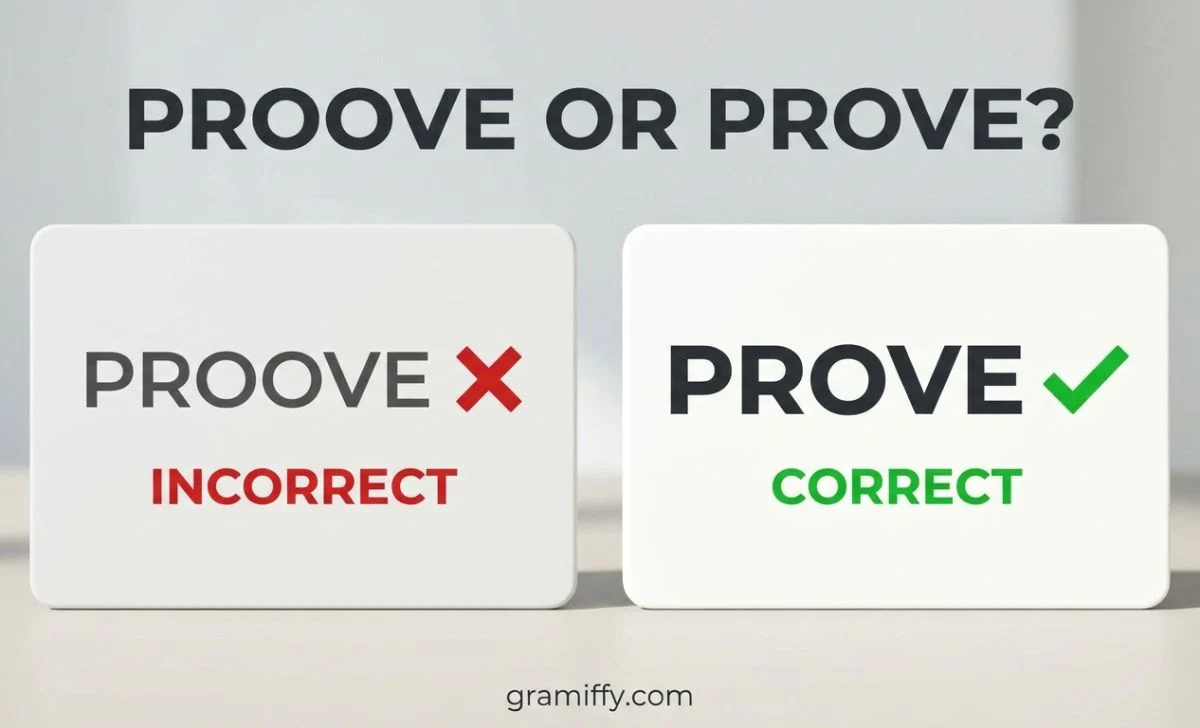
One extra letter can turn a correct word into a spelling mistake, even when the incorrect version looks perfectly reasonable.
If you have ever typed proove and wondered whether it was right, you are not alone.
The confusion often comes from the word proof, which contains two O’s and looks closely related to prove.
Here is the simple answer: prove is the correct spelling in modern standard English.
Proove is not the standard modern form, although it appears as an obsolete spelling in historical sources.
But knowing the correct spelling is only half the story.
You also need to understand when to use prove, how it differs from proof, and why both proved and proven can be correct.
Let’s explore these differences with clear examples and practical tips.
Quick Answer: Proove or Prove?
Prove is the correct modern spelling.
It is a verb meaning to show that something is true, demonstrate something, or establish that a claim is supported by evidence.
Proove is not the accepted spelling in modern standard English.
| Word | Correct today? | Meaning |
|---|---|---|
| Prove | Yes | To demonstrate or establish something |
| Proove | No, not in standard modern English | An obsolete historical spelling |
| Proof | Yes | Evidence that something is true |
| Proved | Yes | The simple past form of prove |
| Proven | Yes | A past participle of prove, also used as an adjective |
Remember: You prove a claim, and you may use proof to support it.
Example: “The witness provided proof to prove that the statement was true.”
What Does Prove Mean?
The verb prove has several related meanings. It does not only refer to showing that something is true; it can also describe demonstrating a quality or showing how something turns out.
1. Prove means to show that something is true
Use prove when you establish the truth of a statement, claim, or allegation through evidence, reasoning, or demonstration.
Examples:
- The scientist conducted further experiments to prove the theory.
- Can you prove that the information is accurate?
- The documents helped prove his innocence.
- She worked hard to prove that the decision was correct.
In each example, prove describes the act of establishing something as true or justified.
2. Prove means to demonstrate an ability
The word can also describe showing that someone has a particular skill, quality, or ability.
Examples:
- He wanted to prove himself in his new position.
- She proved her ability to lead the team.
- The young athlete proved that she could compete at the highest level.
- He was determined to prove his critics wrong.
Here, the word focuses on demonstrating ability or showing that someone’s opinion was mistaken.
3. Prove means to turn out a certain way
Sometimes, prove describes the eventual result of an experience, decision, or situation.
Examples:
- The new strategy proved successful.
- The journey proved more difficult than expected.
- Her advice proved useful during the interview.
- The meeting proved to be a valuable learning experience.
In these sentences, prove means that something turned out to have a particular quality.
Understanding these meanings helps you use the word naturally instead of memorising a single definition.
Why Is Proove Incorrect in Modern English?
The most important thing to remember is that modern standard English uses prove, with one O.
The confusion is understandable because English spelling does not always follow a simple pattern.
The word proof has two O’s, while its related verb prove has only one.
A writer who assumes that both words should share the same vowel pattern may accidentally write proove.
However, related words do not always retain identical spellings.
Compare these examples:
- Proof → prove
- Roof → roofing
- Belief → believe
- Grief → grieve
These pairs illustrate that related English words can have different spelling patterns. They are examples, not a universal rule for predicting spelling.
Historically, proove has appeared as an obsolete spelling. That historical fact does not make it an acceptable alternative in present-day schoolwork, professional writing, emails, or everyday communication.
If you encounter proove in an old text, it may reflect historical spelling rather than a modern spelling choice. For contemporary writing, use prove.
For verification, consult a current dictionary entry such as the Cambridge Dictionary’s definition of prove and a historical reference for the obsolete form.
Proof vs. Prove: What Is the Difference?
This is one of the most useful distinctions to learn because it explains why the two spellings are often confused.
Proof is usually a noun, while prove is a verb.
A noun names a thing, concept, or piece of evidence. A verb describes an action or state.
| Word | Part of speech | Example |
|---|---|---|
| Proof | Noun | We need proof of the claim. |
| Prove | Verb | We must prove the claim. |
| Proved | Past-tense verb | The evidence proved useful. |
| Proven | Past participle or adjective | She is a proven leader. |
Consider these sentences:
Proof: “The photograph provided proof of the damage.”
Here, proof names the evidence.
Prove: “The photograph helped prove that the damage had occurred.”
Here, prove describes what the photograph helped establish.
Another example makes the difference clear:
- Correct: The experiment provides proof of the result.
- Correct: The experiment helps prove the result.
- Incorrect: The experiment helps proove the result.
The two words are related, but you cannot substitute one for the other in every sentence.
Prove, Proves, Proved, Proven, and Proving
A common source of confusion is knowing which form of prove to use. Each form has a specific grammatical role.
| Form | When to use it | Example |
|---|---|---|
| Prove | Base form; used after to, modal verbs, and with plural subjects in the present | We need to prove the result. |
| Proves | Present tense with a third-person singular subject | This evidence proves the point. |
| Proved | Simple past tense; also a standard past participle | The test proved the theory wrong. |
| Proven | Past participle and adjective | The method has proven effective. |
| Proving | Used in continuous tenses or as a gerund | She is proving her ability. |
Is proved or proven correct?
Both are correct, but their use depends on the sentence and the variety of English.
Proved is the usual simple past form:
- The experiment proved successful.
- She proved her point during the discussion.
Both proved and proven can serve as past participles:
- The evidence has proved useful.
- The evidence has proven useful.
Proven is also common before a noun as an adjective:
- A proven method
- A proven track record
- A proven solution
Do not confuse this variation with proove. The standard forms are prove, proves, proved, proven, and proving.
Proove or Prove in a Sentence
Examples help you see how the spelling works in everyday writing.
Correct examples
- The researcher hopes to prove the hypothesis.
- The documents prove that the payment was made.
- She proved her ability to manage the project.
- The new treatment has proven effective in the study.
- He wants to prove his critics wrong.
- The final results may prove surprising.
- We need more evidence to prove the claim.
- The experience proved to be valuable.
Incorrect examples
- Incorrect: The researcher hopes to proove the hypothesis.
Correct: The researcher hopes to prove the hypothesis. - Incorrect: The documents proove that the payment was made.
Correct: The documents prove that the payment was made. - Incorrect: She prooved her ability to manage the project.
Correct: She proved her ability to manage the project. - Incorrect: He is prooving his critics wrong.
Correct: He is proving his critics wrong.
Notice that the error is not limited to the base word. Adding an extra O to its other forms is also incorrect in standard modern English.
Common Mistakes to Avoid
1. Writing proove instead of prove
Incorrect: I can proove that the information is correct.
Correct: I can prove that the information is correct.
Use prove whenever you need the modern standard verb.
2. Writing prooved instead of proved
Incorrect: The evidence prooved his point.
Correct: The evidence proved his point.
The simple past tense is proved, not prooved.
3. Confusing proof with prove
Incorrect: We need to proof that the statement is true.
Correct: We need to prove that the statement is true.
In this sentence, the intended meaning requires a verb. Proof can be a verb in other contexts, such as proofreading a document or preparing a printing proof, but it is not the correct substitute here.
4. Assuming proven is always wrong
Incorrect assumption: Proven is never a correct form of prove.
Correct: The method has proven effective.
Proven is a standard form. The right choice between proved and proven depends on the grammatical construction and intended style.
How to Remember the Correct Spelling
You do not need a complicated spelling rule. Use this simple memory trick:
Proof is evidence; prove is the action.
Think of the sentence:
“We need proof to prove the claim.”
The first word names the evidence. The second describes the action of establishing the claim.
You can also remember this phrase:
One O in prove, one step toward the truth.
Whenever you are about to type proove, pause and ask yourself whether you mean to establish something as true. If you do, write prove.
Quick Practice: Test Yourself
Choose the correct word or form for each sentence.
- The scientist wants to (proove / prove) the theory.
- The documents provide (proof / prove) of ownership.
- She (prooved / proved) that she could lead the team.
- This is a (proven / prooven) method.
- He is (proving / prooving) his point.
Answers:
- Prove
- Proof
- Proved
- Proven
- Proving
If you answered all five correctly, you understand the essential spelling distinction and the most common related forms.
FAQs
Is proove a real word?
Proove appears as an obsolete spelling in historical English sources, but it is not the standard modern spelling. Use prove in contemporary writing.
Is prove or proove correct?
Prove is correct in modern standard English. Proove is not an accepted alternative for ordinary modern usage.
Why do people spell prove as proove?
The mistake may occur because proof contains two O’s, making proove look plausible. However, the correct verb spelling is prove.
What is the difference between proof and prove?
Proof is usually a noun meaning evidence that something is true. Prove is a verb meaning to establish something as true or demonstrate a quality.
Is proved or proven correct?
Both are correct. Proved is the usual simple past form, while proved and proven can both be past participles. Proven is also commonly used as an adjective.
What is the past tense of prove?
The simple past tense is proved. For example, “She proved that the figures were correct.”
How do you pronounce prove?
Prove is pronounced /pruːv/, rhyming with move and groove in standard English. The final sound is /v/, not /f/.
Conclusion
When choosing between proove or prove, remember that prove is the correct spelling in modern standard English.
It means to establish that something is true, demonstrate an ability, or show how something turns out. Proove is an obsolete historical spelling, not a modern alternative.
Keep the related words straight: proof is usually a noun, prove is a verb, proved is the simple past form, and proven is also a correct past participle and adjective.
The easiest reminder is simple: You need proof to prove something.
Read More:

Hi, I’m Safdar Ali, an English language teacher with 26 years of teaching experience. My expertise is in English linguistics, grammar, and the differences between British and American English.
Through Gramiffy, I share practical, research-based guides to help students, writers, and English learners improve their language skills. My goal is to make English simple, accurate, and easy for everyone to understand.