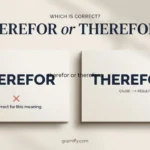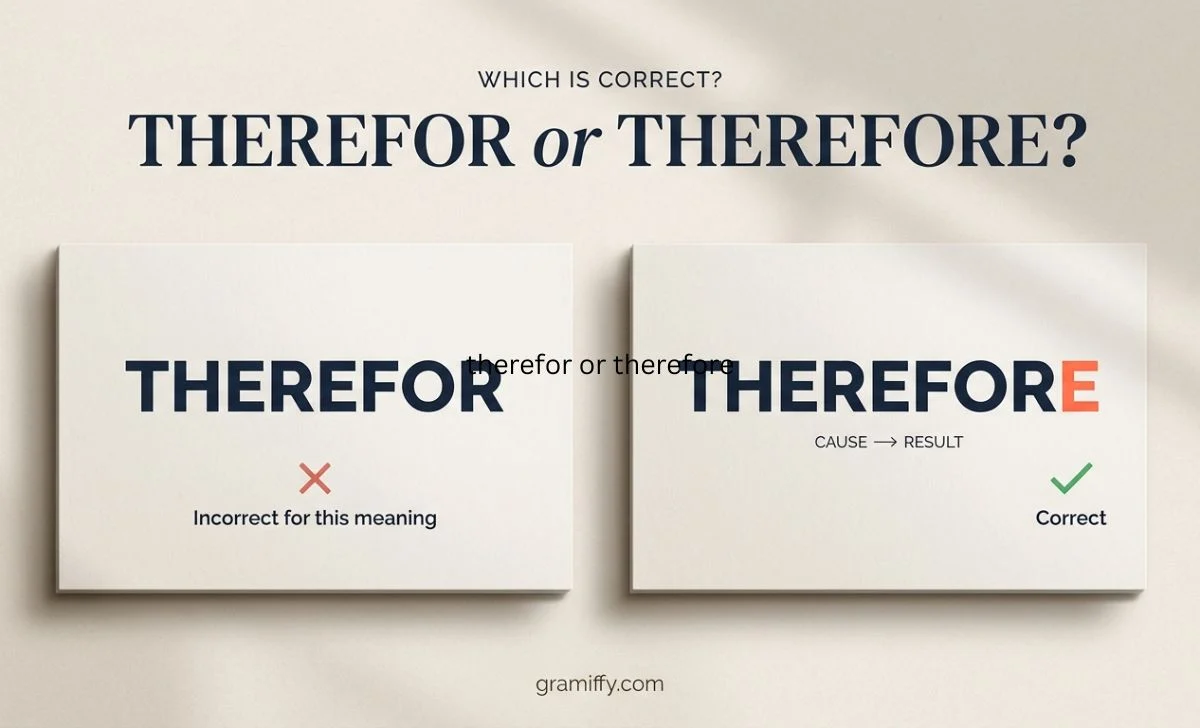
Therefore means “as a result” or “so”. Therefor means “for that” or “for it”. They are two separate words, and neither is a typo of the other. In almost everything you write, therefore is the one you want.
| Word | Meaning | Where you’ll see it |
|---|---|---|
| therefore | as a result, so, consequently | Everywhere: essays, emails, reports, speeches |
| therefor | for that, for it | Mostly legal and formal writing |
Here’s the part many guides get wrong: therefor is not a misspelling. It’s a real word with its own job. It’s just rare, so most people who type it by accident mean therefore.
The one-second swap test
If you’re stuck, replace the word and see what still makes sense.
- If you can swap in “so” or “as a result”, use therefore.
- If you can swap in “for that” or “for it”, use therefor.
Try it:
- She missed the bus; therefore, she was late. → “so, she was late” works. Therefore.
- I returned the shoes and received a refund therefor. → “a refund for it” works. Therefor.
If neither swap works, you’ve probably got the wrong word, or the sentence needs rewriting.
What “therefore” means
Therefore signals that one thing follows from another. It shows that something happens because of something else, and it’s often called a conjunctive adverb because it connects ideas the way a conjunction does.
Examples:
- The roads were icy; therefore, the school closed.
- She studied for weeks and therefore passed with ease.
- The evidence was missing. We cannot, therefore, close the case.
- I think; therefore I am.
Similar words include so, thus, hence, consequently and as a result.
What “therefor” means
Therefor means “for that” or “for it”. It refers back to something already mentioned, usually a thing, payment or purpose. Grammarly places it with words like therein, thereafter and thereof, which you rarely say but should recognise.
Examples:
- I returned the damaged lamp and the store gave me credit therefor.
- The tenant shall pay rent and any fees due therefor.
- She submitted the form along with the payment therefor.
- The company sold the goods and issued an invoice therefor.
You’ll notice therefor usually comes at the end of a clause, after the thing it refers to. That placement is a common sign of the word: it tends to appear at the end of sentences.
Why two spellings exist
Therefor and therefore started out as the same word. Etymonline describes therefor as a Middle English variant spelling of therefore, and notes that since about 1800 the shorter form has leaned toward “for that” while the longer form has leaned toward “in consequence”.
In other words, English had one word with two spellings and gradually gave each spelling its own job. That’s why the pair feels so slippery: they’re relatives, not strangers.
How to pronounce them
The stress is different:
- therefore: THERE-for (stress on the first syllable)
- therefor: there-FOR (stress on the last syllable)
LawProse makes the same distinction: stress on the first syllable for therefore, and on the last for therefor. In everyday speech you’ll almost never hear therefor, which is another reason it rarely appears outside legal and formal documents.
The “there-” word family
Therefor belongs to a group of formal words built from there plus a preposition. Each one means “preposition + that”:
| Word | Means | Example |
|---|---|---|
| therefor | for that | The fee due therefor is $50. |
| thereof | of that | The terms thereof are binding. |
| therein | in that | The documents and the data contained therein. |
| thereto | to that | The contract and the exhibits attached thereto. |
| thereafter | after that | He resigned and thereafter left the city. |
| therefrom | from that | The profits derived therefrom. |
| thereby | by that means | He signed the form, thereby accepting the terms. |
If you’re not writing a contract or formal document, you can usually replace all of these with plain phrases such as “for that”, “of that” or “in it”.
How to punctuate “therefore”
Therefore causes more punctuation mistakes than spelling mistakes. Here are the rules that matter.
1. Between two full sentences, use a semicolon before it and a comma after it.
- He studied hard; therefore, he passed.
2. Or use a period before it.
- He studied hard. Therefore, he passed.
3. A comma alone before it creates a comma splice.
- ❌ He studied hard, therefore he passed.
- LawProse notes that incorrect punctuation around therefore can create a run-on sentence or comma splice, and the fix is a semicolon or a period before it.
4. Mid-sentence, commas around it make it a pause.
- The answer, therefore, is no.
- But LawProse also advises that in short sentences you shouldn’t set it off with commas at all, since it spoils the rhythm and puts emphasis on the word before it. A lighter version works fine: We must therefore deny the motion.
5. After “and”, skip the comma.
- She was tired and therefore went to bed early.
Therefore, thus, hence, so: which to choose?
| Word | Tone | Example |
|---|---|---|
| so | Casual | It rained, so we stayed in. |
| therefore | Neutral to formal | It rained; therefore, we stayed in. |
| thus | Formal, often “in this way” | Thus, the experiment failed. |
| hence | Formal, “from this” | Hence the delay. |
| consequently | Formal, stresses the result | Consequently, sales fell. |
| ergo | Latin; formal or playful | Cogito, ergo sum. |
Therefore is the safe middle choice. It works in school essays, business emails and reports alike.
Should you ever use “therefor”?
Only if you’re writing something formal, usually legal, where it fits naturally. Even then, it’s optional. The usage writer Eric Partridge noted that many good writers don’t even know therefor exists, and LawProse jokes that they may be better writers for it.
In plain-language writing, you can usually avoid therefor altogether:
- The fees due therefor → the fees due for it
- A refund therefor → a refund for that
- Payment therefor → payment for it
Both versions are correct. The plain one is easier to read.
Why “therefor” slips past spellcheck
Because therefor is a real word, most spellcheckers won’t flag it as a misspelling, even when you meant therefore. That’s why the mistake often survives editing.
Before you publish, search your draft for “therefor” and check that each one passes the swap test.
Common mistakes
- Using therefor to mean “so”: ❌ He worked hard, therefor he deserved a raise. → ✅ He worked hard; therefore, he deserved a raise.
- Treating therefor as always wrong: it’s a real word with its own meaning.
- Comma splices: ❌ It was late, therefore we left. → ✅ It was late; therefore, we left.
- Over-commaing short sentences: ❌ We must, therefore, go. → ✅ We must therefore go.
- Confusing the word with “there for”: therefor is one word, while “there for” is two (I was there for you).
Quick quiz: therefor or therefore?
- “She missed the train; ______, she was late.” → therefore
- “I returned the shoes and received a refund ______.” → therefor
- “It rained all day, and the match was ______ cancelled.” → therefore
- “The invoice lists the services and the fees due ______.” → therefor
- “Spot the error: He studied hard, therefor he passed.” → therefore, and a semicolon before it: He studied hard; therefore, he passed.
FAQs
Is it therefor or therefore?
Almost always therefore, which means “as a result”. Therefor is a rare word meaning “for that” or “for it”.
Is “therefor” a word?
Yes. It’s a real word, mostly found in legal and formal writing.
What does “therefor” mean?
“For that” or “for it”, as in a refund therefor.
What does “therefore” mean?
“As a result”, “so” or “consequently”.
Do you put a comma after therefore?
Usually yes when it starts a clause (Therefore, we left), and no when it sits in the middle of a short sentence or follows “and”.
Do you put a semicolon before therefore?
Yes, when it joins two complete sentences: He was tired; therefore, he left.
Is “therefor” British or American?
Neither. It isn’t regional. It’s a formal or legal word in both.
Can I use “therefore” at the start of a sentence?
Yes. Therefore, we must act. is correct.
What’s an easy way to remember the difference?
Use the swap test: “so” means therefore, and “for that” means therefor.
The bottom line
Therefore means “as a result” and is the word you’ll want nearly every time. Therefor means “for that” and is a real, rare word for formal and legal writing.
If you can swap in “so”, write therefore. If you can swap in “for that” or “for it”, write therefor, or just use the plain phrase instead.
Read More:

Hi, I’m Safdar Ali, an English language teacher with 26 years of teaching experience. My expertise is in English linguistics, grammar, and the differences between British and American English.
Through Gramiffy, I share practical, research-based guides to help students, writers, and English learners improve their language skills. My goal is to make English simple, accurate, and easy for everyone to understand.