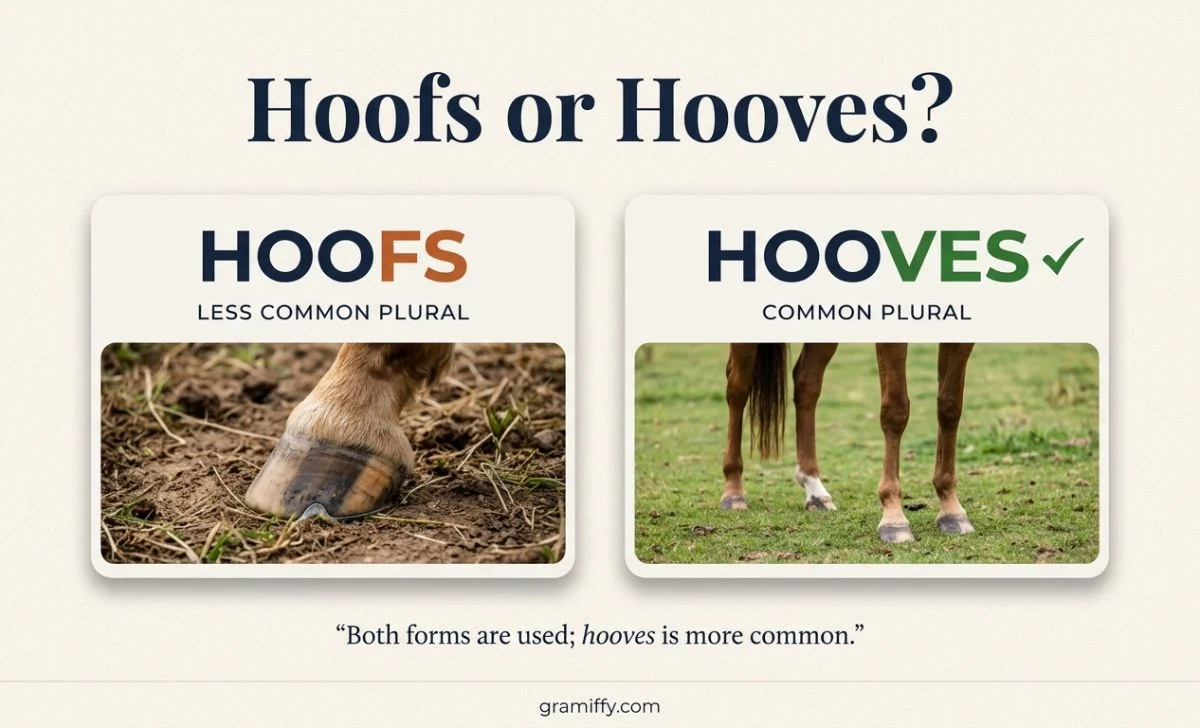
A horse has four feet, but should you write that its hoofs or hooves struck the ground? Both spellings are correct, so this is not a case of choosing a real word over a misspelling.
The difference comes down to usage, preference, and sometimes regional style.
Hooves is a common choice in modern writing, particularly in American English. Hoofs is also an accepted plural and appears in established dictionaries.
If you’re unsure which to choose, hooves is a safe option for general writing, unless your publisher or style guide prefers hoofs.
There is another reason these words can be confusing: hoofs is also a verb form. You can write, “He hoofs it to work,” meaning he walks there. In that sentence, hoofs is not a plural noun at all.
Hoofs or Hooves: The Quick Answer
Both hoofs and hooves are accepted plurals of hoof, the hard covering on the feet of animals such as horses, cattle, sheep, and deer.
| Word | Meaning or role | Example |
|---|---|---|
| Hoof | Singular noun | The horse lifted one hoof. |
| Hooves | Plural noun | The horse’s hooves struck the ground. |
| Hoofs | Alternative plural noun | The animal’s hoofs left marks in the mud. |
| Hoofs | Verb used with he, she, or it | He hoofs it to work. |
| Hoofed | Past-tense verb | She hoofed it across town. |
| Hoofing | -ing form of the verb | They were hoofing it home. |
The simple rule: Use hooves when you want the familiar plural form for an animal’s feet. Use hoofs when you prefer that accepted variant or when the sentence requires the verb form, as in “she hoofs it.”
Which Should You Use: Hoofs or Hooves?
For most general writing, hooves is a good default. It is familiar to readers and widely used in descriptions of horses, livestock, and wildlife.
Examples:
- The horse’s hooves were covered in mud.
- The farrier examined all four hooves.
- The deer disappeared into the forest, its hooves barely making a sound.
- The cattle left hoof marks along the trail.
Hoofs is also correct when used as a plural noun:
- The sound of hoofs echoed through the valley.
- The horse’s hoofs were muddy after the ride.
You do not need to treat hoofs as a spelling mistake. However, using one form consistently makes your writing easier to read.
Is there a British and American difference?
Usage guides report a regional distinction: hooves is the more common plural in American English, while hoofs is recorded as a British preference in some references. Other major dictionaries list both forms without requiring writers to follow that distinction.
For practical purposes:
- American English: Hooves is a safe and familiar choice.
- British English: Both forms are recognized; check your preferred dictionary or house style.
- International English: Hooves is a sensible default.
If you’re writing for a specific publication, follow its style guide rather than assuming one spelling is universally British or American.
Why Are There Two Plurals of Hoof?
Many English nouns form their plural by adding -s or -es. For example:
- book → books
- horse → horses
- dish → dishes
Some nouns ending in -f or -fe have a different pattern. The ending changes to -ves:
- calf → calves
- half → halves
- knife → knives
- leaf → leaves
- shelf → shelves
- wife → wives
The plural of hoof can follow either pattern:
- hoof → hoofs
- hoof → hooves
Hoofs adds the regular plural ending. Hooves uses the familiar f-to-v pattern found in several other English nouns.
However, English spelling is not perfectly predictable. Some nouns ending in -f take only -s, others use -ves, and a few accept both.
That is why it is better to learn the accepted plural forms of individual words rather than apply one rule to every noun.
Which Words Change F to V in the Plural?
The f-to-v pattern is useful, but it is not universal. Compare these examples.
| Pattern | Singular | Plural |
|---|---|---|
| Changes to -ves | Calf | Calves |
| Changes to -ves | Half | Halves |
| Changes to -ves | Knife | Knives |
| Changes to -ves | Leaf | Leaves |
| Changes to -ves | Shelf | Shelves |
| Usually adds -s | Roof | Roofs |
| Usually adds -s | Chief | Chiefs |
| Usually adds -s | Cliff | Cliffs |
| Both forms accepted | Hoof | Hoofs or hooves |
| Both forms accepted | Scarf | Scarfs or scarves |
| Both forms accepted | Dwarf | Dwarfs or dwarves |
The key lesson is that you cannot predict every plural from the final letter alone.
For example, roof becomes roofs in standard modern English. Do not assume it follows the same pattern as hoof.
Is Hoofs Ever a Verb?
Yes. Hoofs can be the third-person singular form of the verb hoof. It is used with subjects such as he, she, it, or a singular noun.
The verb has several uses, including walking or going somewhere on foot in the informal expression hoof it. It can also refer to kicking a ball forcefully.
Examples:
- He hoofs it to the station every morning.
- She hoofs it home when she misses the bus.
- The defender hoofs the ball down the field.
In each sentence, hoofs describes an action rather than naming an animal’s feet.
Hoof, hoofs, hoofed, and hoofing
| Verb form | Example |
|---|---|
| Hoof | We can hoof it to the restaurant. |
| Hoofs | He hoofs it to work. |
| Hoofed | They hoofed it across town. |
| Hoofing | We were hoofing it through the rain. |
Notice the difference between the noun and the verb:
- Noun: The horse’s hooves were muddy.
- Verb: He hoofs it to the office.
In standard writing, hooves is the plural noun form, while hoofs is the third-person singular form of the verb.
What Does “Hoof It” Mean?
Hoof it is an informal expression meaning to walk somewhere or travel on foot, often because no transport is available or because walking is the easiest option.
Examples:
- We missed the last bus, so we hoofed it home.
- The parking lot was full, and we had to hoof it from the next street.
- She decided to hoof it to the shops instead of waiting for a taxi.
The expression is conversational rather than formal. In a business report or academic paper, walk or travel on foot may be more appropriate.
The verb hoof can also be used when someone kicks a ball hard, as in “The defender hoofed the ball out of danger.”
Common Idioms and Phrases With Hoof
The word hoof appears in several English expressions.
1. Hoof it
To walk or travel on foot.
We missed the bus and had to hoof it home.
2. On the hoof
When referring to livestock, this means alive rather than slaughtered. Informally, it can also describe doing something while moving around or without much preparation.
The cattle were sold on the hoof.
3. Cloven hoof
A hoof divided into two parts, as found in animals such as cattle, sheep, goats, and pigs.
The animal left a clear cloven-hoof print in the soft earth.
4. Hoofbeat
The sound made when an animal’s hoof strikes the ground.
The hoofbeats grew louder as the horse approached.
5. Hoofed animal
An animal that has hooves.
Deer, horses, and cattle are examples of hoofed animals.
These expressions are useful vocabulary to learn alongside the singular and plural forms.
What Is a Hoof?
A hoof is the hard covering that protects the end of the foot of certain mammals. It is made primarily of keratin, the same type of structural protein found in human fingernails and hair.
Hooves help support an animal’s weight, protect sensitive structures inside the foot, and provide traction during movement. In horses, regular hoof care is important for comfort and sound movement.
Animals with hooves include:
- Horses and donkeys
- Cattle, sheep, and goats
- Deer and reindeer
- Giraffes
- Pigs
Hooves differ among species. Horses have a single hoof on each foot, while cattle, sheep, goats, and pigs have divided hooves.
Because hoof shape and structure vary between animals, hoof care also varies. Horses may need regular trimming or shoeing, while other hoofed animals have different care requirements.
How Do You Pronounce Hoof, Hoofs, and Hooves?
Pronunciation varies by accent, particularly for the singular word hoof. The most widely taught pronunciation of hooves uses the long “oo” sound, as in grooves.
| Word | Approximate pronunciation | Notes |
|---|---|---|
| Hoof | “hoof” or “huf” | The vowel varies by accent. |
| Hoofs | “hoofs” | Ends with an unvoiced /s/ sound. |
| Hooves | “hoovz” | Usually ends with a /z/ sound. |
In IPA, hooves is commonly represented as /huːvz/. Some American dictionary entries also record a shorter vowel variant.
If you are unsure, listen to the pronunciation audio in a reliable dictionary. The important spelling point is that both hoofs and hooves are accepted plural forms, even though their final sounds differ.
A Simple Memory Trick for Hoofs or Hooves
Use these reminders to keep the forms straight:
- Hooves: Think of the familiar plural ending in -ves, as in leaves and shelves.
- Hoofs: Remember that it is also a verb form, as in “he hoofs it to work.”
- Both are nouns: Either spelling can refer to more than one hoof.
- Follow your style guide: If your publication prefers one plural, use it consistently.
The memory trick is only a guide, not a strict grammar rule. Both plurals are accepted.
Common Mistakes With Hoofs and Hooves
Mistake 1: Calling hoofs incorrect
Incorrect claim: Hoofs is never a real word.
Correct: Both hoofs and hooves are accepted plurals.
Mistake 2: Using hooves as the verb in “hoof it”
Incorrect: He hooves it to work every day.
Correct: He hoofs it to work every day.
Mistake 3: Writing hoves
Incorrect: The horse’s hoves were muddy.
Correct: The horse’s hooves were muddy.
Mistake 4: Applying the f-to-v pattern to every word
Incorrect: The storm damaged the rooves.
Correct: The storm damaged the roofs.
Mistake 5: Switching between plurals without a reason
Less consistent: The horse’s hooves were clean, but its hoofs were muddy the next day.
Better: Choose one form for the article unless you are discussing the spelling difference itself.
Mistake 6: Assuming the spelling difference changes the meaning
In ordinary use, hoofs and hooves mean the same thing when used as plural nouns. The spelling alone does not indicate a different type of hoof.
Why Spellcheck Won’t Flag Hoofs or Hooves
Both hoofs and hooves are accepted English plurals, so a spellchecker may allow either spelling. That does not mean every choice will suit your publication’s style.
A spellchecker may also accept hooves in a sentence where you intended the verb hoofs. For example, it might not identify the problem in “He hooves it to work.”
To check your writing, look at the role the word plays:
- If it names several animal feet, either plural can be correct.
- If it describes someone walking or kicking, check the verb form.
- If you are following a publisher’s style guide, use its preferred spelling consistently.
Context and proofreading are still important even when a word passes a spellcheck.
Quick Quiz: Hoofs or Hooves?
Choose the correct form for each sentence. Remember that both spellings can work as plural nouns.
- The horse’s ___ clattered against the cobblestones.
- He ___ it to the station every morning.
- The farrier checked all four ___.
- The defender ___ the ball down the field.
- The deer left its ___ prints in the mud.
- We missed the bus, so we ___ it home.
- Which plural forms of hoof are accepted: hoofs, hooves, or both?
- What is the standard plural of roof?
Answers
- Hooves — Hoofs is also acceptable.
- Hoofs — The verb form used with he.
- Hooves — Hoofs is also acceptable.
- Hoofed — Past-tense verb.
- Hoof — The sentence refers to one deer and uses the singular possessive its; the full phrase would be “its hoof prints.” For several feet or animals, use hooves or hoofs.
- Hoofed — The past tense of hoof it.
- Both — They are accepted plural forms.
- Roofs — This is the standard modern plural.
FAQs
Is it hoofs or hooves?
Both are correct plurals of hoof. Hooves is a familiar and widely used choice, while hoofs is also accepted. Follow your style guide if it specifies a preference.
What is the plural of hoof?
The plural can be hooves or hoofs. Both forms are recorded in major dictionaries.
Is hoofs a real word?
Yes. Hoofs is an accepted plural noun and also the third-person singular form of the verb hoof, as in “He hoofs it to work.”
Is hooves a real word?
Yes. Hooves is an accepted plural of hoof, the hard covering on the foot of an animal such as a horse or deer.
Which is more common, hoofs or hooves?
Hooves is a common choice in modern general writing, particularly in American English. Both forms remain accepted, and usage can vary by region and publication.
Is hooves American or British English?
Hooves is widely used in American and British English. Some style references report a preference for hooves in American English and hoofs in British English, but both forms are recognized.
Can hooves be a verb?
In standard modern usage, hooves is the plural noun. The third-person singular verb form is hoofs, as in “She hoofs it home.”
What does “hoof it” mean?
Hoof it is an informal expression meaning to walk or travel on foot. For example, “We missed the bus, so we hoofed it home.”
What does “on the hoof” mean?
When used about livestock, on the hoof means alive rather than slaughtered. Informally, it can also mean doing something while moving around or with little preparation.
Is it roofs or rooves?
Roofs is the standard modern plural of roof. Although rooves appears in some historical or variant references, it is not the usual choice in contemporary writing.
Is it scarfs or scarves?
Both scarfs and scarves are accepted plurals of scarf. Scarves is a common choice in general writing.
How do you pronounce hooves?
Hooves is commonly pronounced /huːvz/, approximately “hoovz,” rhyming with grooves. Pronunciation can vary somewhat by accent.
Conclusion
Hoofs and hooves are both correct plurals of hoof.
Hooves is a familiar, widely used choice for general writing, while hoofs remains acceptable. Regional preferences and house styles can influence which form an editor chooses.
Remember one extra detail: hoofs can also be a verb, as in “He hoofs it to work.” If you are writing about an animal’s feet, either plural is valid—but hooves is a sensible default when you are unsure.
Read More:

Hi, I’m Safdar Ali, an English language teacher with 26 years of teaching experience. My expertise is in English linguistics, grammar, and the differences between British and American English.
Through Gramiffy, I share practical, research-based guides to help students, writers, and English learners improve their language skills. My goal is to make English simple, accurate, and easy for everyone to understand.