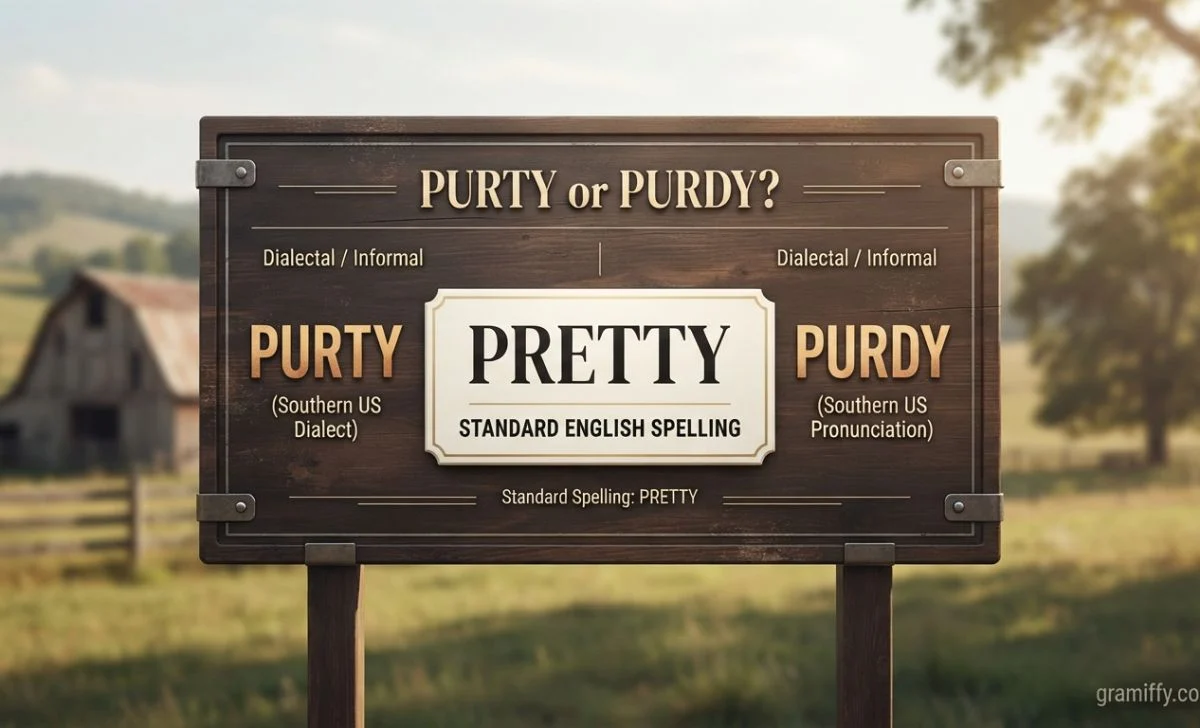
Quick answer: If you mean the standard English word, the correct spelling is pretty.
Purty and purdy are nonstandard or dialectal spellings used to represent a pronunciation of pretty, especially in informal or regional speech.
Purty is the more widely documented dialect spelling, while purdy also appears as a nonstandard variant. Neither should normally replace pretty in formal writing.
Why Do People Write “Purty” or “Purdy”?
Have you ever heard someone say pretty in a way that sounds more like “purty” or “purdy”?
That pronunciation can be reflected in writing by changing the spelling. This is why you may see phrases such as “a purty girl” or “that’s purdy good” in dialogue, novels, songs, and informal online writing.
The important point is that purty and purdy are not competing standard spellings of the same English word. They are nonstandard or dialectal representations of pretty.
So if you’re writing an essay, email, application, article, or professional document, stick with pretty.
If you’re deliberately reproducing a character’s speech, either purty or purdy may appear depending on the voice and style you’re trying to represent.
Purty vs. Purdy: Quick Comparison
| Word | Standard English? | Meaning | Typical use |
|---|---|---|---|
| pretty | Yes | Attractive, pleasing, fairly/quite | Standard English |
| purty | No; dialectal/nonstandard | Pretty | Dialect, informal speech, fictional dialogue |
| purdy | No; nonstandard/dialectal | Pretty | Informal or dialect writing |
Bottom line: Pretty is the standard spelling. Purty and purdy are stylized spellings that can represent nonstandard pronunciation.
What Does “Purty” Mean?
Purty is a dialectal pronunciation spelling of pretty. The American Heritage Dictionary describes it as a regional variant of pretty and explains that the form developed through a linguistic process called metathesis, involving a change in the order or realization of sounds.
Dictionary.com likewise labels purty as dialectal and defines it simply as pretty.
For example:
- That’s a purty dress.
- She sure is purty.
- You have a purty good view from here.
In these sentences, purty has the same basic meaning as pretty. The unusual spelling is there to suggest a particular speech style.
Can “Purty” Mean “Very” or “Quite”?
Sometimes, yes.
Collins records purty not only as an informal adjective meaning pretty, but also as an adverb meaning very.
For example:
That’s purty good.
Here, purty can function more like quite or very, depending on context.
This is one reason the word can appear in expressions such as purty good even when the speaker isn’t literally describing someone’s appearance.
What Does “Purdy” Mean?
Purdy can also be used as a nonstandard spelling of pretty, particularly when a writer wants to reproduce an informal pronunciation.
However, it is important not to treat purdy as having one fixed regional meaning that is always different from purty. Dictionaries and dialect sources show overlapping usage, and the spelling can vary depending on the speaker, writer, region, or literary style.
For example:
- That’s one purdy little house.
- She looks purdy in that dress.
- What a purdy sunset.
In these examples, purdy = pretty.
Purdy Can Also Be a Name
There is another important distinction: Purdy can be a surname.
For example, Purdy may refer to a person whose family name is Purdy. Dictionary.com lists Purdy as a proper name and gives examples of people with that surname.
So context matters:
- That’s a purdy dress. → dialectal pretty
- Brock Purdy is an NFL quarterback. → surname
Purty or Purdy: Is One More Correct?
Not in standard English.
If your sentence requires the ordinary English adjective, the answer is:
Pretty.
If you’re intentionally representing informal or dialect speech, both purty and purdy can occur.
However, purty has stronger dictionary documentation as a pronunciation spelling of pretty. The American Heritage Dictionary explicitly calls it a regional variant of pretty, while Wiktionary lists purdy as an alternative form.
So you should not think of the choice as:
purty = correct
purdy = incorrect
A better way to think about it is:
pretty = standard English
purty/purdy = informal or dialectal spellings
Where Did “Purty” Come From?
The history is interesting because purty isn’t an unrelated word that happens to mean pretty. It developed as a representation of how pretty was pronounced in some varieties of English.
Etymonline dates the use of purty as a representation of colloquial pronunciation to 1829.
The American Heritage Dictionary explains the form through metathesis, a linguistic process involving the rearrangement of sounds. It specifically notes that pretty has historically been realized as purty in regional speech.
The standard word pretty itself has a much older history. It ultimately goes back to Old English prættig, originally associated with meanings such as “cunning,” “crafty,” or “clever,” before its meaning developed over time toward its modern senses.
Is “Purty” a Southern Word?
It can be associated with Southern and other regional American speech, but it is better not to treat it as exclusively Southern.
Purty is documented as a regional form of pretty, and historical dialect evidence shows the spelling in more than one English-speaking region.
It has also appeared in American literature as a way of representing informal or regional speech.
Therefore, saying “purty always means Southern” is too restrictive.
A safer explanation is:
Purty is a dialectal spelling associated with informal and regional pronunciation, including varieties of American English.
Is “Purdy” a Southern Word?
Purdy can also appear in informal and dialect writing, including representations of Southern speech, but there is no need to make a strict rule that purdy is exclusively Southern or Appalachian.
The two spellings can overlap in actual usage.
If you’re writing fiction, the most important consideration is consistency. Choose the spelling that fits the voice you’ve established rather than assuming that one spelling is universally correct for one particular region.
Purty vs. Purdy Pronunciation
Both spellings are generally intended to suggest a pronunciation of pretty that differs from the standard pronunciation.
Standard:
pretty → /ˈprɪti/
A dialectal pronunciation represented by purty can be closer to:
purty → /ˈpɝːti/
Wiktionary lists purty with pronunciations including /ˈpɜɹ.ti/ and a version with a tapped consonant.
The exact pronunciation varies by speaker and dialect, so there isn’t one universal way to pronounce either purty or purdy.
Purty Examples
Here are some natural examples of purty in informal or dialect-style writing:
- That’s a purty little house.
- She’s a mighty purty girl.
- You picked a purty good spot.
- That’s one purty sunset.
- He sure does have a purty smile.
Notice that the spelling is doing something stylistic. In standard writing, these sentences would normally use pretty.
Purdy Examples
Purdy can be used in the same general way:
- That’s a purdy little cabin.
- She has a purdy smile.
- What a purdy dress.
- That’s purdy good, if you ask me.
- It’s a purdy nice place.
Again, pretty would normally be used in standard English.
Purty or Purdy in Formal Writing
If you’re writing any of the following, use pretty:
- School assignments
- Academic essays
- Business emails
- Resumes
- Cover letters
- Reports
- Professional websites
- Formal applications
For example:
❌ She is a purty talented designer.
✅ She is a pretty talented designer.
The first sentence deliberately uses dialect spelling. The second uses standard English.
Purty or Purdy in Dialogue
Dialogue is different.
Writers sometimes deliberately alter spelling to make a character’s speech feel distinctive.
For example:
“That’s a purty little place,” he said.
The spelling immediately signals that the writer is reproducing a particular informal voice.
But use this technique carefully. Overusing phonetic spellings can make dialogue difficult to read, and spelling alone does not accurately reproduce an entire accent.
Purty vs. Pretty: What’s the Difference?
The main difference is standardness and style, not meaning.
Pretty is the standard English form.
Purty is a dialectal or pronunciation spelling of pretty.
For example:
- She looks pretty. → standard English
- She looks purty. → informal/dialect representation
The underlying meaning remains essentially the same.
Purdy vs. Pretty: What’s the Difference?
The same principle applies to purdy.
- That is a pretty dress. → standard
- That’s a purdy dress. → informal/dialect spelling
The unusual spelling tells the reader that the writer is representing pronunciation or character voice.
Common Mistakes
Mistake 1: Thinking “purty” is the standard spelling
It isn’t.
If you simply mean attractive or pleasing, write pretty.
Mistake 2: Thinking “purdy” is the official alternative
It isn’t a standard alternative spelling.
Purdy can represent dialect pronunciation, but pretty remains the normal spelling in standard English.
Mistake 3: Assuming “purdy” and “purty” have completely different meanings
They generally don’t.
Both can be used as informal or dialectal representations of pretty. The choice may reflect pronunciation, personal spelling preference, literary convention, or the voice of a particular character.
Mistake 4: Forgetting that “Purdy” can be a surname
Purdy may be a person’s last name rather than a spelling of pretty.
Always check the context.
Purty or Purdy: Which One Should You Use?
Use pretty when you’re writing standard English.
Use purty or purdy when you’re deliberately representing informal, dialectal, or character speech.
If you’re writing a novel or screenplay, don’t choose between them simply because one is supposedly “more correct.” Instead, consider the character’s voice and keep your spelling consistent.
Quick Memory Trick
Remember:
Pretty = proper standard spelling.
Purty/Purdy = pronunciation-style spellings.
So when you’re unsure, choose:
Pretty
Purty or Purdy: Self-Check Quiz
1. Which spelling should you use in a formal essay?
A. Purty
B. Purdy
C. Pretty
Answer: C. Pretty
2. Which forms can appear as dialect spellings of “pretty”?
A. Purty
B. Purdy
C. Both
Answer: C. Both
3. Which sentence uses standard English?
A. That’s a purty dress.
B. That’s a purdy dress.
C. That’s a pretty dress.
Answer: C. That’s a pretty dress.
4. What can “Purdy” also be?
A. A surname
B. A verb
C. A punctuation mark
Answer: A. A surname
Frequently Asked Questions
Is “purty” a real word?
Yes, purty is a documented dialectal/regional form of pretty. Dictionaries identify it as a nonstandard or regional variant rather than the normal standard spelling.
Is “purdy” a real word?
Purdy is also found as a nonstandard or dialectal form of pretty. It can additionally function as a surname.
Is purty the same as pretty?
Generally, yes. When purty is being used as a dialect spelling, it represents pretty.
Is purdy the same as pretty?
Generally, yes, when it is being used as a dialectal spelling. Context is important because Purdy can also be a surname.
Which is correct: purty or purdy?
Neither is the standard spelling when you mean the ordinary English adjective. The standard spelling is pretty.
Is “purty” Southern slang?
It can be associated with Southern and other regional speech, but calling it exclusively Southern would be too narrow. It is better described as a regional or dialectal form of pretty.
Can I use purty in a novel?
Yes. It can work well when you’re intentionally representing a character’s dialect or informal speech. Just make sure the spelling fits the character and is used consistently.
Can I use purty in formal writing?
Usually, no. In formal or standard English, use pretty.
What is the plural of purty?
When purty is used as an adjective, it follows adjective patterns. Its comparative and superlative forms are commonly given as purtier and purtiest.
Purty vs. Purdy: Final Answer
If you’re asking for the standard English spelling, choose pretty.
Purty and purdy are informal or dialectal spellings that can represent a pronunciation of pretty. Purty has particularly strong dictionary documentation as a regional variant, while purdy is also used as a nonstandard variant.
So remember:
Formal writing → pretty
Dialect/informal dialogue → purty or purdy
The key isn’t deciding which of purty or purdy is “correct.” The real question is whether you want standard English or a deliberate dialect spelling.
Read More:

Hi, I’m Safdar Ali, an English language teacher with 26 years of teaching experience. My expertise is in English linguistics, grammar, and the differences between British and American English.
Through Gramiffy, I share practical, research-based guides to help students, writers, and English learners improve their language skills. My goal is to make English simple, accurate, and easy for everyone to understand.