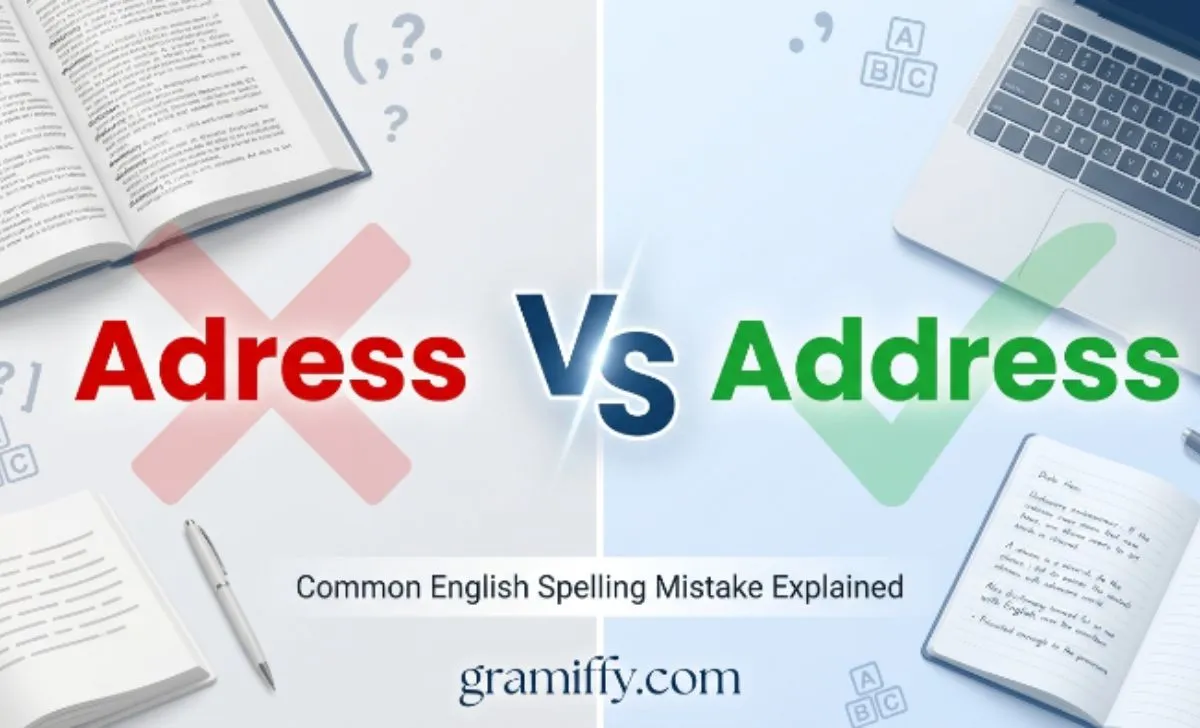
At a Glance
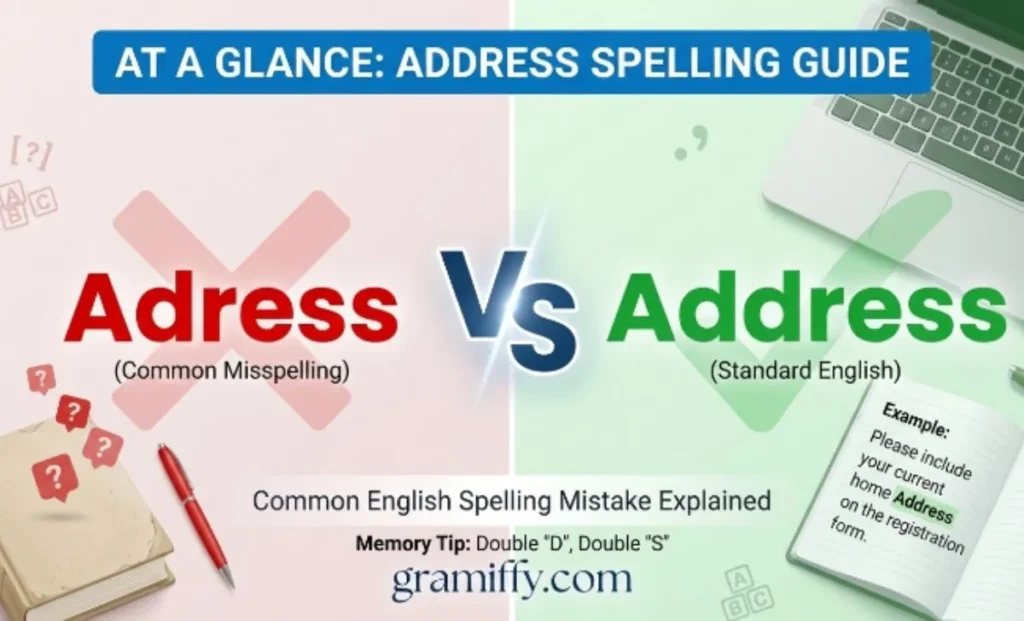
| Question | Answer |
|---|---|
| Which spelling is correct? | ✅ Address |
| Is adress a real English word? | ❌ No |
| Is adress ever correct? | ❌ Never |
| British English | Address |
| American English | Address |
| Parts of speech | Noun and Verb |
| Most common mistake | Omitting one d and writing adress |
Bottom line: If you’re choosing between adress and address, always use address.
Introduction
Have you ever stopped while writing an email, filling out an online form, or completing a school assignment because you weren’t sure whether to write “adress” or “address”?
You’re not alone.
This is one of the most common English spelling questions because the two words look almost identical. The only visible difference is one extra d, yet that single letter completely changes whether the spelling is correct.
The good news is that the rule is simple.
Address is the only correct spelling in English.
The spelling adress is a common mistake caused by typing too quickly, forgetting one of the double letters, or assuming the word follows the same spelling pattern as words like adapt, admire, or adopt.
Because address is used in many everyday situations—such as writing a home address, email address, postal address, billing address, or shipping address learning the correct spelling is essential for clear and professional communication.
But this guide goes far beyond answering a simple spelling question.
You’ll discover:
- The correct spelling and why it matters.
- The meaning of address in different contexts.
- How address works as both a noun and a verb.
- The pronunciation in British and American English.
- Common spelling mistakes and why they happen.
- Easy memory tricks to remember the correct spelling.
- Real-world examples.
- Frequently asked questions.
- Related grammar tips that improve your English writing.
By the end of this guide, you’ll know exactly when and how to use address correctly and you’ll never confuse it with adress again.
Quick Answer: Adress or Address?
If you only need the answer, here it is:
| Word | Correct? | Explanation |
|---|---|---|
| Address | ✅ Correct | The standard English spelling used worldwide. |
| Adress | ❌ Incorrect | A common misspelling of address. |
Correct Examples
- Please enter your address.
- What’s your email address?
- The company changed its business address.
- We need to address this issue today.
- The principal will address the students tomorrow.
Incorrect Examples
- Please enter your adress.
- What’s your email adress?
- We must adress the problem.
- My adress has changed.
Every one of these incorrect examples should use address instead.
What Is the Correct Spelling: Adress or Address?
The correct spelling is address.
The spelling adress is not accepted in standard English and should never appear in formal or informal writing.
Whether you’re writing:
- a home address
- an email address
- a postal address
- a web address
- an IP address
- a billing address
- a shipping address
or using the word as a verb, the spelling always remains address.
Unlike some English words that have different British and American spellings, address is spelled exactly the same in every major variety of English.
That means you’ll write address whether you’re using:
- British English
- American English
- Canadian English
- Australian English
- New Zealand English
There are no spelling variations.
Why Is “Adress” Incorrect?
Many people wonder why adress is wrong when it sounds almost identical to address.
The answer lies in the history and standard spelling of the word.
Modern English recognizes only one spelling:
Address
The version adress is simply a spelling error that usually happens because the writer accidentally leaves out one d.
Most spell-checkers including Microsoft Word, Google Docs, Grammarly, and browser spell checkers immediately identify adress as incorrect and recommend address instead.
If you’re writing:
- an essay
- a business email
- a resume
- a cover letter
- an academic paper
- a legal document
- a website article
you should always use address.
Why Do So Many People Misspell “Address”?
Although the rule is straightforward, address remains one of the most frequently misspelled words in English.
Here are the main reasons.
The Double Letters Cause Confusion
The biggest reason is that address contains two separate double letters.
It has:
- DD
- SS
Many writers remember only one pair and accidentally produce spellings like:
- adress
- addres
- adreess
- adrees
- addresss
None of these spellings are correct.
The only correct spelling is:
Address
Pronunciation Doesn’t Reveal Every Letter
English spelling doesn’t always match pronunciation perfectly.
When native speakers say address, the second d isn’t strongly emphasized.
As a result, learners often spell the word exactly as they hear it:
adress
instead of
address
This is a common mistake with many English words containing silent or lightly pronounced letters.
Similar Words Influence Our Memory
Many English words beginning with ad- contain only one d.
Examples include:
- adapt
- admire
- admit
- adore
- adopt
- advance
- adjust
Because these words are so common, many writers unconsciously assume address follows the same spelling pattern.
It doesn’t.
Instead, address keeps both its double D and double S.
Fast Typing Leads to Mistakes
Another reason is simple typing speed.
When people type quickly, repeated letters are among the easiest characters to miss.
That’s why you’ll often see:
❌ adress
instead of
✅ address
This mistake is especially common in:
- emails
- online forms
- text messages
- social media posts
- search queries
Fortunately, most modern spell checkers catch it instantly.
What Does “Address” Mean?
One reason the word address appears so often is that it has several meanings.
Depending on the context, it can refer to a location, contact information, a formal speech, or the act of dealing with a problem.
Let’s look at each meaning in detail.
1. Address as a Physical Location
The most common meaning of address is the place where a person, family, business, or organization is located.
Examples include:
- home address
- residential address
- postal address
- mailing address
- office address
- business address
Examples in sentences
- Please write your home address on the application form.
- Our business address has changed.
- She forgot to include her postal address.
- The courier couldn’t find the correct delivery address.
More Meanings of “Address”
The word address is one of the most versatile words in English. While many people immediately think of a home or mailing location, it has several other meanings that are equally common.
Understanding every meaning helps you choose the right word in every situation and strengthens your English vocabulary.
2. Address as Contact Information
Today, address often refers to digital contact details rather than a physical location.
Common examples include:
- Email address
- Website address
- Web address
- Internet address
- IP address
- MAC address
Although these refer to different things, they all share one idea: they identify where information should be sent or found.
Examples
- Please enter your email address to create an account.
- Copy the web address from your browser.
- Every device connected to the internet has an IP address.
- Your network card has a unique MAC address.
- Verify your email address before submitting the registration form.
3. Address as a Verb
As a verb, address means to deal with, discuss, solve, answer, or speak to someone or something.
This meaning is extremely common in business, education, government, journalism, and everyday communication.
Examples
- We need to address this problem immediately.
- The company addressed customer complaints quickly.
- The teacher addressed every student’s question.
- Let’s address the issue before it becomes more serious.
- The committee addressed concerns raised by the public.
In professional writing, you’ll often see expressions such as:
- address an issue
- address concerns
- address a challenge
- address customer feedback
- address a complaint
- address the root cause
- address a misunderstanding
4. Address as a Formal Speech
Address can also refer to a formal speech delivered to an audience.
This usage is common in politics, education, business, and public events.
Examples
- The president delivered a televised address.
- Her graduation address inspired thousands of students.
- The CEO’s opening address lasted twenty minutes.
- Everyone applauded after the keynote address.
How Is “Address” Pronounced?
Many spelling mistakes happen because English pronunciation isn’t always obvious.
British English
/əˈdres/
American English
/əˈdrɛs/
The pronunciation is almost identical in both varieties of English.
Notice that although the pronunciation changes slightly depending on whether the word is a noun or verb in connected speech, the spelling never changes.
Examples:
- What’s your address?
- Please address the audience.
- The minister will address the nation tonight.
- Enter your email address carefully.
Address as a Noun vs Address as a Verb
One question many English learners ask is:
Is “address” a noun or a verb?
The answer is:
Both.
The spelling stays exactly the same, but the meaning changes depending on the sentence.
| Part of Speech | Meaning | Example |
|---|---|---|
| Noun | A location or formal speech | My address has changed. |
| Verb | To deal with or speak to | We must address the issue today. |
Address as a Noun
Examples:
- My address is on the envelope.
- Please update your postal address.
- The school needs your home address.
- What’s your email address?
Address as a Verb
Examples:
- We should address the customer’s complaint.
- The principal will address the students.
- The government must address inflation.
- The report addresses several important issues.
A helpful tip:
If you can replace address with location, it’s probably a noun.
If you can replace it with deal with or speak to, it’s probably a verb.
Common Types of Addresses
The word address appears in many everyday expressions. Learning these collocations will make your English sound more natural.
Home Address
The location where someone lives.
Examples
- Please write your home address.
- My home address changed last year.
Residential Address
The official address of your residence.
Examples
- Enter your residential address exactly as it appears on your ID.
- Your residential address is required for verification.
Mailing Address
The address used for receiving mail.
It may be different from your home address.
Examples
- My mailing address is a post office box.
- Please send all correspondence to my mailing address.
Postal Address
The address recognized by postal services.
Examples
- Confirm your postal address before we dispatch the package.
- The courier couldn’t locate the postal address.
Business Address
The official address of a company.
Examples
- The company’s business address is listed on its website.
- Update the business address on all invoices.
Office Address
The location where someone works.
Examples
- Please deliver the documents to my office address.
- His office address is in downtown Chicago.
Billing Address
The address connected to a payment method.
Examples
- Your billing address must match your bank records.
- Incorrect billing address information may cause payment failure.
Shipping Address
The location where goods are delivered.
Examples
- Double-check your shipping address before checkout.
- The parcel was delivered to the wrong shipping address.
Delivery Address
The destination where a package is sent.
Examples
- Please confirm your delivery address.
- The courier couldn’t locate the delivery address.
Email Address
A unique identifier used for sending and receiving emails.
Examples
- Enter your email address.
- I forgot your email address.
Web Address
Also called a URL.
Examples
- Type the web address into your browser.
- Check the website address before clicking the link.
IP Address
A numerical identifier assigned to a device on a network.
Examples
- Every smartphone has an IP address.
- The technician checked the IP address.
MAC Address
A unique hardware identifier assigned to a network interface.
Examples
- Find your computer’s MAC address in the network settings.
- The administrator registered every MAC address.
Adress vs Address: Side by Side Comparison
If you’re still unsure which spelling is correct, this comparison removes all doubt.
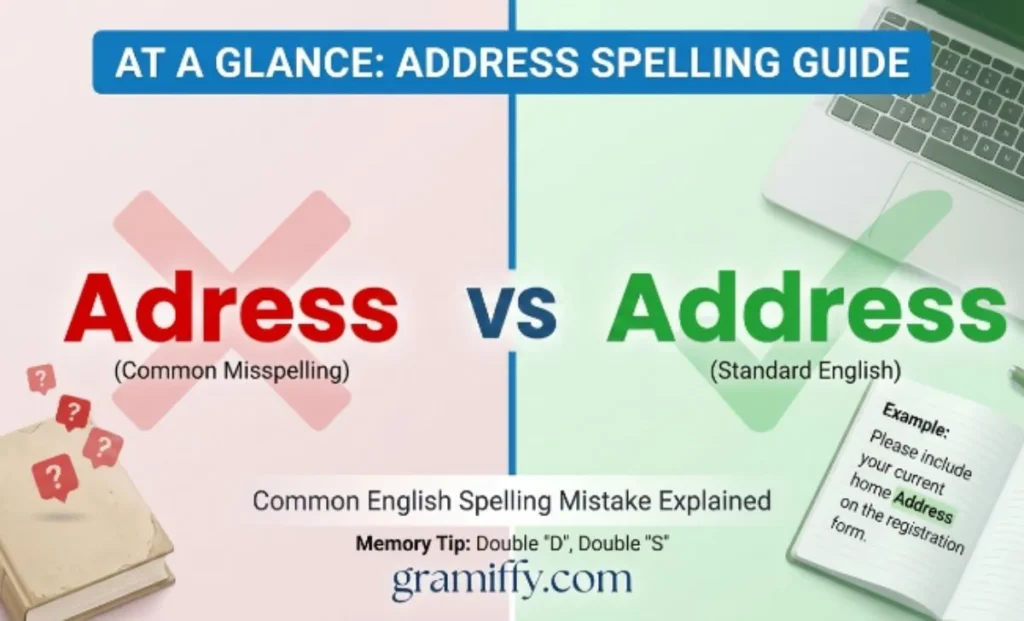
| Feature | Adress | Address |
|---|---|---|
| Correct English spelling | ❌ No | ✅ Yes |
| Found in English dictionaries | ❌ No | ✅ Yes |
| Accepted in formal writing | ❌ Never | ✅ Always |
| Used in academic writing | ❌ No | ✅ Yes |
| Appropriate for business communication | ❌ No | ✅ Yes |
| Used in books and newspapers | ❌ No | ✅ Yes |
| Accepted by spell-checkers | ❌ No | ✅ Yes |
| Standard worldwide spelling | ❌ No | ✅ Yes |
Final verdict: Address is the only correct spelling.
Adress vs Address in Sentences
The easiest way to remember the correct spelling is to see it used naturally.
Correct Sentences
- Please write your address clearly.
- What is your email address?
- Our business address has changed.
- The package arrived at the wrong address.
- We need to address this problem immediately.
- The speaker addressed the audience confidently.
- Please verify your billing address.
- The technician updated the server’s IP address.
Incorrect Sentences
❌ Please write your adress.
✅ Please write your address.
❌ What is your email adress?
✅ What is your email address?
❌ We must adress the issue.
✅ We must address the issue.
❌ My adress has changed.
✅ My address has changed.
Why “Adress” Is Always Incorrect
Many English learners wonder whether adress is an old spelling, a British spelling, or an accepted alternative.
The answer is simple:
No. “Adress” is never correct in standard English.
Unlike words such as color/colour or honor/honour, there is no spelling variation for address.
The spelling adress is simply a typo or spelling mistake.
You should never use adress in:
- Academic essays
- School assignments
- Research papers
- Business emails
- Job applications
- Cover letters
- Resumes (CVs)
- Legal documents
- Government forms
- Blog articles
- Professional websites
- Books or published content
Whether you’re writing formally or informally, address is always the correct choice.
Why Do Spell Checkers Flag “Adress”?
Modern writing tools compare every word you type with trusted English dictionaries.
Since adress isn’t recognized as a valid English word, it is automatically marked as a spelling error.
Popular tools that identify adress as incorrect include:
- Microsoft Word
- Google Docs
- Grammarly
- Apple Pages
- Gmail
- Outlook
- Most modern web browsers
- AI writing assistants
In nearly every case, these tools recommend replacing adress with address.
This is another strong indication that address is the only accepted spelling.
British English vs American English
One reason people search for adress or address is that many English words have different spellings depending on the variety of English.
For example:
| American English | British English |
|---|---|
| color | colour |
| honor | honour |
| favorite | favourite |
| center | centre |
| theater | theatre |
Because of these differences, some people assume address might also have an alternative spelling.
It doesn’t.
Correct Spelling Around the World
| Variety of English | Correct Spelling |
|---|---|
| American English | ✅ Address |
| British English | ✅ Address |
| Canadian English | ✅ Address |
| Australian English | ✅ Address |
| New Zealand English | ✅ Address |
| International English | ✅ Address |
No matter where you’re writing or speaking English, address is always spelled the same way.
Common Spelling Mistakes Related to “Address”
Since address contains two pairs of repeated letters, people often make small typing or spelling errors.
Here are the most common mistakes.
| ❌ Incorrect | ✅ Correct |
|---|---|
| adress | address |
| addres | address |
| adreess | address |
| adrees | address |
| adrress | address |
| adddress | address |
| addresss | address |
| addreses | addresses |
| adresses | addresses |
| adressed | addressed |
| addresing | addressing |
Remember this simple rule:
If the spelling doesn’t contain both “DD” and “SS,” it’s probably incorrect.
How to Remember the Correct Spelling
The good news is that you only need one simple memory trick.
Trick #1: Double D + Double S
Break the word into four parts:
A + DD + RE + SS
This makes the spelling much easier to remember.
Whenever you’re unsure, ask yourself:
Did I write two D’s and two S’s?
If not, you’ve probably misspelled the word.
Trick #2: Think of Your Home
Imagine your house.
Your house has:
- Two doors (DD)
- Two street signs (SS)
No house feels complete without them.
Likewise, address isn’t complete without DD and SS.
It’s a simple visual memory trick that works surprisingly well.
Trick #3: Learn the Word in Context
Instead of memorizing the spelling alone, practice it in common phrases.
Examples include:
- Home address
- Residential address
- Mailing address
- Postal address
- Business address
- Office address
- Email address
- Shipping address
- Billing address
- Web address
- Address the issue
- Address customer concerns
The more often you see these expressions, the more natural the spelling becomes.
Word Forms of “Address”
Learning different forms of the word improves both your grammar and vocabulary.
| Word | Part of Speech | Meaning |
|---|---|---|
| address | Noun / Verb | Base form |
| addresses | Plural noun / Verb | More than one address or third-person singular verb |
| addressed | Verb | Past tense and past participle |
| addressing | Verb | Present participle |
| addressee | Noun | The person receiving a letter, parcel, or email |
| addressable | Adjective | Capable of being dealt with or identified |
Examples
Address
- Please write your address clearly.
Addresses
- She has three email addresses.
Addressed
- The manager addressed the problem immediately.
Addressing
- We are addressing customer feedback.
Addressee
- The addressee signed for the registered letter.
Synonyms of “Address”
The meaning of address changes depending on how it’s used, so the best synonym also depends on the context.
When “Address” Means a Location
Possible synonyms include:
- Location
- Residence
- Residence details
- Contact information
- Mailing location
- Postal location
- Destination
- Place of residence
Example
- Please provide your address.
- Please provide your residential location.
When “Address” Means “Deal With”
Possible synonyms include:
- Handle
- Solve
- Resolve
- Tackle
- Discuss
- Consider
- Examine
- Manage
- Respond to
- Approach
- Confront
Example
- We need to address the issue.
- We need to resolve the issue.
When “Address” Means a Speech
Possible synonyms include:
- Speech
- Talk
- Lecture
- Presentation
- Keynote
- Remarks
- Public statement
Example
- The mayor delivered an inspiring address.
- The mayor delivered an inspiring speech.
Antonyms of “Address”
Like its synonyms, the opposite of address depends on the meaning.
When It Means “Deal With”
Possible antonyms include:
- Ignore
- Avoid
- Neglect
- Overlook
- Disregard
- Dismiss
- Postpone
Example
- Good leaders address problems.
- Poor leaders ignore problems.
When It Means “Speak To”
Possible opposites include:
- Remain silent
- Ignore
- Avoid speaking
- Withhold comment
Real Life Examples of “Address”
Understanding how native speakers use address helps reinforce the correct spelling.
Everyday Communication
- Please update your address after moving.
- I forgot to include my postal address.
- The invitation was sent to the wrong address.
Business
- Verify the customer’s billing address before processing payment.
- The company’s registered address appears on every invoice.
- Please send the signed agreement to our office address.
Technology
- Enter your email address to sign in.
- Copy the web address from the browser.
- Every device connected to the internet has an IP address.
- Your computer also has a unique MAC address.
Education
- Students must write their address on the examination form.
- The school requested each student’s current address.
Public Speaking
- The principal will address the students tomorrow.
- The CEO delivered the opening address at the conference.
- The minister addressed the media after the meeting.
FAQs
The following questions are based on what users commonly search for about “adress or address.
Is it “adress” or “address”?
Address is the correct spelling.
Adress is a spelling mistake and is not recognized in standard English. Whether you’re referring to a physical location, an email, or using the word as a verb, you should always write address.
Is “adress” a real English word?
No.
Adress is not a valid English word. It is simply a common misspelling of address and does not appear as the correct spelling in standard English dictionaries.
Why do people write “adress” instead of “address”?
There are several reasons:
- They forget the second d.
- The word contains two double letters (dd and ss).
- They type too quickly.
- The pronunciation doesn’t clearly emphasize every letter.
- They assume it follows the spelling pattern of words like adapt or admire.
How do you spell “address” correctly?
The correct spelling is:
A-D-D-R-E-S-S
A simple memory trick is:
Address = Double D + Double S
If your spelling doesn’t contain both DD and SS, it’s incorrect.
What does “address” mean?
The meaning depends on the context.
As a noun, address can mean:
- A home or business location
- An email address
- A mailing or postal address
- A website or web address
- An IP address
- A formal speech
As a verb, address means:
- To deal with a problem
- To discuss an issue
- To speak to someone
- To respond to a concern
Is “address” a noun or a verb?
It can be both.
As a noun
- My address has changed.
As a verb
- We need to address the issue.
The spelling remains the same in both cases.
Is “address” spelled differently in British and American English?
No.
Unlike colour/color or honour/honor, the spelling of address never changes.
The correct spelling is:
- British English → Address
- American English → Address
- Canadian English → Address
- Australian English → Address
Is “email address” correct?
Yes.
Email address is the standard expression used worldwide.
Examples:
- Enter your email address.
- Please verify your email address.
Is “web address” the same as a URL?
Almost.
A web address is the everyday name for a URL (Uniform Resource Locator). In most situations, the two terms are used interchangeably.
Example:
- Copy the web address from the browser’s address bar.
What is an IP address?
An IP address is a unique numerical identifier assigned to a device connected to a network.
It allows devices to communicate with each other over the internet or a local network.
Can I use “adress” in formal writing?
No.
Never use adress in:
- Business emails
- Academic essays
- Research papers
- Reports
- Job applications
- Resumes
- Legal documents
- Government forms
- Professional websites
Always use address.
How can I remember the correct spelling?
The easiest way is to remember:
Address = A + DD + RE + SS
Another tip is to think of a house with two doors (DD) and two street signs (SS).
Which spelling appears in dictionaries?
Every reputable English dictionary recognizes only one spelling:
✅ Address
The spelling adress is treated as an error.
Common Search Queries About “Adress or Address”
People search for this topic in many different ways. This guide answers all of the following questions naturally.
- adress or address
- address or adress
- how to spell address
- correct spelling of address
- spelling of address
- address meaning
- address definition
- address pronunciation
- address grammar
- address examples
- address in a sentence
- address noun or verb
- address spelling mistake
- why is address spelled with two d’s
- why does address have two s’s
- is adress correct
- email address spelling
- postal address spelling
- web address meaning
- IP address meaning
- business address meaning
- mailing address meaning
- address dictionary definition
- address English meaning
- address grammar rules
No matter which query brought you here, the answer remains the same:
The correct spelling is always “address.”
Common Mistakes to Avoid
Even fluent English speakers occasionally misspell address. Here are the mistakes you should watch for.
Mistake #1: Writing “Adress”
❌ My adress has changed.
✅ My address has changed.
Mistake #2: Forgetting the Second “D”
❌ Adress
✅ Address
Remember:
DD + SS
Mistake #3: Forgetting the Second “S”
❌ Addres
✅ Address
Mistake #4: Assuming British English Uses “Adress”
This is incorrect.
Both British and American English use:
✅ Address
Mistake #5: Confusing the Noun and Verb
Some learners think the spelling changes depending on whether the word is a noun or a verb.
It doesn’t.
Noun
- What’s your address?
Verb
- Please address the issue.
The spelling always stays the same.
Editor’s Tip
If you’re proofreading an email, resume, assignment, or blog post, pay extra attention to the word address.
Because it’s used so frequently in forms, contact details, and professional writing, even a small spelling mistake can leave a poor impression.
Before clicking Send or Publish, quickly check that you’ve written:
✅ Address
not
❌ Adress
This simple habit can eliminate one of the most common English spelling mistakes.
Key Takeaways
Here’s a quick recap of the most important points.
- Address is the only correct spelling.
- Adress is always incorrect.
- Address contains two D’s and two S’s.
- It functions as both a noun and a verb.
- It can refer to a location, contact information, a formal speech, or the act of dealing with a problem.
- The spelling is identical in British and American English.
- Common phrases include email address, postal address, shipping address, billing address, web address, and address a problem.
- Every major spell-check tool identifies adress as a spelling mistake.
Quick Quiz
Test your understanding.
1. Which spelling is correct?
A. Adress
B. ✅ Address
2. Which sentence is correct?
A. Please enter your email adress.
B. ✅ Please enter your email address.
3. Which spelling appears in English dictionaries?
A. Adress
B. ✅ Address
4. Which word contains two D’s and two S’s?
A. Adress
B. ✅ Address
5. Which sentence is grammatically correct?
A. We need to adress the issue.
B. ✅ We need to address the issue.
Final Verdict
There is no debate between adress and address in standard English.
- ✅ Address is the correct spelling.
- ❌ Adress is a misspelling.
- ✅ The spelling is the same in British and American English.
- ✅ It can be used as both a noun and a verb.
- ✅ It applies to physical locations, digital contact information, speeches, and dealing with issues.
- ✅ Remember the simple rule: two D’s and two S’s.
Whether you’re writing an email, filling out a form, preparing a report, or publishing a blog post, always choose address.
Read More :

I am Bryan A. Garner a lexicographer, and language expert passionate about clear and effective writing.
I contribute grammar, spelling, and usage guides on Gramiffy.com to help readers improve their English skills. Through my work, I aim to make language rules simple, practical, and easy to understand.