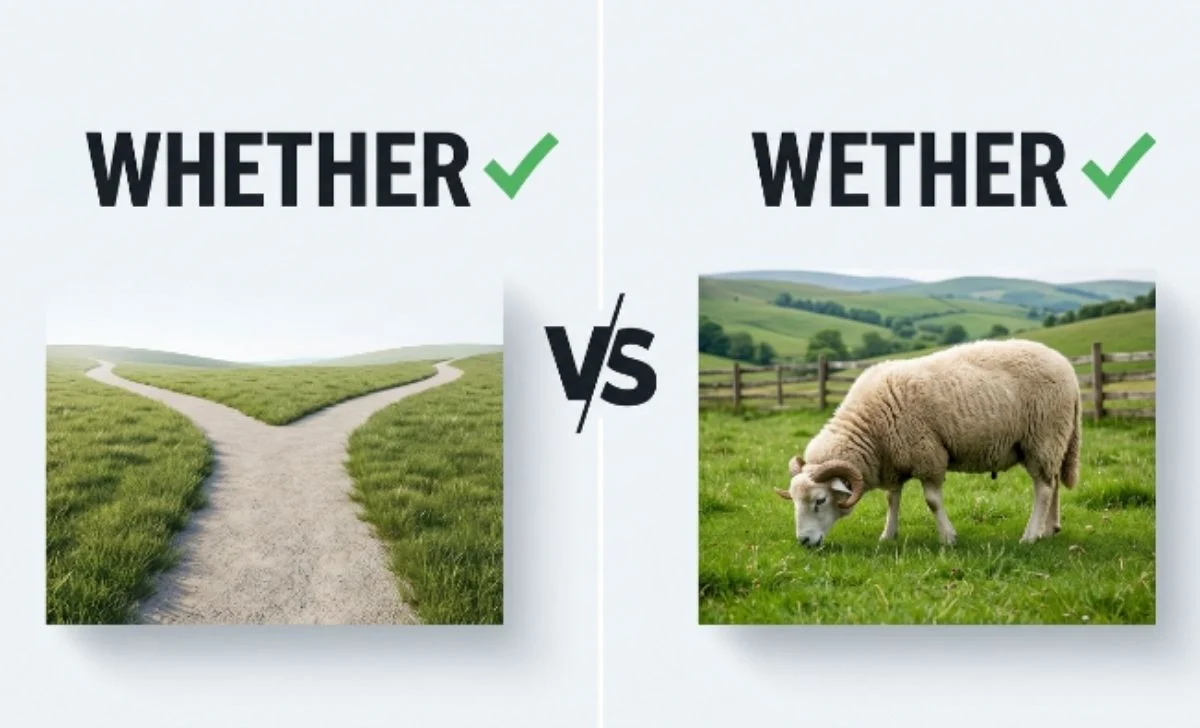
Wether and whether look almost identical, but they have completely different meanings. If you’re asking which word to use when you mean “if” or when presenting two possibilities, the correct spelling is whether.
Wether is a real English word too, but it is a rare term for a castrated male sheep.
The confusion is easy to understand because wether and whether are pronounced the same in standard English. However, they cannot normally be used interchangeably.
Wether or Whether: Quick Answer
Whether is the correct word when you mean “if,” “regardless of which,” or when discussing alternatives.
Wether is a specialized agricultural term referring to a castrated male sheep.
| Word | Meaning | Example |
|---|---|---|
| Whether | if; which of two or more possibilities | I don’t know whether she will come. |
| Wether | a castrated male sheep | The farmer raised a wether for its wool. |
The easiest way to remember
Whether = choice or possibility
I don’t know whether to stay.
Wether = sheep
The wether was grazing in the field.
If your sentence is about a decision, condition, or possibility, you almost certainly need whether.
What Does Whether Mean?
Whether is a conjunction used to introduce alternatives, uncertainty, or a condition.
It is often followed by or, but or not is not always necessary.
Whether means “if”
I don’t know whether he is coming.
This means:
I don’t know if he is coming.
Whether introduces alternatives
We need to decide whether to drive or take the train.
The sentence presents two options: drive or take the train.
Whether can be followed by “or not”
I don’t know whether or not they will agree.
It can also appear without or not:
I don’t know whether they will agree.
Both are grammatically correct.
What Does Wether Mean?
Wether is a noun with a very specific meaning. It refers to a male sheep that has been castrated, especially one kept for purposes such as wool or meat.
It is not a common everyday word.
Examples
- The farmer bought a young wether.
- Several wethers were grazing near the barn.
- The shepherd separated the wethers from the breeding rams.
You are most likely to encounter wether in agricultural, farming, veterinary, or historical contexts.
Wether vs Whether: The Main Difference
The simplest distinction is:
Whether = a choice, possibility, or uncertainty
Wether = a castrated male sheep
Compare these sentences:
I can’t decide whether to go.
The wether was standing near the fence.
The words sound alike, but their meanings have nothing in common.
| Feature | Whether | Wether |
|---|---|---|
| Part of speech | Usually conjunction | Noun |
| Main meaning | If; alternatives; possibilities | Castrated male sheep |
| Common in everyday English? | Yes | No |
| Related to decisions? | Yes | No |
| Related to farming? | Sometimes | Yes |
| Example | I wonder whether she’ll come. | The wether is in the pasture. |
Whether vs If: Are They the Same?
In many sentences, whether and if can be used in similar ways.
I don’t know whether he will come.
I don’t know if he will come.
Both are natural.
However, whether is generally the better choice when the sentence involves explicit alternatives.
I don’t know whether to stay or leave.
It is also preferred in certain formal constructions.
When Should You Use Whether?
Use whether when you are talking about:
- two or more alternatives
- uncertainty
- a choice
- possibilities
- a condition involving alternatives
Examples
She asked whether I wanted tea or coffee.
We haven’t decided whether to buy the house.
I wonder whether they know the truth.
He couldn’t decide whether to call or wait.
Tell me whether you agree.
Whether With “Or”
A common structure is:
whether + option A + or + option B
Examples
I don’t know whether to stay or leave.
We need to decide whether to travel by car or train.
She asked whether we wanted pizza or pasta.
You can also use:
whether … or not
We will go whether or not it rains.
Here, the meaning is similar to regardless of whether it rains.
Whether or Not vs Whether
Both structures are useful, but they can have slightly different emphasis.
Whether
I don’t know whether he will come.
This expresses uncertainty.
Whether or not
I don’t know whether or not he will come.
This makes both possibilities explicit: he may come, or he may not.
In another construction, whether or not can mean regardless of whether:
I’ll support you whether or not you agree with me.
The decision does not depend on the other person’s agreement.
Common Mistakes With Wether and Whether
Mistake 1: Using wether for “if”
Incorrect:
I don’t know wether she will arrive.
Correct:
I don’t know whether she will arrive.
Mistake 2: Thinking wether is simply a misspelling
Wether is not always a spelling mistake. It is a legitimate English noun.
The problem is that it has a very different meaning.
The wether was grazing.
Here, wether is correct because the sentence is about a sheep.
Mistake 3: Confusing whether with weather
There is another word that sounds similar:
Weather = conditions in the atmosphere.
The weather is cold today.
Whether = if or which possibility.
I don’t know whether it will snow.
Wether = castrated male sheep.
The wether is in the field.
These three words are easy to confuse in speech.
Whether vs Weather vs Wether
This three-way comparison is especially useful because all three words can sound very similar.
| Word | Meaning | Example |
|---|---|---|
| Whether | if; alternatives | I don’t know whether to go. |
| Weather | atmospheric conditions | The weather is beautiful. |
| Wether | castrated male sheep | The wether is grazing. |
A simple memory trick
Think:
Whether → choice
Weather → rain, wind, sunshine
Wether → sheep
If you’re talking about a decision, use whether.
If you’re talking about rain or temperature, use weather.
If you’re talking about a particular type of male sheep, use wether.
Real-Life Examples of Whether
At work
Please let me know whether you can attend the meeting.
At school
The teacher asked whether we had completed the assignment.
While making plans
We’re deciding whether to travel this weekend.
In conversation
I’m not sure whether I should call him.
In formal writing
The study examined whether the treatment improved the results.
In each case, whether expresses uncertainty, a question, or alternatives.
Real-Life Examples of Wether
Because wether is uncommon, its use is mostly associated with farming and animal husbandry.
The farmer kept several wethers in the pasture.
The young wether was separated from the breeding flock.
The shepherd inspected each wether before moving the flock.
You would not normally use wether in an ordinary sentence about uncertainty.
How Do You Pronounce Whether?
In most varieties of modern English, whether is pronounced like wether and weather, although pronunciation can vary by speaker and region.
A common pronunciation is approximately:
WHETH-er
The pronunciation is one reason these words are frequently confused when heard rather than seen.
The spelling therefore matters.
Is Wether a Common English Word?
No. Wether is a legitimate dictionary word, but it is relatively uncommon in everyday English.
Most people are far more likely to encounter:
- whether
- weather
than wether.
If you are writing an email, essay, article, or everyday message and you have written wether, check whether you actually mean whether or weather.
Whether in Formal and Academic Writing
Whether is very common in formal and academic English.
Examples include:
The researchers examined whether age affected the results.
The study investigated whether the two methods produced similar outcomes.
The report considers whether further research is necessary.
In academic writing, whether is often useful when presenting alternatives or describing an unresolved question.
Word Origin of Whether
Whether has a long history in English. It comes from Old English hwæther, related to the idea of which of two or which one.
Its connection with alternatives explains why modern English uses whether when presenting choices or possibilities.
The word has remained common for centuries and is now a basic part of everyday English.
Word Origin of Wether
Wether also comes from Old English, from a word referring to a castrated male sheep.
Although the term has survived into modern English, its use has become specialized.
This is why wether can look familiar without being a word most people use regularly.
Wether or Whether: Which One Should You Use?
Use whether in almost every ordinary situation involving a choice, possibility, or uncertainty.
Use wether only when you specifically mean a castrated male sheep.
Compare
I don’t know whether to buy it.
Correct because the sentence describes a choice.
The farmer bought a wether.
Correct because the sentence refers to a sheep.
I don’t know wether to buy it.
Incorrect because wether does not mean “if.”
Frequently Asked Questions
Is whether or wether correct?
Both are correct English words, but they have different meanings. Whether means “if” or introduces alternatives. Wether means a castrated male sheep.
Is wether a real word?
Yes. Wether is a real English noun used mainly in farming and animal-related contexts.
Is whether the same as if?
Often, yes. Whether can frequently be replaced by if, especially when expressing uncertainty. However, whether is preferred in many sentences involving alternatives.
Is wether the same as weather?
No. Wether means a castrated male sheep, while weather refers to atmospheric conditions.
How do you remember whether vs wether?
Remember: whether = choice, wether = sheep, and weather = atmosphere.
Which is correct: “I don’t know wether”?
The correct sentence is:
I don’t know whether.
Use whether when you mean “if.”
Can whether be used without or?
Yes.
I don’t know whether she is coming.
You do not always need whether … or.
Can you say whether or not?
Yes.
I don’t know whether or not they will arrive.
This is grammatically correct and commonly used.
Wether or Whether: Quick Practice Quiz
Choose the correct word.
1. I don’t know ___ she will come.
Answer: whether
The sentence expresses uncertainty.
2. The farmer raised a ___.
Answer: wether
The sentence refers to a castrated male sheep.
3. We need to decide ___ to stay or leave.
Answer: whether
The sentence presents two alternatives.
4. The ___ is getting colder.
Answer: weather
This sentence is about atmospheric conditions.
5. She asked ___ I wanted tea or coffee.
Answer: whether
The sentence presents two choices.
Final Answer: Wether or Whether?
Whether is the word you need when you mean “if,” “which option,” or when discussing uncertainty and alternatives.
Wether is a real but uncommon word meaning a castrated male sheep.
And don’t forget the third look-alike:
Whether = choice or possibility
Wether = castrated male sheep
Weather = atmospheric conditions
If you’re writing a normal sentence such as “I don’t know ___ she will come,” the answer is whether.
Read More:

Hi, I’m Safdar Ali, an English language teacher with 26 years of teaching experience. My expertise is in English linguistics, grammar, and the differences between British and American English.
Through Gramiffy, I share practical, research-based guides to help students, writers, and English learners improve their language skills. My goal is to make English simple, accurate, and easy for everyone to understand.