Eg and ie are two common abbreviations that often appear in writing, but they serve different purposes.
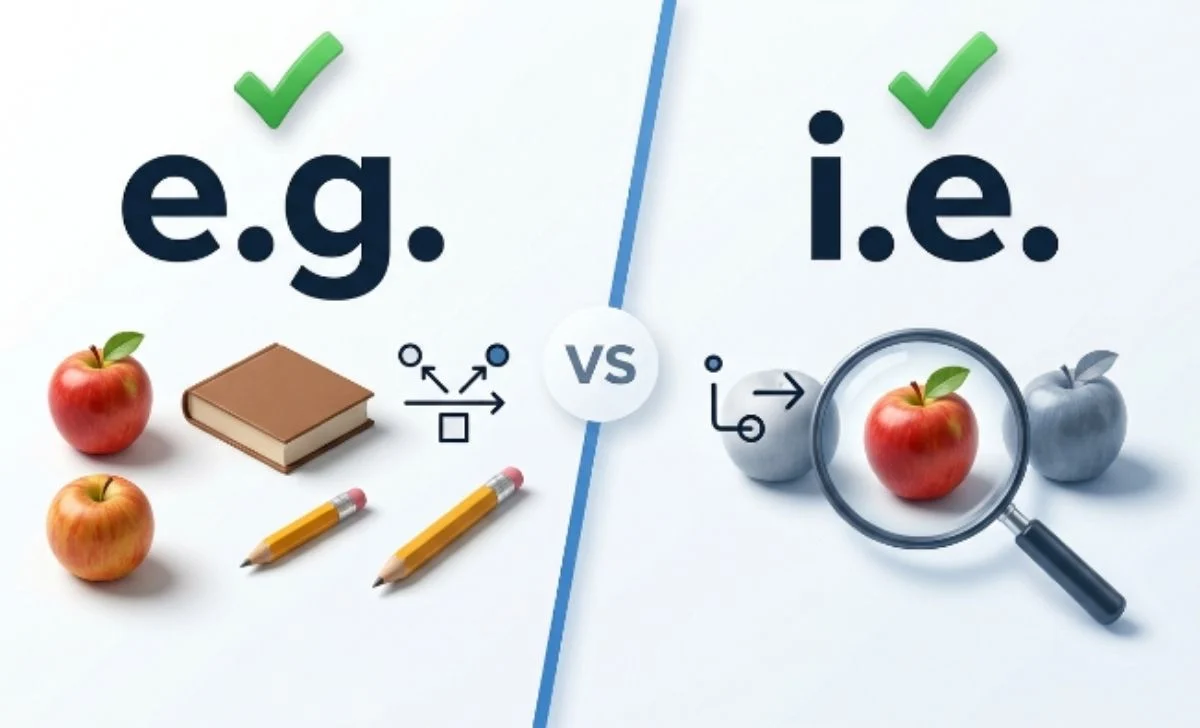
E.g. means “for example,” while i.e. means “that is” or “in other words.” The easiest way to remember them is: e.g. introduces an example, while i.e. clarifies or restates something.
Eg vs Ie: Quick Answer
E.g. is used when you want to give one or more examples.
I.e. is used when you want to explain exactly what you mean or restate something more clearly.
| Abbreviation | Meaning | Use | Example |
|---|---|---|---|
| e.g. | for example | Introduces examples | Bring a fruit, e.g., an apple or banana. |
| i.e. | that is / in other words | Clarifies or specifies | He works remotely, i.e., from home. |
Quick rule: e.g. = example given; i.e. = in explanation.
What Does E.g. Mean?
E.g. comes from the Latin phrase exempli gratia, meaning “for the sake of example.”
In modern English, it means “for example.”
Use e.g. when the item or items that follow are examples of a larger category.
Examples
- You can use citrus fruits, e.g., oranges and lemons.
- Several countries, e.g., Canada and Australia, use English widely.
- I enjoy outdoor activities, e.g., hiking and cycling.
- Bring something to read, e.g., a magazine or book.
Notice that the examples do not represent the entire category.
If you say:
I like fruit, e.g., apples and oranges.
You are giving examples of fruit, not saying that apples and oranges are the only fruit you like.
What Does I.e. Mean?
I.e. comes from the Latin phrase id est, meaning “that is.”
It is used when you want to clarify, define, narrow down, or restate what you have just said.
Examples
- The meeting is on the weekend, i.e., Saturday or Sunday.
- She is my only sibling, i.e., my sister.
- Please arrive before noon, i.e., by 12:00 p.m.
- He lives in the capital, i.e., London.
Here, the information after i.e. explains exactly what the writer means.
Eg vs Ie: The Main Difference
The difference becomes easy when you ask one question:
Am I giving an example, or am I explaining exactly what I mean?
If you’re giving an example, use e.g.
If you’re clarifying or restating the meaning, use i.e.
| Situation | Correct | Example |
|---|---|---|
| Giving an example | e.g. | I like citrus fruit, e.g., oranges. |
| Clarifying meaning | i.e. | I work weekdays, i.e., Monday to Friday. |
| Listing possibilities | e.g. | Try a warm drink, e.g., tea. |
| Defining something | i.e. | She is a vegetarian, i.e., she does not eat meat. |
E.g. Means “For Example”
A simple way to remember e.g. is to connect the e with example.
E.g. = Example
This is not the literal expansion of the Latin phrase, but it is a useful English memory trick.
Example
There are many ways to exercise, e.g., walking, swimming, and cycling.
Walking, swimming, and cycling are only examples. Other forms of exercise are possible.
I.e. Means “In Other Words”
A useful memory trick for i.e. is:
I.e. = in other words
This is not the literal Latin translation, but it helps you remember its function.
Example
The store closes early today, i.e., at 5 p.m.
The second part explains exactly what “early” means in this context.
E.g. vs I.e. in Real-Life Writing
In emails
We need someone with technical skills, e.g., coding or data analysis experience.
You’re providing examples of technical skills.
Please send the document today, i.e., before 5 p.m.
You’re specifying exactly what “today” means in practical terms.
In academic writing
Several factors affect language learning, e.g., motivation, exposure, and practice.
These are examples.
The study focused on adult learners, i.e., participants aged 18 and older.
The second part defines or clarifies the group.
In everyday writing
You can contact me through several apps, e.g., WhatsApp or Messenger.
We need to leave early, i.e., before the traffic gets heavy.
Common Mistakes With E.g. and I.e.
Using i.e. when giving examples
❌ You can eat citrus fruits, i.e., oranges and lemons.
If oranges and lemons are merely examples, e.g. is better.
✅ You can eat citrus fruits, e.g., oranges and lemons.
Using e.g. when you mean “that is”
❌ I need the original document, e.g., the signed contract you received yesterday.
If you mean one specific document, i.e. may be appropriate.
✅ I need the original document, i.e., the signed contract you received yesterday.
The second phrase identifies exactly which document you mean.
Treating them as interchangeable
They are not interchangeable.
Compare:
Bring a dessert, e.g., cake or ice cream.
This gives examples.
Bring the dessert, i.e., the cake we ordered yesterday.
This identifies a specific dessert.
Changing the abbreviation can change the meaning of the sentence.
Should You Write Eg or E.g.?
The standard abbreviation is e.g., with periods after both letters in traditional American style.
You may also see eg without periods, especially in some British English writing and modern styles.
Both forms can appear in English, but e.g. is widely recognized and remains a safe choice in formal writing.
Example
Traditional:
Choose a fruit, e.g., an apple.
Alternative style:
Choose a fruit, eg, an apple.
For consistency, follow the style guide used by your school, workplace, publication, or organization.
Should You Write Ie or I.e.?
The standard traditional form is i.e., with periods after both letters.
You may also see ie without periods in some modern writing styles.
Example
The deadline is tomorrow, i.e., Friday.
In formal writing, i.e. is generally the safest and most recognizable form unless your chosen style guide specifies otherwise.
Commas With E.g. and I.e.
When these abbreviations appear within a sentence, they are commonly followed by a comma.
Examples
I enjoy several sports, e.g., tennis and swimming.
We need to finish today, i.e., before midnight.
American style commonly places a comma after the abbreviation.
However, punctuation practices vary by style guide and region. The important point is to use one consistent style throughout your writing.
E.g. vs I.e.: Punctuation and Capitalization
Both abbreviations are normally written in lowercase when they occur in the middle of a sentence:
- e.g.
- i.e.
At the beginning of a sentence, some style guides prefer rewriting the phrase rather than beginning with an abbreviation.
Instead of:
E.g., you could use an online dictionary.
A clearer version is:
For example, you could use an online dictionary.
This is often better for readability, especially in formal or educational writing.
E.g. vs I.e. in British and American English
Both e.g. and i.e. are widely used in British and American English.
The difference is not primarily British vs American. It is a difference in meaning and function.
| Feature | American English | British English |
|---|---|---|
| E.g. | Common | Common |
| Eg | Also seen in some styles | Common in some styles |
| I.e. | Common | Common |
| Ie | Seen in some modern styles | Seen in some modern styles |
| Meaning of e.g. | For example | For example |
| Meaning of i.e. | That is | That is |
The main issue is therefore not which variety of English you are using. It is whether you are giving an example or clarifying a statement.
A Simple Memory Trick
Remember these two shortcuts:
E.g. = Example
Think:
E = Example
Use it when you could replace the abbreviation with “for example.”
I.e. = In other words
Think:
I = In other words
Use it when you could replace the abbreviation with “that is” or “in other words.”
Quick test
Try replacing the abbreviation.
If “for example” works, use e.g.
If “that is” works, use i.e.
For example:
I like tropical fruits, ___ mangoes and pineapples.
“For example” works → e.g.
The shop closes early, ___ at 4 p.m.
“That is” works → i.e.
Frequently Asked Questions
What is the difference between e.g. and i.e.?
E.g. means “for example” and introduces examples. I.e. means “that is” or “in other words” and clarifies or specifies something.
Is it eg or e.g.?
E.g. is the traditional and widely recognized form. Eg is also used in some modern and British English styles. Follow the style guide you’re using.
Is it ie or i.e.?
I.e. is the traditional form. Ie is also used in some modern styles.
Does e.g. mean for example?
Yes. E.g. comes from the Latin exempli gratia and is used in English to mean “for example.”
Does i.e. mean in other words?
Yes, i.e. can often be understood as “in other words.” Its Latin source, id est, literally means “that is.”
Can I use e.g. and i.e. interchangeably?
No. E.g. introduces examples, while i.e. clarifies or identifies exactly what you mean.
Which is better for formal writing, e.g. or i.e.?
Both are appropriate in formal writing when used correctly. If there is any chance your reader may not understand them, writing “for example” or “that is” can be clearer.
Is e.g. capitalized?
It is normally written as e.g. in lowercase within a sentence. Capitalization can depend on where it appears and the style being followed.
Is i.e. capitalized?
It is normally written as i.e. in lowercase within a sentence.
E.g. vs I.e. Practice Quiz
Choose e.g. or i.e. in each sentence.
1. I enjoy outdoor sports, ___ hiking and cycling.
Answer: e.g.
Hiking and cycling are examples of outdoor sports.
2. The office closes at noon, ___ 12 p.m.
Answer: i.e.
The second part specifies exactly what noon means in this context.
3. You can use several browsers, ___ Chrome, Firefox, or Safari.
Answer: e.g.
These are examples of browsers.
4. She is an only child, ___ she has no brothers or sisters.
Answer: i.e.
The second part explains exactly what “only child” means.
5. Bring a warm jacket, ___ a coat or sweater.
Answer: e.g.
The coat and sweater are examples of suitable clothing.
Conclusion
E.g. and i.e. are not interchangeable. Use e.g. when you are giving examples, and use i.e. when you are clarifying or restating exactly what you mean.
Remember the easiest shortcut: e.g. = example and i.e. = in other words. If you’re unsure, replace the abbreviation with “for example” or “that is.” The phrase that fits the sentence tells you which abbreviation to use.
Read More:

Hi, I’m Safdar Ali, an English language teacher with 26 years of teaching experience. My expertise is in English linguistics, grammar, and the differences between British and American English.
Through Gramiffy, I share practical, research-based guides to help students, writers, and English learners improve their language skills. My goal is to make English simple, accurate, and easy for everyone to understand.