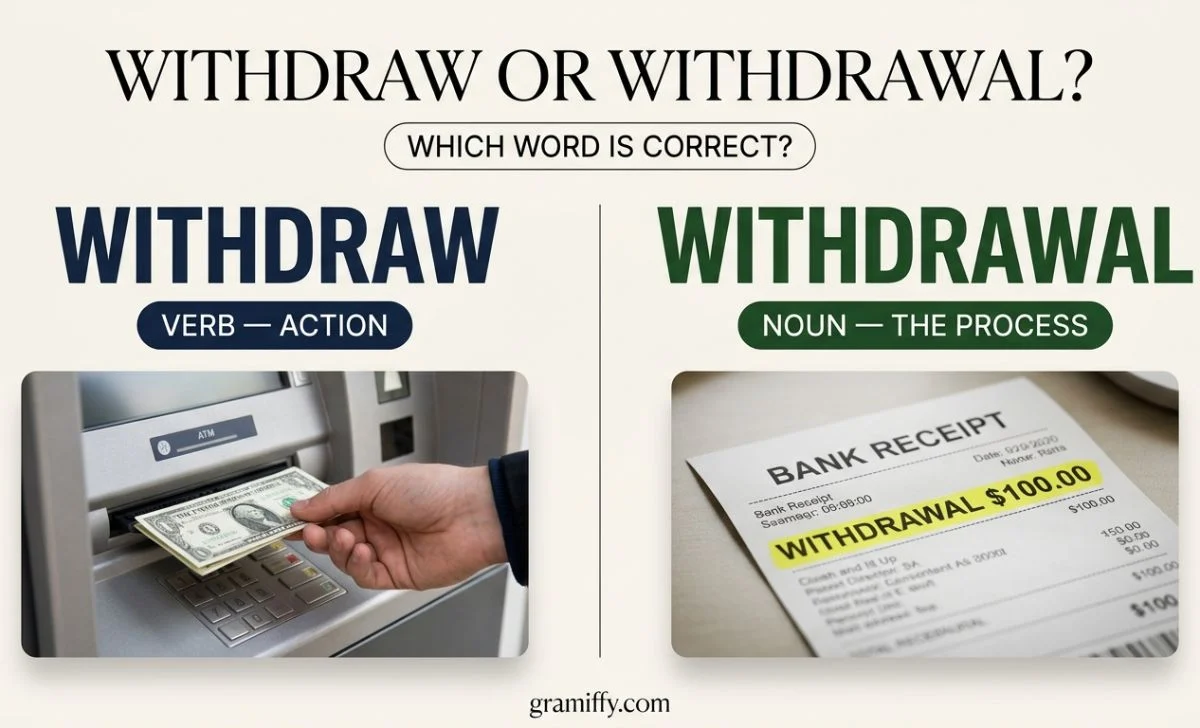
The difference between withdraw and withdrawal may look small, but using the wrong word can make an otherwise correct sentence sound awkward.
Should you write “I want to withdraw money” or “I want to withdrawal money”? Only one is grammatically correct.
The confusion usually comes from the fact that both words relate to taking something back, removing something, or taking money out of an account.
However, they do different jobs in a sentence. Withdraw is a verb that describes an action, while withdrawal is a noun that names the action or process.
Once you understand this simple distinction, choosing the right word becomes much easier.
In this guide, you’ll learn their meanings, see practical examples, avoid common mistakes, and discover a quick rule you can use whenever you’re unsure.
Quick Answer: Withdraw or Withdrawal?
Withdraw is a verb that describes an action. Withdrawal is a noun that names the action, process, or result.
| Word | Part of speech | Meaning | Example |
|---|---|---|---|
| Withdraw | Verb | To take something back, remove it, or leave something | I need to withdraw money. |
| Withdrawal | Noun | The act or process of withdrawing | I made a withdrawal. |
Remember this simple rule:
You withdraw money, but you make a withdrawal.
More examples:
- Correct: She decided to withdraw her application.
- Correct: Her withdrawal from the program surprised everyone.
- Incorrect: She decided to withdrawal her application.
- Incorrect: Her withdraw from the program surprised everyone.
The problem in the incorrect examples is not spelling. Both words are spelled correctly, but the wrong grammatical form has been used.
What Does Withdraw Mean?
Withdraw is a verb meaning to take something away, remove something, pull back, or stop participating in an activity.
It can describe physical actions, financial transactions, decisions, and changes in participation.
1. Withdraw money
In banking, withdraw means to take money out of an account.
Examples:
- I need to withdraw $100 from my bank account.
- She withdrew some cash before going shopping.
- You can withdraw money from an ATM.
Notice that the verb describes the action of taking money out.
2. Withdraw an application
You can use withdraw when you decide not to continue an application or request.
Examples:
- He decided to withdraw his university application.
- I want to withdraw my job application before the deadline.
- She withdrew her application after accepting another offer.
3. Withdraw an offer or statement
The verb can also describe taking back something previously offered or said.
Examples:
- The company decided to withdraw its job offer.
- The politician refused to withdraw his statement.
- The manufacturer withdrew the product from the market.
4. Withdraw from an activity
You can withdraw when you stop participating in a course, competition, agreement, or other activity.
Examples:
- The athlete decided to withdraw from the race.
- She plans to withdraw from the course.
- The team withdrew from the competition because of an injury.
Grammar tip: When you need a word that describes the action someone performs, withdraw is usually the form you need.
What Does Withdrawal Mean?
Withdrawal is a noun. It refers to the act, process, or result of withdrawing.
It can describe a bank transaction, the decision to leave an activity, the removal of an offer, or certain physical symptoms associated with stopping a substance.
1. Withdrawal from a bank account
In banking, a withdrawal is the money taken out of an account or the transaction through which it is taken out.
Examples:
- I made a cash withdrawal this morning.
- The bank charged a fee for the withdrawal.
- Your withdrawal has been processed successfully.
Compare these sentences:
- I need to withdraw cash.
- I need to make a cash withdrawal.
Both are correct, but the first uses a verb and the second uses a noun.
2. Withdrawal from a course or program
Withdrawal can name the process or decision of leaving a course, school, or program.
Examples:
- Her withdrawal from the university was unexpected.
- The deadline for course withdrawal is Friday.
- The school received his withdrawal request.
3. Withdrawal of an offer
When an offer is taken back, the act can be called a withdrawal.
Examples:
- The withdrawal of the job offer disappointed him.
- The company announced the withdrawal of its proposal.
- The product’s withdrawal from the market affected several retailers.
4. Withdrawal in health-related contexts
In medical contexts, withdrawal can refer to symptoms that occur when someone reduces or stops using certain substances or medications. The precise meaning depends on the situation.
Example:
- The doctor explained the possible symptoms of medication withdrawal.
This is another noun use: withdrawal names a process or condition rather than describing the action with a verb.
Withdraw vs. Withdrawal: Key Differences
The easiest way to distinguish the two words is to look at what the sentence is doing.
| Feature | Withdraw | Withdrawal |
|---|---|---|
| Part of speech | Verb | Noun |
| Main function | Describes an action | Names an action, process, or result |
| Common pattern | Withdraw money | Make a withdrawal |
| Application | Withdraw an application | Application withdrawal |
| Education | Withdraw from a course | Course withdrawal |
| Business | Withdraw an offer | Withdrawal of an offer |
| Example | They withdrew from the race. | Their withdrawal surprised us. |
Compare the same idea
Banking
- Verb: I will withdraw money tomorrow.
- Noun: My withdrawal is scheduled for tomorrow.
Education
- Verb: She decided to withdraw from the course.
- Noun: Her withdrawal from the course was approved.
Business
- Verb: The company will withdraw its proposal.
- Noun: The withdrawal of the proposal was unexpected.
The meaning remains closely related. The grammatical role changes.
How to Choose the Correct Word in Three Steps
When you are unsure whether to use withdraw or withdrawal, follow this simple test.
Step 1: Ask whether the sentence describes an action
If someone is doing something, you probably need the verb withdraw.
- I want to withdraw my application.
- They will withdraw the offer.
- She plans to withdraw from the competition.
Step 2: Ask whether the sentence names an event or process
If you are talking about the act or result of withdrawing, use the noun withdrawal.
- The withdrawal of the application was confirmed.
- The company announced the withdrawal of its offer.
- His withdrawal from the competition surprised the fans.
Step 3: Check the surrounding words
The words around the blank can help you decide.
For example:
- I need to _ some money. Answer: withdraw. After need to, the base form of a verb is required.
- I made a _ yesterday. Answer: withdrawal. The phrase made a calls for a noun in this sentence.
- The company will _ its offer. Answer: withdraw. After the modal verb will, use the base form of the verb.
- The company announced the _ of its offer. Answer: withdrawal. The sentence needs a noun after the.
These clues are useful, but always consider the complete sentence rather than relying on a single word.
What Are the Correct Forms of Withdraw?
Another common source of confusion is the verb’s irregular past tense. The forms withdrew and withdrawn are especially important.
| Verb form | Correct word | Example |
|---|---|---|
| Base form | Withdraw | I withdraw money when needed. |
| Third-person singular | Withdraws | He withdraws cash every Friday. |
| Present participle | Withdrawing | She is withdrawing her application. |
| Simple past | Withdrew | They withdrew the offer yesterday. |
| Past participle | Withdrawn | The company has withdrawn the offer. |
| Related noun | Withdrawal | The withdrawal was confirmed. |
Is it withdrew or withdrawn?
Both are correct, but they are used differently.
Use withdrew for the simple past:
- She withdrew her application last week.
- They withdrew from the competition.
Use withdrawn with auxiliary verbs such as has, have, or had:
- She has withdrawn her application.
- They had withdrawn from the competition before the final round.
Is withdrawed correct?
Withdrawed is not the standard past-tense form in modern English. The correct forms are withdrew and withdrawn.
Remember:
Withdraw → Withdrew → Withdrawn
Do not confuse these verb forms with withdrawal, which is a noun.
Common Mistakes With Withdraw and Withdrawal
Here are some mistakes writers frequently make and how to correct them.
| Incorrect sentence | Correct sentence | Why? |
|---|---|---|
| I want to withdrawal money. | I want to withdraw money. | The phrase want to takes the base verb. |
| I made a withdraw. | I made a withdrawal. | The sentence needs a noun. |
| She will withdrawal her application. | She will withdraw her application. | Use the base verb after will. |
| The withdraw was processed. | The withdrawal was processed. | The sentence needs a noun. |
| He has withdrew his offer. | He has withdrawn his offer. | Use the past participle after has. |
| They withdrawed from the race. | They withdrew from the race. | Withdrew is the correct simple past. |
| We requested a withdraw of the proposal. | We requested a withdrawal of the proposal. | The noun withdrawal fits this construction. |
The mistake to remember
The most common error is using withdrawal after to when the sentence requires a verb.
Incorrect: I need to withdrawal cash.
Correct: I need to withdraw cash.
The word withdrawal is not wrong by itself. It is wrong in that particular sentence because the grammar requires a verb.
Withdraw or Withdrawal in Everyday English
The difference becomes easier when you learn a few common phrases.
| Expression | Correct usage | Example |
|---|---|---|
| Withdraw money | Verb | I need to withdraw money. |
| Make a withdrawal | Noun | I made a withdrawal yesterday. |
| Withdraw an application | Verb | She withdrew her application. |
| Withdrawal request | Noun | Your withdrawal request was received. |
| Withdraw an offer | Verb | The company withdrew its offer. |
| Withdrawal of an offer | Noun | The withdrawal of the offer was unexpected. |
| Withdraw from a course | Verb | He withdrew from the course. |
| Course withdrawal | Noun | Course withdrawal requires approval. |
Learning these phrases can help you use both words naturally without memorizing a complicated grammar rule.
Quick Quiz: Withdraw or Withdrawal?
Choose the correct word for each sentence.
1. I need to _ money from the ATM.
A. Withdrawal
B. Withdraw
2. The bank confirmed my cash _.
A. Withdraw
B. Withdrawal
3. She has _ her application.
A. Withdrew
B. Withdrawn
4. The company decided to _ its offer.
A. Withdraw
B. Withdrawal
5. His _ from the competition surprised everyone.
A. Withdraw
B. Withdrawal
Answers and explanations
- B — Withdraw. The phrase need to requires the base form of the verb.
- B — Withdrawal. The sentence needs a noun after cash.
- B — Withdrawn. The past participle follows has.
- A — Withdraw. The verb follows decided to.
- B — Withdrawal. The sentence names the act of leaving the competition.
If you answered all five correctly, you understand the main distinction.
FAQs
1. What is the difference between withdraw and withdrawal?
Withdraw is a verb meaning to take something out, remove it, or leave an activity. Withdrawal is a noun naming the act, process, or result of withdrawing.
Example: “I withdraw money” and “I make a withdrawal.”
2. Is it correct to say “withdraw money”?
Yes. Withdraw money is standard English. The verb describes taking money out of a bank account or another financial source.
Example: “I need to withdraw money before the trip.”
3. Is “make a withdraw” correct?
No, not in standard English when you mean a financial transaction. The correct expression is “make a withdrawal.”
Example: “I made a withdrawal from my account.”
4. What is the past tense of withdraw?
The simple past tense is withdrew.
Example: “She withdrew her application yesterday.”
The past participle is withdrawn, as in “She has withdrawn her application.”
5. Is it withdrew or withdrawn?
Both are correct forms of the verb withdraw. Use withdrew for the simple past and withdrawn with auxiliary verbs such as has, have, and had.
Examples: “He withdrew the offer.” “He has withdrawn the offer.”
6. Can withdrawal be used outside banking?
Yes. Withdrawal can describe leaving a course or competition, taking back an offer, removing a product from sale, or certain health-related processes. Its meaning depends on the context.
7. Is withdrawal a verb or a noun?
Withdrawal is a noun. The corresponding verb is withdraw.
Example: “They withdrew from the program” uses the verb, while “Their withdrawal was approved” uses the noun.
Conclusion: Withdraw or Withdrawal?
Withdraw is the verb; withdrawal is the noun. Both words are correct, but each serves a different grammatical purpose.
Use withdraw when describing an action:
- I need to withdraw money.
- She decided to withdraw her application.
Use withdrawal when naming the act, process, or result:
- I made a withdrawal.
- Her withdrawal from the program was approved.
Keep one simple rule in mind: You withdraw; you make a withdrawal.
Once you recognize whether your sentence needs a verb or a noun, you can choose the correct word with confidence.
Read More:

Hi, I’m Safdar Ali, an English language teacher with 26 years of teaching experience. My expertise is in English linguistics, grammar, and the differences between British and American English.
Through Gramiffy, I share practical, research-based guides to help students, writers, and English learners improve their language skills. My goal is to make English simple, accurate, and easy for everyone to understand.