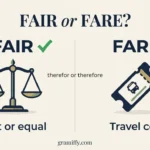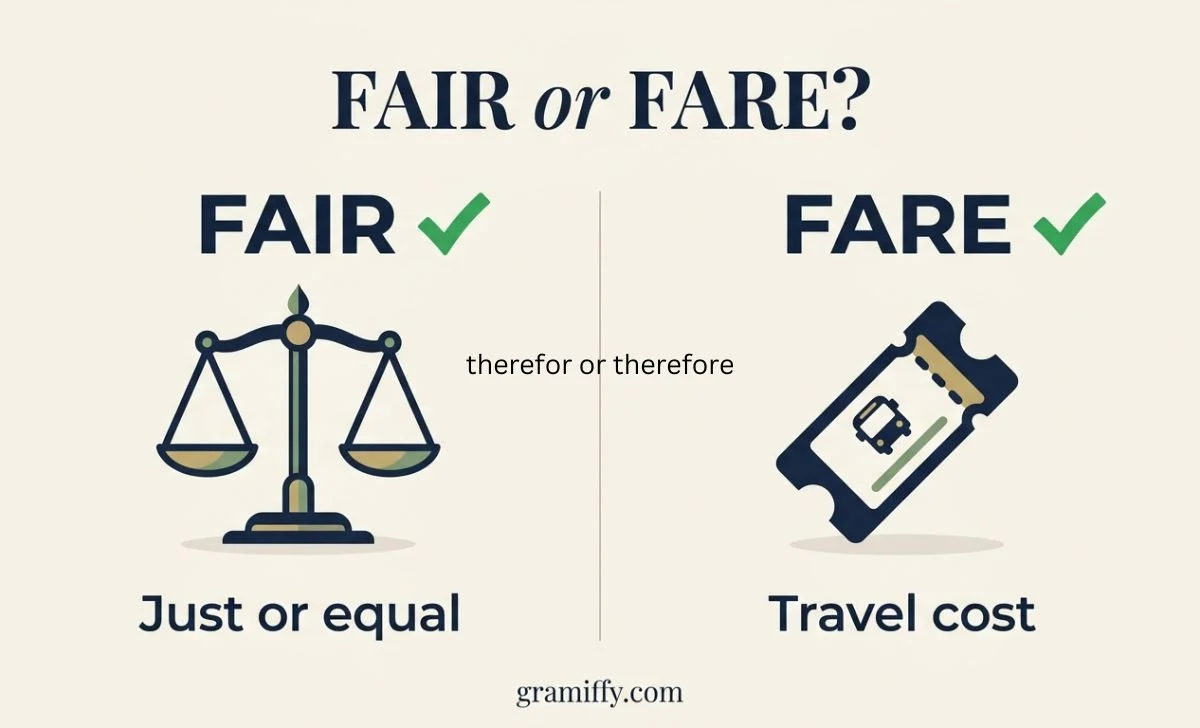
Fair means just, equal, pale, average, pleasant (of weather), or an event such as a county fair. Fare means the price of a ticket or ride, a kind of food, or, as a verb, “to get along”. The two words sound identical, which is why people mix them up in writing.
| Word | Main meanings | Example |
|---|---|---|
| fair | just or unbiased; pale; average; clear (weather); an event | That’s a fair price. We went to the county fair. |
| fare | ticket price; food; to get along | The bus fare is $3. How did you fare? |
Both words are pronounced the same way, as /fɛər/. That means spelling is the only clue, so it helps to understand what each word actually means.
A quick memory trick
- Fare contains far. You travel far and pay a fare.
- Fair contains air and I. Fair weather is clear air, and “I want it to be fair.”
If the sentence is about travel, a ticket, food or how someone is doing, write fare. If it’s about justice, looks, quality, weather or an event, write fair.
What “fair” means
Fair is one of the most flexible words in English. Dictionary.com lists senses including honest and free from bias, proper and according to the rules, average, moderately large, attractive, nice weather and favorable. Here they are with examples.
| Meaning | Example |
|---|---|
| Just, equal, unbiased | The judge gave both sides a fair hearing. |
| According to the rules | It was a fair fight. |
| Average, so-so | The food was fair, nothing special. |
| Ample | She earns a fair income. |
| Pale (skin or hair) | He has fair hair and light eyes. |
| Clear, pleasant (weather) | We’ll go out if the weather stays fair. |
| An event with stalls or rides | We spent the day at the county fair. |
Fair also works as an adverb, as in play fair and fight fair.
Common phrases with “fair”
Popular phrases include fair and square, a fair deal, fair enough, fair’s fair, no fair and by fair means or foul. You may also hear fair game (a reasonable target) and fair-weather friend (someone who is only around when things go well).
What “fare” means
Fare has three main senses, and they’re all useful.
1. The price of a ride (noun).
- The bus fare went up this year.
- She didn’t have enough for the train fare.
- Common compounds include bus fare, flat fare, half fare, fare card, fare dodger and fare evasion.
2. Food or something offered (noun).
- The pub serves classic English fare.
- The festival’s fare ranged from tacos to ramen.
- The word can also mean something offered for entertainment, as in “highbrow fare” or “children’s fare”.
3. To get along (verb).
- How did you fare in the exam?
- The team didn’t fare well against the leaders.
- Small shops are faring better this year.
The verb is the one people most often write wrongly, so it gets its own section below.
Why does “fare” have so many meanings?
You might expect three unrelated meanings, and some sources say as much. But the origin points the other way: they all come from the idea of a journey.
- Etymonline traces the noun to Old English fær (“journey, road, passage”) and the verb to faran (“to journey, set forth, travel”), which also covered being in a particular condition.
- Merriam-Webster’s etymology gives the Middle English noun as meaning journey, passage or supply of food.
Here’s one way to see how the meanings connect:
- A journey needs passage, so the price of passage became the fare.
- A journey also needs supplies, so the provisions became fare as food.
- How a journey goes tells you how someone is getting along, so to fare means to do well or badly.
That’s also why farewell exists. The old travel meaning survives in farewell and “fare thee well”. To wish someone “fare well” was to wish them a good journey.
“Fare well” or “fair well”?
This is the most common mistake with the pair, and it’s worth getting right.
- ✅ She fared well in the interview.
- ❌ She fair well in the interview.
- ✅ The company is faring badly.
- ❌ The company is fairing badly.
One editor notes you fare badly rather than “fair badly”, and that this is the error they see most. The reason is simple: fare is the verb. Fair isn’t a verb at all, so any “to get along” sentence needs fare.
Related forms:
- farewell (one word) is the goodbye. They said their farewells.
- fare well (two words) is the verb phrase. Fare well on your trip.
- fare thee well is the old-fashioned goodbye.
What about “fayre”?
You’ll sometimes see fayre on signs for events, as in “Christmas Fayre”. It’s a pseudo-archaic spelling of fair. It isn’t a separate word.
Use fair in normal writing and keep fayre for names where the organizers have chosen it.
Fare vs fee vs price vs toll
Because fare is about paying for travel, it’s worth separating it from nearby words.
| Word | Used for | Example |
|---|---|---|
| fare | A passenger’s payment to travel | bus fare, airfare, taxi fare |
| fee | A charge for a service or entry | admission fee, booking fee |
| price | The cost of goods | the price of a ticket in a shop |
| toll | A charge to use a road or bridge | bridge toll |
| rate | A cost per unit | an hourly rate |
You pay a fare to ride the train, a fee to book it online, and a toll to cross the bridge on the way.
Fair fare: when both appear together
Sometimes the two words sit side by side, and the result is confusing. These are all correct:
- The bus fare is fair. (the ticket price is reasonable)
- The fair serves tasty fare. (the event offers good food)
- A fair fare for a short trip. (a reasonable price)
If you can read each word on its own, the sentence works. It’s simply two different words in a row.
Common mistakes
- Writing “bus fair”: the price is a fare. ✅ bus fare
- Writing “county fare”: the event is a fair. ✅ county fair
- Writing “fair well” or “fair badly”: the verb is fare. ✅ fare well, fare badly
- Writing “fare enough”: the phrase is fair enough.
- Writing “fare skin”: pale skin is fair.
- Writing “fare play”: the phrase is fair play.
- Splitting or merging “farewell”: the goodbye is one word, while the verb phrase “fare well” is two.
Why spellcheck won’t catch it
Fair and fare are both real words, so most spellcheckers won’t flag the wrong one.
That’s why these mistakes slip through proofreading. Before you publish, search your draft for both words and test each against the memory trick.
Quick quiz: fair or fare?
- “The train ______ to the city is $12.” → fare
- “That’s not ______! I was first in line.” → fair
- “How did the team ______ in the finals?” → fare
- “We spent the weekend at the county ______.” → fair
- “The pub serves hearty traditional ______.” → fare
- “She has ______ skin and freckles.” → fair
- “They said their ______s and left.” → farewell
- “She ______ well in her new job.” → fared
FAQs
Is it fair or fare?
Use fair for justice, looks, quality, weather or an event. Use fare for a ticket price, food, or “to get along”.
Do fair and fare sound the same?
Yes. They’re homophones, both pronounced /fɛər/.
Is it bus fare or bus fair?
Bus fare. The price of a ride is always a fare.
Is it county fare or county fair?
County fair. The event is a fair.
Is it “fare well” or “fair well”?
Fare well. Fare is the verb meaning “to get along”. Fair isn’t a verb.
Is it fair enough or fare enough?
Fair enough. It’s a fixed phrase meaning “that’s reasonable”.
What does fare mean?
It can mean the price of a ride, food or something offered, or “to get along or perform”.
What does fair mean?
It can mean just and unbiased, pale, average, clear (of weather) or a public event.
Is “fayre” correct?
It’s a pseudo-archaic spelling of fair, used mostly for event names. Use fair in ordinary writing.
Why does fare have so many meanings?
They all come from the idea of a journey: the price of passage, supplies for the trip and how someone is getting along.
Conclusion
Fair is about justice, quality, looks, weather or an event.
Fare is about travel and what comes with it: the ticket price, the food, and how you’re getting along.
If you remember that fare contains far, and you’re writing about a journey, a meal or “how did you fare?”, you’ll almost always choose correctly.
Read More:

Hi, I’m Safdar Ali, an English language teacher with 26 years of teaching experience. My expertise is in English linguistics, grammar, and the differences between British and American English.
Through Gramiffy, I share practical, research-based guides to help students, writers, and English learners improve their language skills. My goal is to make English simple, accurate, and easy for everyone to understand.