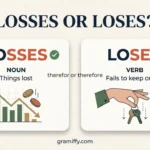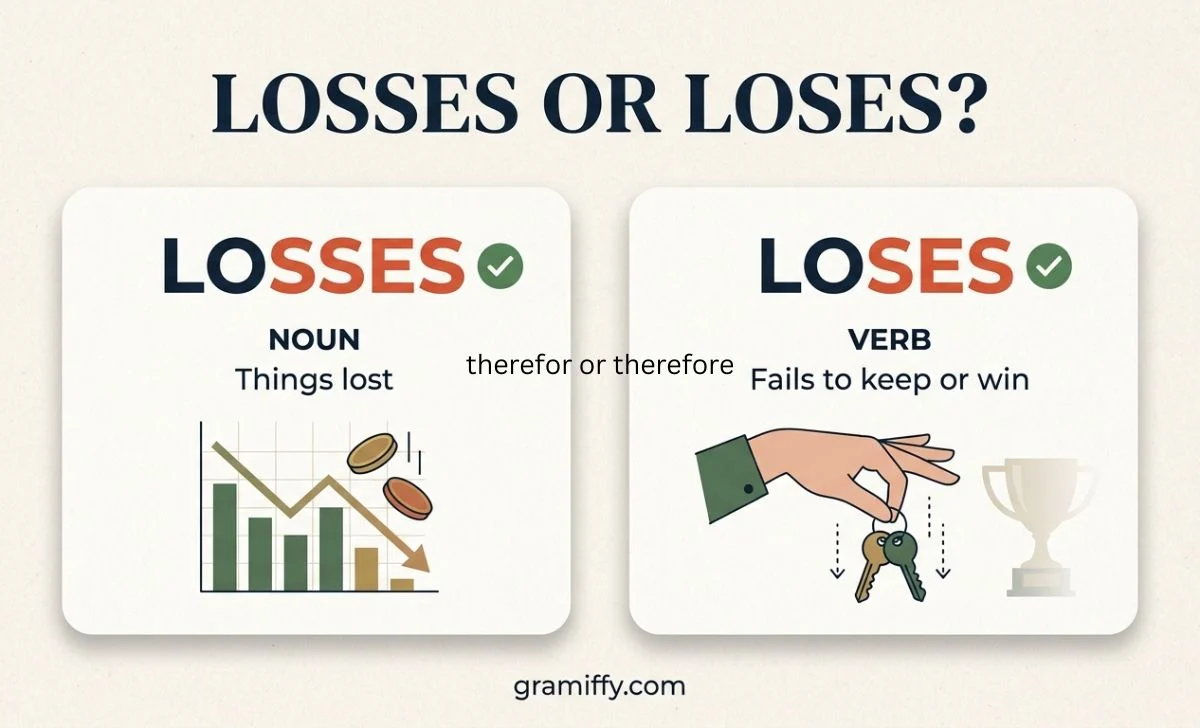
Loses is a verb. It’s what someone or something does: He loses his keys. Losses is a plural noun. It names the things that were lost: The company reported heavy losses.
| Word | Part of speech | Meaning | Example |
|---|---|---|---|
| loses | verb (he/she/it) | fails to keep, misplaces, or is defeated | She loses her temper quickly. |
| losses | plural noun | instances or amounts of losing | The team suffered three losses. |
Grammarly puts it the same way: losses is a noun referring to instances of losing, and loses is a verb describing the act of losing. The tricky part is that the two words look similar on the page, so a test helps.
The two-second test
If you’re stuck, try one of these.
1. The “loss” swap. Replace the word with loss (singular).
- If the sentence still works, you need losses. The company reported huge loss(es).
- If it doesn’t, you need loses. He loss(es) his keys. ❌ doesn’t work, so write loses.
2. The subject test. Loses always follows a subject such as he, she, it, the team or my dog, because it’s a verb. Losses usually follows words like heavy, many, three, the, our or their.
3. The meaning swap.
- If you can swap in misplaces, fails to keep or is defeated, write loses.
- If you can swap in defeats, deficits or casualties, write losses.
A memory trick
Look at the letters.
- Losses has a double s, like boss and moss. It names things you can count: three losses.
- Loses has a single s, and it’s what someone does.
If you can add a number in front (two losses), use the double-s version.
What “loses” means
Loses is the third-person singular present form of the verb lose. You use it with he, she, it or a singular noun. It can mean:
- To misplace: He always loses his glasses.
- To fail to keep: She loses focus after lunch.
- To be beaten: If our team loses again, we’re out.
- To stop having: The plant loses its leaves in autumn.
- To waste or fail to make money: The shop loses money every month.
LanguageTool’s examples are similar: a person who constantly loses important documents. With I, you, we and they, the verb drops the s: I lose, they lose.
What “losses” means
Losses is the plural of the noun loss. It refers to several instances of losing something, or the amounts lost. Dictionary.com says it’s commonly used for defeats in sports, casualties, and the opposite of profits.
Here are the main contexts:
| Context | Example |
|---|---|
| Business and finance | The firm posted net losses for the third year. |
| Sports | After four losses in a row, the coach resigned. |
| News and disasters | The storm caused heavy losses. |
| Employment | The closure means 200 job losses. |
| Personal | She talked about the losses she’d faced that year. |
| Insurance and legal | The policy covers losses from theft or fire. |
Common collocations include job losses, heavy losses and cut your losses, and in disaster reporting the plural can refer to deaths. In contracts, “Losses” is often a defined term that covers damages, liabilities, costs and fees.
What does “cut your losses” mean?
It means to stop putting time or money into something that isn’t working, so you don’t lose any more. After two bad quarters, they cut their losses and closed the branch.
The full word family
Many mistakes come from mixing up the forms. Here they all are in one place:
| Form | Part of speech | Example |
|---|---|---|
| lose | verb (base form) | I never lose my keys. |
| loses | verb (he/she/it) | He loses his keys. |
| losing | verb (-ing form) | We’re losing time. |
| lost | verb (past) / adjective | I lost my phone. / a lost dog |
| loss | noun (singular) | The loss was heavy. |
| losses | noun (plural) | The losses were heavy. |
| loser | noun (person) | The loser shook hands. |
| losers | noun (people) | Both losers went home. |
So loses and losses are simply the “he/she/it” verb and the plural noun from the same family.
How to pronounce them
These two words don’t sound the same, which is why the mistake is a spelling one, not a sound one.
- loses: LOO-ziz (long oo, with a “z” sound)
- losses: LOSS-iz (short vowel, with an “s” sound)
TextRanch notes that the s in “lose” has a “z” sound. That “z” is a clue that loses is the verb form, while losses keeps the hard “s” of the noun loss.
The loose trap: “looses” and “loosing”
Writers also confuse lose with loose, adding an extra o. TextRanch notes that “loses” and “losing” are often misspelled as “looses” and “loosing”.
- ✅ She loses her keys. ❌ She looses her keys.
- ✅ We’re losing time. ❌ We’re loosing time.
Here’s a twist. Looses and loosing are real words, but they belong to a different verb, loose, meaning to let go or release. One forum example shows someone “loosing the knot”. So the mistake isn’t a typo of a non-word. It’s a correctly spelled word with the wrong meaning, which is why spellcheck can’t help.
| You mean | Write |
|---|---|
| fails to keep | loses, losing |
| lets go, releases | looses, loosing |
Forms that don’t exist
Loss is only a noun, so it never takes verb endings. Thesaurus.com notes that “lossed” and “losed” are wrong past-tense forms.
- ❌ He lossed the game. ✅ He lost the game.
- ❌ She losed her job. ✅ She lost her job.
- ❌ The team lost many losses. ✅ The team suffered many losses.
Can you count them?
Loss works in two ways, which affects whether you need the plural.
- Countable (use “losses”): The company had three losses this year.
- Uncountable (use “loss”): Loss of data can be costly. / hair loss, weight loss
Compare heavy losses (several, countable) with heavy loss of life (a general amount, uncountable).
Common mistakes
- Using “losses” as a verb: ❌ He losses his keys. → ✅ He loses his keys.
- Using “loses” as a plural noun: ❌ The firm reported huge loses. → ✅ huge losses
- Adding “es” to the base verb: ❌ They loses. → ✅ They lose.
- Writing “looses” or “loosing” for “loses” or “losing”: see the loose trap above.
- Making up past tenses: ❌ lossed, losed → ✅ lost
- Dropping a letter from the noun: ❌ loses of revenue → ✅ losses of revenue
Why spellcheck won’t catch it
Loses and losses are both real words, and so are looses and loosing. Spellcheck will accept the wrong one if it’s spelled correctly. Before you publish, search for each form and test it with the singular swap.
Quick quiz: losses or loses?
- “He always ______ his phone.” → loses
- “The company reported huge ______.” → losses
- “She ______ patience quickly.” → loses
- “After three straight ______, the coach resigned.” → losses
- “If the team ______ again, they’re out.” → loses
- “Fix this: He lossed the game.” → He lost the game.
- “The tax form lists net operating ______.” → losses
- “Fix this: She looses her temper.” → She loses her temper.
FAQs
Is it losses or loses?
Loses is the verb (he loses). Losses is the plural noun (heavy losses).
Is “losses” a word?
Yes. It’s the plural of the noun loss.
What is the singular of “losses”?
Loss.
Is it “loses” or “looses”?
Loses means to fail to keep. Looses is a different verb meaning to release.
Is it “losing” or “loosing”?
Losing in nearly every case. Loosing means releasing or loosening something.
What’s the past tense of lose?
Lost. Lossed and losed are not words.
Do I say “he lose” or “he loses”?
He loses. With I, you, we and they, use lose.
What does “cut your losses” mean?
To stop investing in something that is failing, so you don’t lose more.
Can “loss” be plural?
Yes, when you mean several instances: losses. It stays singular for general uses like loss of data.
Does “losses” mean deaths?
In news and military reporting, “losses” can refer to casualties, but the word is also used for money, games and many other things.
The bottom line
Loses is a verb: what someone does. Losses is a plural noun: what’s been lost.
If you can put a number in front (two losses), use the double-s version. If you need a he, she or it in front, use loses.
And watch out for the extra o in looses and loosing, which belong to a different word entirely.
Read More:

Hi, I’m Safdar Ali, an English language teacher with 26 years of teaching experience. My expertise is in English linguistics, grammar, and the differences between British and American English.
Through Gramiffy, I share practical, research-based guides to help students, writers, and English learners improve their language skills. My goal is to make English simple, accurate, and easy for everyone to understand.