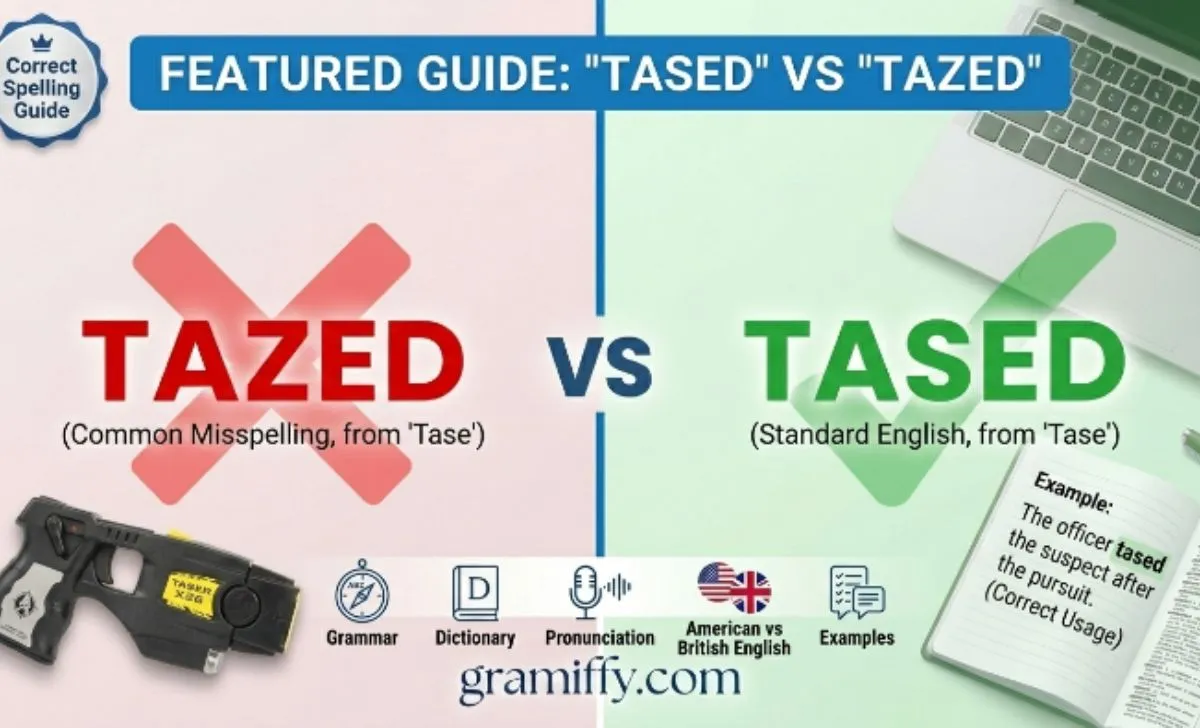
Have you ever paused while writing and wondered whether it should be tased or tazed?
You’re not alone. This is a common spelling question among English learners, students, writers, journalists, and even native speakers.
Since both spellings appear online, many people assume they’re interchangeable or that one is American English while the other is British English.
The truth is much simpler.
Quick Answer: Tased is the correct and standard spelling. Tazed is generally considered a nonstandard spelling or a misspelling. Both American English and British English use tased.
Whether you’re writing a school assignment, news article, legal document, blog post, or professional email, tased is the spelling you should use.
In this complete guide, you’ll discover:
- Whether tased or tazed is correct
- Why tased is the accepted spelling
- What tased means
- Why people mistakenly write tazed
- American vs British English comparison
- Dictionary and grammar guidance
- Pronunciation and word origin
- Real-life sentence examples
- Common spelling mistakes
- Synonyms and antonyms
- Frequently asked questions
- A simple trick to remember the correct spelling forever
By the end of this article, you’ll know exactly which spelling is correct, why it is correct, and how to use it confidently in any type of writing.
Tased or Tazed: Which Is Correct?
The correct spelling is tased.
It is the standard past tense and past participle of the verb tase, which means to use a TASER electronic control device on someone.
Although tazed occasionally appears in online discussions, social media posts, and unedited content, it is not the preferred spelling in standard English.
Quick Comparison
| Spelling | Correct? | Recommended? |
|---|---|---|
| Tased | ✅ Yes | Yes—use in all formal and informal writing |
| Tazed | ❌ No (generally nonstandard) | No—avoid in professional writing |
Bottom line: If you’re unsure which spelling to choose, always use tased.
What Does “Tased” Mean?
Tased means someone was subjected to an electrical discharge from a TASER electronic control device, typically by a law enforcement officer or authorized security personnel.
It is the past tense and past participle of the verb tase.
Definition
Tased (verb): To temporarily incapacitate a person by using a TASER electronic control device.
The word is commonly found in:
- News reports
- Police statements
- Court documents
- Legal writing
- Crime reporting
- Public safety articles
Example Sentences
- The suspect was tased after refusing repeated commands.
- Officers tased the man to prevent further violence.
- Witnesses said the individual was tased before being arrested.
- Police confirmed that no serious injuries occurred after the suspect was tased.
- The officer explained why the individual had been tased during the incident.
In every professional example above, tased is the correct spelling.
Is “Tazed” a Real Word?
This is one of the most searched questions related to this topic.
The answer is:
Not in standard English.
You may see tazed on:
- Social media
- Internet forums
- Comment sections
- Personal blogs
- Unedited websites
However, that does not make it the preferred or standard spelling.
Most editors, teachers, and professional writers would correct tazed to tased.
So while tazed exists as a written variant online, it is generally regarded as a nonstandard spelling rather than the accepted form.
Why Do People Write “Tazed”?
If tased is correct, why do so many people search for tazed?
The answer lies in pronunciation.
When spoken naturally, tased sounds like:
tayzd
Because the s is pronounced with a /z/ sound, many people assume the spelling should also contain the letter z.
This is a common mistake in English.
For example:
| Spoken Sound | Correct Spelling |
|---|---|
| Tayzd | Tased |
| Rayzd | Raised |
| Yoozd | Used |
| Clohzd | Closed |
Although these words sound as if they contain the letter z, standard English spelling keeps the letter s.
Why Is “Tased” the Correct Spelling?
The answer becomes clear when you look at English grammar.
The base verb is:
Tase
Like many English verbs ending in -e, it forms the past tense by simply adding -d.
Examples:
| Base Verb | Past Tense |
|---|---|
| Bake | Baked |
| Save | Saved |
| Move | Moved |
| Tase | Tased |
There is no English spelling rule that changes the s to z when forming the past tense.
That’s why tased is grammatically correct, while tazed is not considered the standard form.
Word Origin (Etymology)

Understanding a word’s origin often makes its spelling easier to remember.
The verb tase comes from TASER, the trademarked name of an electronic control device designed to temporarily incapacitate a person with an electrical discharge.
Over time, English speakers began using the product name as a verb, much like:
- Google → Googled
- Photoshop → Photoshopped
- Xerox → Xeroxed
Following normal English grammar, the past tense of tase became tased.
Because the verb itself is spelled with an s, the past tense also keeps the s.
At a Glance
| Question | Answer |
|---|---|
| Correct spelling | Tased ✅ |
| Incorrect spelling | Tazed ❌ (generally nonstandard) |
| Part of speech | Verb |
| Base form | Tase |
| Past tense | Tased |
| Past participle | Tased |
| Present participle | Tasing |
| American English | Tased |
| British English | Tased |
American vs British English: Is There Any Difference?

One of the most common questions people ask is whether tased is the American spelling and tazed is the British spelling or vice versa.
The answer is no.
Unlike words such as color/colour, center/centre, or license/licence, the spelling of tased does not change between American and British English.
Both varieties of English use tased as the standard spelling.
Quick Answer: There is no American vs British spelling difference. Whether you’re writing in the United States, the United Kingdom, Canada, Australia, or New Zealand, tased is the preferred form.
American vs British English Comparison
| Feature | American English | British English |
|---|---|---|
| Correct spelling | Tased ✅ | Tased ✅ |
| “Tazed” accepted? | No (generally nonstandard) | No (generally nonstandard) |
| Used in newspapers | Yes | Yes |
| Used in legal documents | Yes | Yes |
| Used in police reports | Yes | Yes |
| Recommended in formal writing | Yes | Yes |
As the table shows, there is no spelling variation between the two forms of English.
Why Doesn’t the Spelling Change?
Many spelling differences between American and British English developed over centuries.
For example:
| American English | British English |
|---|---|
| Color | Colour |
| Honor | Honour |
| Theater | Theatre |
| Defense | Defence |
| Center | Centre |
However, tased is a relatively modern word.
It comes from TASER, a trademark that later became widely used as a verb. Because the verb entered modern English long after most American and British spelling differences were established, both varieties adopted the same spelling.
As a result:
- Americans write tased.
- Britons write tased.
- Canadians write tased.
- Australians write tased.
- New Zealanders write tased.
There is no officially recognized British variant spelled tazed.
Dictionary Guidance
Another way to determine the correct spelling is to look at respected dictionaries and language references.
Leading English dictionaries consistently recognize tased as the standard form derived from the verb tase.
Although some dictionaries focus on the noun TASER because it originated as a trademark, standard English usage treats tase as a verb and tased as its regular past tense.
Professional editors and language references also favor tased.
What Standard References Recommend
| Reference Type | Preferred Form |
|---|---|
| English dictionaries | Tased ✅ |
| Grammar references | Tased ✅ |
| Editorial style guides | Tased ✅ |
| News organizations | Tased ✅ |
| Academic writing | Tased ✅ |
If you’re writing anything intended for publication, tased is the spelling you should choose.
Is “Tazed” Listed in Dictionaries?
Some users search:
- Is tazed a dictionary word?
- Do dictionaries accept tazed?
In standard English, tased is the recognized spelling used in professional writing.
Because language evolves, some online dictionaries or user-generated resources may mention tazed as a variant that appears in real-world usage. However, that does not make it the preferred or standard spelling.
For accurate and professional writing, always choose tased.
Pronunciation
One reason people spell the word incorrectly is its pronunciation.
IPA Pronunciation
Tased
/teɪzd/
Sounds like:
tayzd
Notice something interesting.
Although the word is pronounced with a z sound, it is still spelled with the letter s.
English contains many words that follow the same pattern.
| Correct Spelling | Pronunciation |
|---|---|
| Raised | /reɪzd/ |
| Used | /juːzd/ |
| Closed | /kloʊzd/ |
| Chased | /tʃeɪst/ (voiceless /s/ sound) |
| Tased | /teɪzd/ |
This is why relying on pronunciation alone can lead to spelling mistakes.
Grammar Rules Behind “Tased”
The spelling becomes much easier once you understand its grammar.
The base verb is:
Tase
Like other English verbs ending in -e, it follows the regular pattern.
Verb Forms
| Verb Form | Correct Usage |
|---|---|
| Base form | Tase |
| Third-person singular | Tases |
| Present participle | Tasing |
| Past tense | Tased |
| Past participle | Tased |
Examples
Base Form
- Officers may tase a violent suspect if necessary.
Present Simple
- The officer tases individuals only as a last resort.
Present Continuous
- Police are tasing the suspect after repeated warnings.
Past Simple
- Officers tased the suspect during the incident.
Present Perfect
- Police have tased several individuals this year.
Past Perfect
- The suspect had been tased before medical staff arrived.
Every verb form consistently keeps the letter s.
Why “Tazed” Looks Right to Some People
The confusion is understandable.
People naturally expect spelling to match pronunciation.
Since tased sounds like tayzd, many assume it should be written with z.
This happens with many English words.
Examples include:
- Used
- Raised
- Closed
- Bruised
- Housed
- Tased
Each of these words contains the letter s, even though it’s pronounced as z.
Remember:
English pronunciation doesn’t always determine English spelling.
That’s why tased remains the correct spelling in both American and British English.
How to Use Tased Correctly in a Sentence
Knowing that tased is the correct spelling is only the first step. You should also know how to use it naturally and grammatically in different contexts.
Since tased is the past tense and past participle of the verb tase, it describes an action that has already happened.
Simple Past Tense
Use tased when talking about a completed action in the past.
Examples:
- Police tased the suspect after repeated warnings.
- The security officer tased the attacker to stop the assault.
- Officers tased the individual during the arrest.
- The man was tased after refusing to surrender.
- Witnesses said the suspect was tased before being handcuffed.
Present Perfect Tense
Use have/has tased when the action happened in the past but remains relevant to the present.
Examples:
- Police have tased several suspects this month.
- Officers have tased individuals only in high-risk situations.
- Authorities have tased armed suspects in similar incidents.
Past Perfect Tense
Use had tased when describing an action completed before another past event.
Examples:
- Officers had tased the suspect before paramedics arrived.
- Police had tased the man before placing him in custody.
- The individual had been tased before additional officers reached the scene.
Passive Voice
The passive voice is extremely common with tased, especially in news reports.
Examples:
- The suspect was tased after threatening officers.
- Two individuals were tased during the disturbance.
- The attacker was tased before being arrested.
- The man had been tased before receiving medical treatment.
Real World Usage Examples
The word tased frequently appears in journalism, legal writing, and official reports.
News Reporting
- Police confirmed the suspect was tased during the arrest.
- Officers tased the individual after de-escalation efforts failed.
- The report stated that the suspect was tased once before being restrained.
- Authorities said no bystanders were injured when the suspect was tased.
Law Enforcement Reports
- The individual was tased after ignoring multiple verbal commands.
- Officers tased the suspect because less forceful options were ineffective.
- The official report explained why the suspect had been tased.
Everyday Conversation
Although less common, the word also appears in casual speech.
Examples:
- Did you hear someone was tased outside the stadium?
- He was tased, but thankfully he wasn’t seriously injured.
- Everyone was surprised that the suspect was tased so quickly.
Common Mistakes to Avoid
Many writers make predictable mistakes when spelling or using this word.
Mistake #1: Writing Tazed
❌ Police tazed the suspect.
✅ Police tased the suspect.
Mistake #2: Assuming It’s British English
❌ American English: tased
❌ British English: tazed
✅ Both American and British English use tased.
Mistake #3: Spelling by Pronunciation
Many people hear:
tayzd
and assume the spelling should be:
tazed
However, English spelling often differs from pronunciation.
The correct spelling remains:
tased
Mistake #4: Confusing the Device with the Verb
Remember the difference.
| Word | Part of Speech | Meaning |
|---|---|---|
| TASER | Noun | The electronic control device |
| Tase | Verb | To use a TASER on someone |
| Tased | Verb | Past tense of tase |
Example:
✅ The officer used a TASER.
✅ The officer tased the suspect.
Tased vs Tazed: Side by Side Comparison
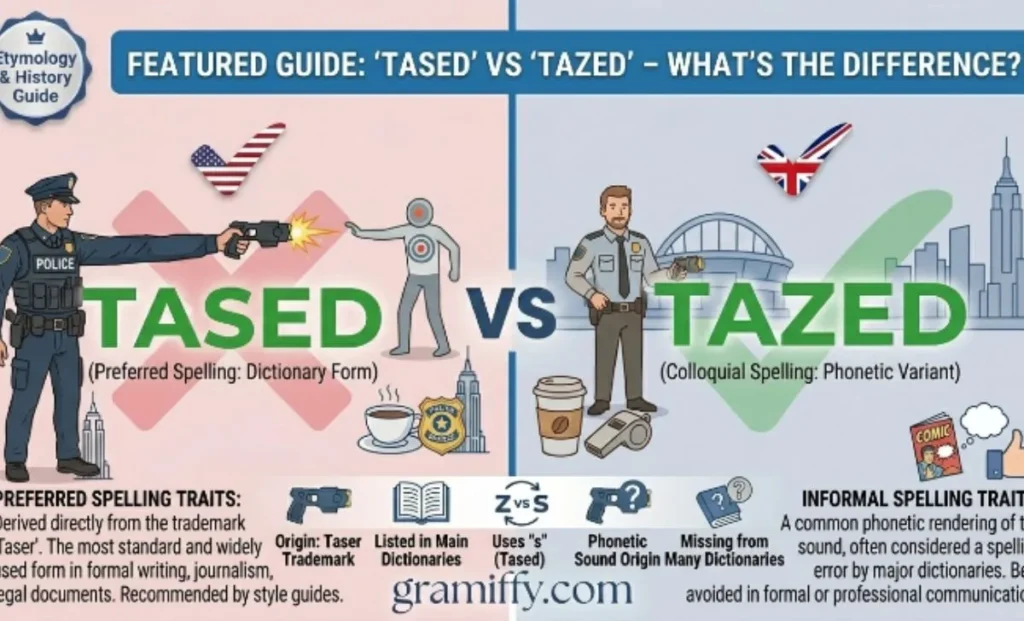
| Feature | Tased | Tazed |
|---|---|---|
| Correct spelling | ✅ Yes | ❌ Generally nonstandard |
| Dictionary-supported | ✅ Yes | Generally no |
| Standard English | ✅ Yes | ❌ No |
| American English | ✅ Standard | ❌ Not standard |
| British English | ✅ Standard | ❌ Not standard |
| Journalism | ✅ Preferred | ❌ Avoid |
| Academic writing | ✅ Recommended | ❌ Not recommended |
| Professional writing | ✅ Yes | ❌ Avoid |
| Grammar | Correct | Nonstandard |
The comparison clearly shows that tased is the appropriate choice in virtually every formal and professional context.
Why the Confusion Exists
The popularity of the search “tased or tazed” isn’t surprising. Several factors contribute to the confusion.
Pronunciation
The letter s is pronounced like z in tased, leading many people to spell it phonetically.
Typing Errors
Fast typing on phones or computers can easily turn tased into tazed, especially with autocorrect or simple keyboard slips.
Social Media Influence
People often copy spellings they see online. If an incorrect spelling appears in a viral post or comment, others may assume it’s correct without checking reliable language sources.
Lack of Familiarity
Unlike everyday verbs such as walked or played, tased is mostly seen in:
- Crime reports
- Court cases
- Police statements
- News articles
- Public safety discussions
Because it’s less common in everyday conversation, many people are unsure of its spelling.
Memory Tricks to Never Misspell It Again
Use these simple tricks whenever you’re unsure.
Trick #1: Remember the Base Verb
The verb is:
Tase
So the past tense is:
Tased
Just like:
- Bake → Baked
- Save → Saved
- Move → Moved
- Tase → Tased
Trick #2: Ignore the Sound
Even though tased sounds like tayzd, English spelling doesn’t always match pronunciation.
Think of these words:
- Raised
- Used
- Closed
- Bruised
- Tased
They all contain the letter s, despite the /z/ sound.
Trick #3: Remember This Sentence
If you can spell saved, you can spell tased.
It’s one of the easiest ways to remember the correct spelling
Synonyms of Tased
Because tased refers to a specific action involving a TASER electronic control device, it has very few exact synonyms. However, depending on the context, several words and phrases can express a similar idea.
| Synonym | Meaning | Can It Replace Tased? |
|---|---|---|
| Shocked | Received an electric shock | Sometimes |
| Stunned | Temporarily incapacitated | Sometimes |
| Immobilized | Unable to move freely | Context-dependent |
| Incapacitated | Made temporarily unable to act | Context-dependent |
| Restrained | Brought under control | Sometimes |
| Subdued | Controlled using force | Sometimes |
| Neutralized | Prevented from posing a threat | Context-dependent |
| Disabled | Temporarily prevented from acting | Context-dependent |
Note: These words are contextual synonyms, not perfect replacements. Tased specifically refers to the use of a TASER device, while the other words describe the result or effect.
Words That Are Not True Synonyms
Some words are often confused with tased, but they have different meanings.
| Word | Why It’s Different |
|---|---|
| Electrocuted | Usually means seriously injured or killed by electricity. A person who is tased is not necessarily electrocuted. |
| Shocked | Can describe emotional surprise or an electrical shock. |
| Arrested | Someone may be arrested without being tased. |
| Injured | Being tased does not automatically mean someone was injured. |
Antonyms of Tased
There is no single direct antonym because tased describes a specific law enforcement action. However, these words express the opposite idea depending on the context.
| Antonym | Meaning |
|---|---|
| Released | Allowed to leave |
| Freed | No longer restrained |
| Assisted | Given help rather than force |
| Protected | Kept safe from harm |
| Rescued | Saved from danger |
| Comforted | Given reassurance |
| Untouched | Not physically affected |
| Helped | Received assistance instead of force |
Related Word Forms
Learning every form of the word makes it much easier to use correctly.
| Word | Part of Speech | Example |
|---|---|---|
| TASER | Noun | The officer carried a TASER. |
| Tase | Verb | Officers may tase violent suspects if necessary. |
| Tases | Verb | The officer rarely tases anyone. |
| Tasing | Verb | Police are tasing the suspect. |
| Tased | Verb | The suspect was tased. |
Commonly Confused Words
Many people confuse tased with similar-looking words. Here’s how they differ.
| Word | Correct? | Explanation |
|---|---|---|
| Tased | ✅ Yes | Standard spelling |
| Tazed | ❌ Generally nonstandard | Often a spelling mistake |
| Taser | ✅ Yes | Common spelling of the device name (often styled as TASER by the manufacturer) |
| Tasered | ⚠️ Sometimes seen | Many editors prefer tased when using the verb tase |
| Tazing | ❌ No | Incorrect spelling of tasing |
Writing Tips: When Should You Use Tased?
Use tased whenever you’re referring to the past action of using a TASER device.
In News Articles
✅ The suspect was tased after refusing to surrender.
In Academic Writing
✅ The report examined cases in which individuals were tased by law enforcement.
In Legal Documents
✅ The defendant claimed he had been tased without sufficient warning.
In Everyday Conversation
✅ He was tased, but fortunately he wasn’t seriously injured.
In every example above, tased is the correct choice.
People Also Ask
These are common questions related to tased or tazed.
Is tased a real word?
Yes. Tased is the standard past tense and past participle of the verb tase.
Is tazed ever correct?
In standard English, no. While you may encounter it online, tazed is generally treated as a nonstandard spelling rather than the preferred form.
Why is it spelled tased instead of tazed?
Because the base verb is tase. English forms its past tense by adding -d, producing tased.
Is tased used in American English?
Yes. It is the standard spelling in American English.
Is tased used in British English?
Yes. British English also uses tased. There is no standard British spelling tazed.
How do you pronounce tased?
It is commonly pronounced /teɪzd/, which sounds like “tayzd.”
What is the base form of tased?
The base verb is:
Tase
Verb forms:
- Tase
- Tases
- Tasing
- Tased
Is tased a verb or an adjective?
Tased is primarily a verb (past tense and past participle), although it can function as part of an adjectival phrase in sentences such as:
The tased suspect was taken to hospital.
Is tased capitalized?
Generally, no. In normal writing, tase and tased are written in lowercase. The device name may appear as TASER (the original trademark styling) or Taser, depending on editorial style.
Can civilians be tased?
Yes. Grammatically, tased simply describes someone being subjected to a TASER device. It does not specify the person’s role or legal status.
Expert Tips to Avoid the Mistake
Keep these simple rules in mind whenever you write.
- Always start with the base verb tase.
- Add -d to make the past tense.
- Never change the s to z.
- Don’t rely on pronunciation to determine spelling.
- In professional, academic, legal, and journalistic writing, always choose tased.
Easy Memory Rule
If the verb is tase, the past tense is tased just like save → saved and move → moved.
This simple pattern will help you remember the correct spelling every time.
Quick Recap
Here’s everything you need to remember.
| Question | Correct Answer |
|---|---|
| Which spelling is correct? | Tased ✅ |
| Is tazed correct? | ❌ Generally nonstandard |
| Base verb | Tase |
| Past tense | Tased |
| Past participle | Tased |
| Present participle | Tasing |
| American English | Tased |
| British English | Tased |
| Formal writing | Tased |
| Academic writing | Tased |
| Professional writing | Tased |
One Minute Memory Trick
If you ever forget the correct spelling, use this simple rule.
The verb is tase, so the past tense is tased—never tazed.
Compare it with familiar English verbs:
| Base Verb | Past Tense |
|---|---|
| Bake | Baked |
| Save | Saved |
| Move | Moved |
| Tase | Tased |
If you wouldn’t write zaved instead of saved, you shouldn’t write tazed instead of tased.
Common Mistakes to Avoid
Before publishing your writing, make sure you avoid these frequent errors.
❌ Writing tazed because it sounds like tayzd
✅ Always write tased
❌ Assuming tazed is the British spelling
✅ Both American and British English use tased
❌ Confusing the device with the verb
- TASER (or Taser) = the electronic control device
- Tase = the verb
- Tased = the past tense of the verb
❌ Using tazed in professional writing
✅ Use tased in:
- Essays
- Research papers
- News articles
- Business emails
- Legal documents
- Blog posts
- Professional reports
Why This Difference Matters
Using the correct spelling makes your writing more:
- Accurate
- Professional
- Credible
- Consistent
- Easy to understand
Even a small spelling mistake can reduce a reader’s confidence in your writing, especially in academic, legal, or professional contexts.
If you want your English to sound polished and reliable, choosing tased over tazed is the right decision.
Final Thoughts
The difference between tased and tazed may seem small, but using the correct spelling makes your writing more accurate and professional.
While tazed sometimes appears on social media, forums, or unedited websites, tased is the standard spelling accepted in modern English.
If you’re writing an essay, news article, blog post, legal document, or business email, always choose tased.
Keeping this simple rule in mind will help you avoid a common spelling mistake and write with greater confidence.
Whenever you’re unsure, think of the pattern save → saved and tase → tased. Following this rule will ensure your English remains clear, correct, and professional.
Read More :

I am Constance Hale, an, editor, and writing expert dedicated to helping people write with clarity and confidence. Through my articles on Gramiffy.com, I simplify grammar, spelling, and language usage for readers of all levels. My goal is to make English writing more engaging, accurate, and enjoyable.