Have you ever stopped mid-sentence and wondered whether the word you need is gamble or gambol? They look almost identical, sound very similar, and differ by just one letter. Yet their meanings are completely different.
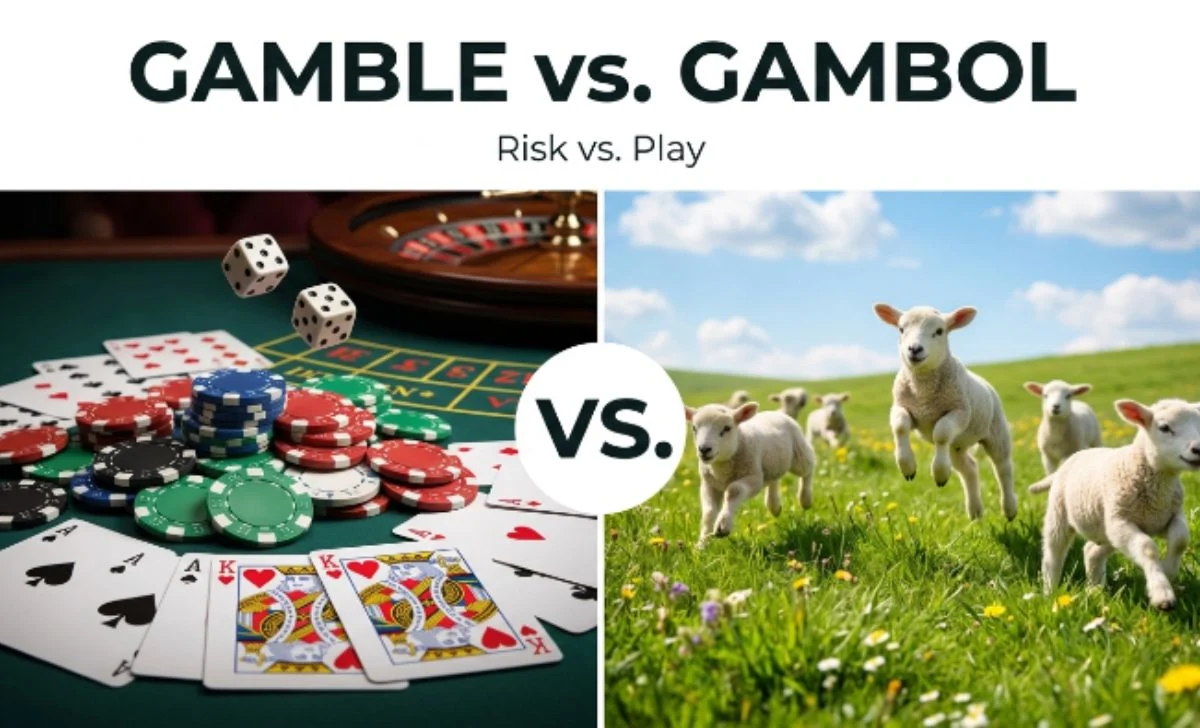
Gamble is about risk, uncertainty, betting, or taking a chance. Gambol is about playful movement, such as skipping, leaping, or frolicking.
So you might gamble money on a football match, but you would watch puppies gambol around a garden.
The easiest way to remember the difference is this:
Gamble = risk or bet.
Gambol = play or frolic.
And there is a useful spelling trick: gambOl contains an O, just like frOlic.
Quick Answer: Gamble vs. Gambol
Gamble means to risk money, property, or something valuable on an uncertain result. It can also mean to take a risky chance in a situation where success is not guaranteed.
Gambol means to move around playfully by skipping, jumping, leaping, or frolicking. It is especially common when describing children or young animals.
| Word | Meaning | Example |
|---|---|---|
| Gamble | To take a risk or bet on an uncertain outcome | He decided to gamble on the new business. |
| Gambol | To play, skip, leap, or move around joyfully | The lambs gamboled across the field. |
The easiest rule
Ask yourself:
Is there risk, betting, or uncertainty?
Use gamble.
Is something moving playfully or joyfully?
Use gambol.
Gamble vs. Gambol at a Glance
| Feature | Gamble | Gambol |
|---|---|---|
| Meaning | Take a risk or bet | Move or play joyfully |
| Main idea | Risk and uncertainty | Playful movement |
| Part of speech | Verb and noun | Verb and noun |
| Pronunciation | Usually /ˈɡæm.bəl/ | Usually /ˈɡæm.bəl/ |
| Past tense | gambled | gamboled / gambolled |
| Present participle | gambling | gamboling / gambolling |
| Person noun | gambler | — |
| Common subjects | People, gamblers, investors, businesses | Children, puppies, lambs, animals |
| Typical context | Gambling, business, decisions, risk | Fields, parks, play, animals |
| Example | She gambled her savings on the investment. | The puppies gamboled in the grass. |
What Does Gamble Mean?
Gamble is a verb and noun connected with risk and uncertainty.
As a verb, to gamble means to risk money or something valuable on an uncertain outcome. It can also mean to take a risky chance without involving money.
For example:
- He likes to gamble at the casino.
- She gambled her savings on the business.
- They decided to gamble on a new marketing strategy.
- I wouldn’t gamble my reputation on an untested product.
As a noun, a gamble means a risky action, decision, or attempt.
- Starting a business was a big gamble.
- Moving to another country without a job was a gamble.
- Investing all his money in one company was a risky gamble.
Gamble does not always involve money
This is an important point.
Although gamble is strongly associated with betting and gambling for money, the word can also describe any risky decision or action.
For example:
“Leaving a secure job to start a company was a gamble.”
No money is being placed on a traditional bet. Instead, gamble describes a risky choice.
Common expressions include:
- gamble on something
- gamble with something
- gamble away something
- take a gamble
- a risky gamble
- a calculated gamble
What Does Gambol Mean?
Gambol means to skip, jump, leap, or move about playfully.
It often describes energetic and cheerful movement rather than ordinary walking or running.
For example:
- The lambs gamboled through the meadow.
- The children gamboled across the playground.
- Puppies gamboled around the garden.
- The young goats gamboled over the grass.
The word often creates an image of something light, energetic, playful, and carefree.
Gambol can be a verb or noun
As a verb:
The puppies gamboled around the yard.
As a noun:
The lambs’ gambols delighted the children.
The noun gambol is grammatically correct, but it is much less common in modern everyday English than the verb.
Gamble vs. Gambol: The One-Second Memory Trick
Here’s a simple way to remember the spelling:
GambOl = frOlic
Both words contain an O associated with playful movement.
So:
Gamble → risk, betting, uncertainty
Gambol → play, jumping, frolicking
You can also remember the phrase:
Don’t gamble with the O—gambol with it!
When you see gambol, think of a puppy or lamb bouncing happily through a field.
Why Are Gamble and Gambol Confused?
The confusion comes mainly from their similar spelling and pronunciation.
Both words begin with gamb-, contain the same number of letters, and can be pronounced very similarly. In many standard pronunciations, they are effectively homophonous.
But their histories and meanings are unrelated.
Gamble developed from older English forms associated with game, while gambol came into English through French gambade, meaning a leap or springing movement.
So although the words look like close relatives, they do not share the same meaning.
One is associated with risk.
The other is associated with playful movement.
Gamble vs. Gambol: Are They Homophones?
They are often treated as homophones or near-homophones, depending on pronunciation and dictionary convention.
A homophone is a word that sounds the same as another word but has a different meaning or spelling.
Examples include:
- right / write
- sea / see
- pair / pear
Gamble and gambol are commonly pronounced alike or almost alike in standard English, which explains why they are easy to confuse when heard rather than read.
However, pronunciation can vary among speakers and accents. For practical writing purposes, the important point is that their spelling and meanings must be distinguished carefully.
Gamble vs. Gambol Pronunciation
In many dictionaries, both words are represented with essentially the same pronunciation:
- gamble: /ˈɡæm.bəl/
- gambol: /ˈɡæm.bəl/
The first syllable sounds like gam, while the final syllable is an unstressed -bəl sound.
This means that context is often what tells the listener which word is intended.
For example:
“The company decided to gamble on the new technology.”
Here, gamble clearly means take a risk.
Compare:
“The lambs gambolled across the field.”
Here, gambolled clearly means moved playfully.
Gamble vs. Gambol: Word Origins
Understanding the origins can make the distinction easier to remember.
Origin of Gamble
Gamble is an English word that developed in the eighteenth century. It is generally connected with dialectal forms related to game and the idea of playing games or taking chances.
Over time, gamble became strongly associated with wagering money or something valuable on an uncertain outcome.
This eventually produced related words such as:
- gambling
- gambler
- gambled
The modern meaning can extend beyond traditional betting to include any risky decision.
Origin of Gambol
Gambol has a different history.
It entered English through French gambade, meaning a leap, spring, or playful movement. The word ultimately relates to ideas of jumping or moving the legs.
This history fits its modern meaning perfectly: to gambol is to leap or move playfully.
So the etymology gives us a useful conceptual distinction:
Gamble → game and risk
Gambol → leap and movement
Gamble: Common Word Forms
The most common forms of gamble are:
| Form | Example |
|---|---|
| Gamble | I would never gamble my savings. |
| Gambles | He gambles too often. |
| Gambled | She gambled on the new plan. |
| Gambling | Gambling can involve serious financial risk. |
| Gambler | The gambler placed another bet. |
Notice the spelling:
gamble → gambled → gambling
The final e is dropped before -ing:
gamble → gambling
Gambol: Common Word Forms
Gambol has some spelling variation, particularly between American and British English.
| Form | Common spelling | Alternative |
|---|---|---|
| Base form | gambol | — |
| Third-person singular | gambols | — |
| Past tense | gamboled | gambolled |
| Present participle | gamboling | gambolling |
| Noun | gambol | — |
| Plural noun | gambols | — |
The spellings with a double l—gambolled and gambolling—are especially associated with British English, while gamboled and gamboling are standard American forms.
Gamboling or Gambolling?
Both forms are correct, but regional spelling conventions matter.
American English
American English generally uses:
- gamboled
- gamboling
Example:
The children were gamboling through the park.
British English
British English commonly uses:
- gambolled
- gambolling
Example:
The children were gambolling through the park.
This follows a broader spelling pattern in which British English often doubles the final l before certain suffixes, while American English usually does not.
So neither form is simply “wrong.”
Is Gambol a Common Word?
Gambol is a legitimate standard English word, but it is considerably less common than gamble.
You are much more likely to encounter gamble in everyday conversations, news articles, business writing, and general online content.
Gambol is more literary or descriptive. It frequently appears in writing about:
- animals
- children
- nature
- parks
- fields
- playful movement
For example:
“The lambs gambolled in the meadow.”
This sounds natural and descriptive, whereas simply saying:
“The lambs ran in the meadow.”
is more ordinary.
When to Use Gamble
Use gamble when the sentence involves:
- risk
- uncertainty
- betting
- money
- potentially losing something
- taking a chance
- making a risky decision
Examples:
He decided to gamble on the new business.
Don’t gamble your savings on a single investment.
She gambled on the weather being good.
Buying the old house was a huge gamble.
The company is gambling on strong consumer demand.
When to Use Gambol
Use gambol when something is:
- skipping
- jumping
- leaping
- frolicking
- moving energetically
- playing joyfully
Examples:
The puppies gamboled around the garden.
The lambs gambolled through the meadow.
The children gambolled across the field.
We watched the goats gamboling on the hillside.
A useful clue is that gambol often describes movement that looks cheerful or carefree.
Gamble vs. Gambol Examples
Examples with Gamble
- He wouldn’t gamble his life savings on one investment.
- She decided to gamble on the new restaurant.
- Starting a business without experience was a risky gamble.
- The company is gambling on higher demand.
- He gambled away most of his money.
- I wouldn’t gamble with my reputation.
- They took a gamble by launching the product early.
- The investor was willing to gamble on the young company.
Examples with Gambol
- The lambs gamboled across the meadow.
- The puppies gamboled around the garden.
- The children gambolled through the park.
- Young goats were gamboling on the hillside.
- The foals gamboled happily beside their mothers.
- We watched the children gambol in the sunshine.
- The kittens gamboled around the room.
- The young animals spent the morning gamboling in the grass.
Common Mistakes with Gamble and Gambol
Mistake 1: Using gamble for playful movement
Incorrect:
The puppies gambled around the garden.
Correct:
The puppies gamboled around the garden.
Why? The puppies are moving playfully, not taking a risk.
Mistake 2: Using gambol for betting
Incorrect:
He likes to gambol on football games.
Correct:
He likes to gamble on football games.
Why? The sentence involves betting.
Mistake 3: Assuming gambol means gamble
The spelling is similar, but the meanings are not.
Gamble = risk
Gambol = frolic
Mistake 4: Assuming gambol is a spelling variant of gamble
It isn’t.
Gambol is a separate word with a different origin and meaning.
Gamble vs. Gambol in Business Writing
In business and professional writing, gamble is the word you will usually need.
For example:
The company gambled on rapid growth.
Expanding into the new market was a calculated gamble.
The investment could be a risky gamble.
Gambol would rarely appear in this context unless the writer is deliberately using figurative or literary language.
Gamble vs. Gambol in Descriptive Writing
Gambol is especially useful when you want vivid imagery.
Compare:
The puppies ran across the grass.
with:
The puppies gamboled across the grass.
The second sentence suggests more than movement. It gives the reader a sense of energy, playfulness, and joy.
That makes gambol a useful word for descriptive and creative writing.
Synonyms for Gamble
Depending on context, synonyms for gamble include:
- bet
- risk
- wager
- speculate
- chance
- stake
- venture
- take a chance
Examples:
He decided to risk his savings.
She decided to bet on the outcome.
They speculated on the company’s future.
Not every synonym works in every sentence, so choose according to the intended meaning.
Synonyms for Gambol
Synonyms for gambol include:
- frolic
- romp
- skip
- prance
- caper
- frisk
- leap
- bound
- play
For example:
The puppies romped around the yard.
The children frolicked in the park.
The lambs skipped through the field.
The exact synonym depends on the type of movement being described.
Gamble vs. Gambol: Noun vs. Verb
Both words can function as nouns and verbs, but their usage differs.
Gamble as a verb
He decided to gamble on the investment.
Gamble as a noun
The investment was a gamble.
Gambol as a verb
The lambs gambolled across the field.
Gambol as a noun
The lambs’ gambols entertained the children.
The noun gambol is correct but relatively uncommon in modern everyday English.
Is “Gambol” Ever a Noun?
Yes.
A gambol can mean an instance or period of playful movement.
For example:
The lambs’ gambols delighted the visitors.
However, most modern speakers are more likely to use the verb:
The lambs gambolled across the field.
rather than the noun:
The lambs’ gambols delighted the visitors.
So if you’re learning everyday English, prioritize the verb gambol.
British vs. American English
The meanings of gamble and gambol do not change significantly between British and American English.
The main spelling difference appears in the inflected forms of gambol.
| Form | American English | British English |
|---|---|---|
| Base | gambol | gambol |
| Past | gamboled | gambolled |
| -ing form | gamboling | gambolling |
| Meaning | playful movement | playful movement |
| Gamble | gamble | gamble |
| Gambled | gambled | gambled |
| Gambling | gambling | gambling |
Therefore:
Gamboling is standard American spelling.
Gambolling is standard British spelling.
Both mean the same thing.
Gamble or Gambol: Which One Is Correct?
Both are correct words, but they are correct in different situations.
Use gamble for:
- betting
- risk
- uncertainty
- risky decisions
- taking chances
Use gambol for:
- playful movement
- skipping
- leaping
- frolicking
- energetic movement
Consider these two sentences:
He decided to gamble on the new business.
The puppies decided to gambol around the garden.
Both sentences are correct because each word matches its meaning.
A Simple Way to Remember the Difference
Think of two images.
Gamble: Imagine someone placing a bet.
Gambol: Imagine a lamb jumping through a meadow.
Then remember:
Gamble = chance.
Gambol = cheerfully jump.
Or use the spelling trick:
GambOl = frOlic
The O can remind you of playful movement.
Frequently Asked Questions
Is gamble and gambol the same word?
No. Gamble and gambol are separate words with different meanings. Gamble means to take a risk or bet, while gambol means to move playfully.
What is the difference between gamble and gambol?
Gamble is associated with risk, betting, and uncertain outcomes. Gambol means to skip, leap, or move playfully.
Are gamble and gambol homophones?
They are commonly pronounced the same or almost the same in standard English, so they are often described as homophones or near-homophones. Pronunciation can vary by accent.
Is gambol a real word?
Yes. Gambol is a standard English word meaning to move, jump, skip, or play in a lively way.
Is gambol the past tense of gamble?
No. The past tense of gamble is gambled. The past tense of gambol can be gamboled or gambolled, depending on spelling convention.
What is the past tense of gambol?
Both gamboled and gambolled are used. Gamboled is common in American English, while gambolled is common in British English.
What is the noun of gambol?
Gambol itself can be a noun. It means a playful leap, movement, or frolic.
Can gamble be used without money?
Yes. Gamble can describe any risky decision or action, even when no money is involved.
For example:
Leaving his job without another one was a gamble.
Can gambol describe people?
Yes. Although gambol is especially common when describing animals, it can also describe children or people moving playfully.
For example:
The children gambolled across the lawn.
Which is more common, gamble or gambol?
Gamble is much more common in modern everyday English. Gambol is less common and is often used in descriptive, literary, or nature-related writing.
Is “gambolling” correct?
Yes. Gambolling is a standard British English spelling. American English generally uses gamboling.
Practice Quiz: Gamble or Gambol?
Choose gamble or gambol in each sentence.
- The puppies ___ around the yard.
- He decided to ___ on the risky investment.
- The lambs ___ across the meadow.
- Starting a company with no experience was a huge ___.
- She would never ___ her family’s savings.
- The children ___ happily through the park.
- The investor was willing to ___ on the new technology.
- We watched the young goats ___ on the hillside.
- Buying that old house was a risky ___.
- The foals were ___ in the field.
Answers
- gamboled
- gamble
- gamboled
- gamble
- gamble
- gamboled
- gamble
- gambol
- gamble
- gamboling
Gamble vs. Gambol: Final Comparison
| If you mean… | Use |
|---|---|
| Take a risk | gamble |
| Bet money | gamble |
| Take a chance | gamble |
| Make a risky decision | gamble |
| Skip playfully | gambol |
| Frolic | gambol |
| Leap playfully | gambol |
| Move around joyfully | gambol |
| A risky decision | gamble |
| A playful movement | gambol |
The Bottom Line
Gamble and gambol may look and sound almost identical, but they describe completely different ideas.
Gamble is about risk, uncertainty, betting, and taking a chance:
She decided to gamble on the new business.
Gambol is about playful movement, skipping, leaping, and frolicking:
The lambs gamboled across the meadow.
If you need a quick memory trick, remember:
Gamble = risk.
Gambol = play.
And for the spelling, think:
gambOl = frOlic.
Once you connect gamble with risk and gambol with playful movement, these two easily confused words become much easier to tell apart.
Read More:

Hi, I’m Safdar Ali, an English language teacher with 26 years of teaching experience. My expertise is in English linguistics, grammar, and the differences between British and American English.
Through Gramiffy, I share practical, research-based guides to help students, writers, and English learners improve their language skills. My goal is to make English simple, accurate, and easy for everyone to understand.