Two English words can sound exactly alike and still mean completely different things. Gait and gate are a perfect example.
If you have ever wondered whether you should write gait or gate, you are dealing with a homophone pair that can easily cause confusion.
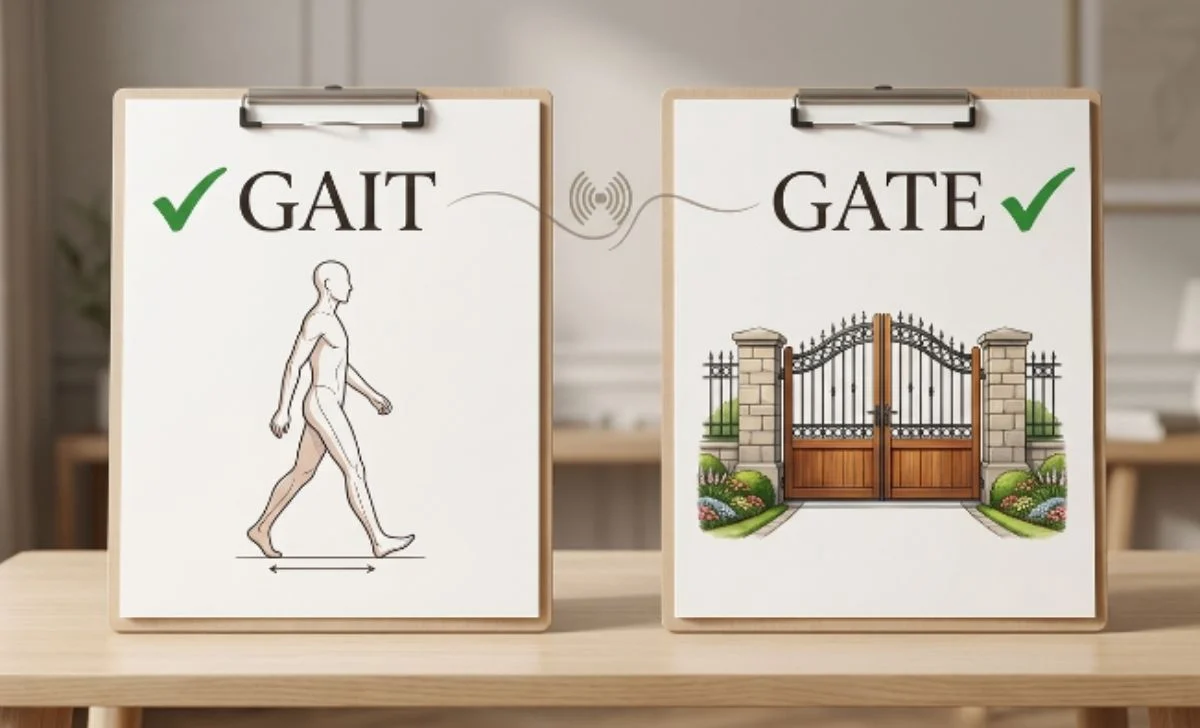
The good news is that the difference is simple once you connect each word with its meaning. Gait refers to the way a person or animal walks or moves. Gate is a barrier, door, or entrance that opens and closes.
So, a horse has a particular gait, but you may walk through a gate.
This guide explains their meanings, pronunciation, origins, grammar, British and American usage, common mistakes, everyday examples, and a quick trick to remember which spelling to use.
Quick Answer
Gait and gate are both correct English words, but they have completely different meanings.
- Gait = the way someone or an animal walks or moves.
- Gate = a movable barrier or an entrance in a fence, wall, or building.
Examples
The doctor examined the patient’s gait.
Please close the garden gate.
At a glance
| Word | Meaning | Example |
|---|---|---|
| gait | A person’s or animal’s manner of walking | She has a graceful gait. |
| gate | A barrier or entrance | The gate is locked. |
The key point is:
Gait = walking style
Gate = entrance or barrier
What Does Gait Mean?
Gait is a noun meaning the way a person or animal walks, runs, or moves.
It can describe things such as:
- walking speed
- walking pattern
- posture while walking
- movement of the legs
- rhythm of walking
- style of movement
For example:
The athlete has a powerful gait.
This means the athlete has a particular way of moving.
The word is also common in medicine, physiotherapy, sports science, veterinary medicine, and anatomy.
The doctor noticed an unusual gait.
This means the person’s walking pattern appeared unusual.
What Does Gate Mean?
A gate is a movable structure that provides access through an opening.
A gate may be found in:
- a garden
- a farm
- a fence
- a wall
- a driveway
- an airport
- a stadium
- a railway station
Examples:
Please leave the garden gate open.
We waited at the airport gate.
The farmer closed the gate behind the animals.
Unlike gait, gate is usually something physical that you can open, close, enter through, or pass through.
Gait vs Gate: The Main Difference
The easiest way to understand the difference is to think about movement versus entrance.
Gait describes how something moves.
Gate is something that allows or prevents movement.
Compare:
The horse has a fast gait.
The word describes how the horse moves.
The horse ran through the gate.
The word refers to the entrance or barrier.
This distinction makes the two words much easier to remember.
Pronunciation: Do Gait and Gate Sound the Same?
Yes. In standard English, gait and gate are homophones.
They are generally pronounced:
/ɡeɪt/
They sound like:
gate
This is why spelling them correctly can be difficult. You cannot usually determine which word someone means just by hearing it.
You need to understand the context.
Compare
He has an unusual gait.
He opened the gate.
Both words sound the same, but their meanings are completely different.
Why Are Gait and Gate Confusing?
The main reason is pronunciation.
English contains many homophones—words that sound alike but have different spellings and meanings.
Examples include:
- pair / pear
- right / write
- flower / flour
- sea / see
- there / their
- brake / break
- gait / gate
Because gait and gate have the same pronunciation, you must use meaning and context to choose the spelling.
Gait as a Noun
Gait is normally used as a noun.
Examples:
His gait changed after the injury.
The horse has a smooth gait.
The therapist analyzed her walking gait.
The runner has an efficient gait.
You can describe a gait as:
- slow
- fast
- steady
- awkward
- graceful
- unusual
- natural
- abnormal
- smooth
Gate as a Noun
Gate is also commonly used as a noun.
Examples:
The gate was locked.
She opened the garden gate.
We entered through the main gate.
The flight leaves from Gate 12.
The word can refer to a physical barrier or an entrance.
Gate as a Verb
Unlike gait, gate can also be used as a verb in certain contexts.
It can mean to provide or control access with a gate.
For example:
The property is gated for security.
In technical or specialized contexts, gate can have additional meanings, but the everyday noun is the most familiar use.
Singular and Plural Forms
Gait
Singular:
gait
Plural:
gaits
Example:
Different horses have different gaits.
Gate
Singular:
gate
Plural:
gates
Example:
The property has two large gates.
| Singular | Plural |
|---|---|
| gait | gaits |
| gate | gates |
Word Origin of Gait
Gait has an interesting history.
It comes from older Germanic roots related to going or walking. It is connected historically with words associated with movement and the act of going.
Over time, gait developed its modern meaning:
a manner or pattern of walking or moving.
This connection is useful because gait is all about movement.
Word Origin of Gate
Gate also has Germanic roots and is related to older words meaning an opening, passage, or entrance.
Interestingly, in some older forms of English and related Germanic languages, words connected with gate could refer more broadly to a way or passage.
Today, however, gate usually refers to:
a movable barrier or entrance.
So while the histories of the two words are interesting, their modern meanings are very different.
Gait vs Gate in American and British English
There is no major spelling difference between American and British English.
Both varieties use:
gait
and
gate
with the same meanings.
| Meaning | American English | British English |
|---|---|---|
| Way of walking | gait | gait |
| Entrance/barrier | gate | gate |
| Pronunciation | /ɡeɪt/ | /ɡeɪt/ |
Unlike words such as color/colour or center/centre, these spellings do not change between the two major varieties of English.
Gait in Medical English
Gait is particularly important in medical and healthcare contexts.
Doctors, physiotherapists, occupational therapists, and other professionals may examine a person’s gait.
For example:
The physiotherapist assessed the patient’s gait.
A change in gait may sometimes be associated with injury, muscle weakness, balance problems, neurological conditions, or other physical issues.
You may encounter terms such as:
- gait analysis
- gait pattern
- gait abnormality
- walking gait
- gait training
- gait assessment
Here, gate would be completely incorrect.
Gait in Horses and Animals
Gait is also widely used when discussing animals, especially horses.
A horse can have different types of movement, including different gaits.
For example:
The horse has a smooth gait.
The rider changed the horse’s gait.
This is another useful association:
Gait = how an animal moves
Gate in Everyday Life
Gate is much more common in ordinary physical situations.
You might see:
garden gate
driveway gate
front gate
entrance gate
security gate
airport gate
school gate
railway gate
Examples:
The children ran through the school gate.
Our neighbor installed a new gate.
Please wait near the departure gate.
Common Mistakes
Mistake 1: Using gate for walking style
❌ The doctor examined his gate.
✅ The doctor examined his gait.
Mistake 2: Using gait for an entrance
❌ Please close the garden gait.
✅ Please close the garden gate.
Mistake 3: Confusing pronunciation with spelling
Because the words sound identical, you cannot choose the spelling from pronunciation alone.
Instead, ask:
Am I talking about walking or movement?
Use gait.
Or:
Am I talking about an entrance or barrier?
Use gate.
Everyday Examples of Gait
She has a confident gait.
The injury affected his gait.
The horse’s gait was smooth.
The therapist observed the patient’s gait.
His unusual gait attracted attention.
The runner changed his gait during the race.
Everyday Examples of Gate
Please close the gate.
The garden gate needs repair.
We entered through the main gate.
The airport gate changed at the last minute.
The dog escaped through the open gate.
They installed an electric gate.
A Simple Memory Trick
Here is an easy way to remember the difference:
Gait = Going
Both gait and going are connected with movement.
Think:
Gait = how you GO
Then:
Gate = entrance
A gate is something you go through.
So remember:
Gait = movement
Gate = entrance
If you are talking about someone’s walking style, choose gait.
If you are talking about something you walk through, choose gate.
Gait vs Gate: Quick Comparison
| Feature | Gait | Gate |
|---|---|---|
| Pronunciation | /ɡeɪt/ | /ɡeɪt/ |
| Sounds like | gate | gait |
| Word type | Noun | Noun/verb |
| Main meaning | Way of walking or moving | Barrier or entrance |
| Common context | Walking, medicine, horses, sports | Gardens, buildings, airports, fences |
| Plural | gaits | gates |
| US spelling | gait | gate |
| UK spelling | gait | gate |
Practice Exercise
Choose gait or gate in each sentence.
1. The doctor noticed a change in his _____.
2. Please close the garden _____.
3. The horse has a beautiful _____.
4. We waited at the airport _____.
5. The injury affected her walking _____.
Answers
- gait
- gate
- gait
- gate
- gait
People Also Ask
Is it gait or gate?
Both gait and gate are correct words, but they have different meanings. Gait means a way of walking or moving, while gate means a barrier or entrance.
Are gait and gate pronounced the same?
Yes. They are homophones and are normally pronounced /ɡeɪt/.
What is the difference between gait and gate?
Gait refers to someone’s or an animal’s manner of walking or moving. Gate refers to a barrier or entrance.
What does gait mean?
Gait means the particular way a person or animal walks or moves.
What does gate mean?
A gate is a movable barrier or entrance in a fence, wall, building, or other structure.
Is gait a noun?
Yes. Gait is primarily a noun.
What is the plural of gait?
The plural is gaits.
What is the plural of gate?
The plural is gates.
Is gait used in medical terminology?
Yes. Gait is commonly used in medicine, physiotherapy, rehabilitation, and related fields to describe walking patterns.
Are gait and gate homophones?
Yes. They have the same pronunciation but different spellings and meanings.
Final Verdict: Gait or Gate?
The choice between gait and gate depends entirely on what you mean.
Use gait when you are talking about:
the way someone or something walks or moves
Use gate when you mean:
a barrier or entrance
Remember the simple connection:
GAIT = how you GO
GATE = what you GO through
So:
The doctor examined his gait. ✅
She opened the garden gate. ✅
Although they sound exactly alike, their meanings are worlds apart. Once you connect gait with movement and gate with an entrance, this homophone pair becomes much easier to remember.
Read More:

Hi, I’m Safdar Ali, an English language teacher with 26 years of teaching experience. My expertise is in English linguistics, grammar, and the differences between British and American English.
Through Gramiffy, I share practical, research-based guides to help students, writers, and English learners improve their language skills. My goal is to make English simple, accurate, and easy for everyone to understand.