Choosing the right word can be tricky, especially when undecisive looks perfectly logical.
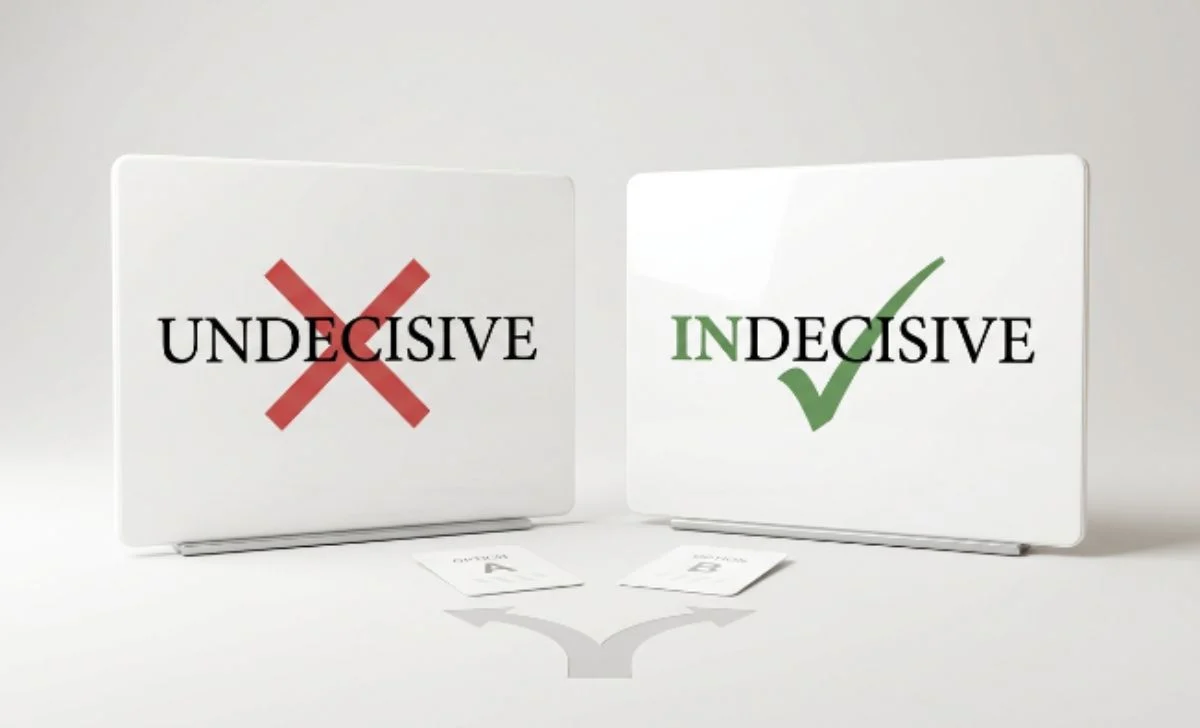
But is it actually correct? If you have ever hesitated between undecisive and indecisive, you are not alone. The standard and widely accepted word is indecisive.
It describes someone who struggles to make decisions, hesitates between choices, or finds it difficult to settle on an option. Undecisive may occasionally appear, but it is uncommon and is generally best avoided in standard English.
There is also an important difference between indecisive and undecided: an indecisive person tends to struggle with decisions, while an undecided person simply has not made a particular choice yet.
Once you understand this small difference, choosing the correct word becomes much easier.
Quick Answer: Is It Undecisive or Indecisive?
The standard word is:
Indecisive ✅
Usually avoid:
Undecisive ❌
Examples:
She is indecisive about which job to accept.
His indecisive behavior frustrated the team.
The related noun is:
indecision
And the opposite is:
decisive
| Word | Standard modern usage | Meaning |
|---|---|---|
| indecisive | Yes | Unable or slow to make decisions |
| undecisive | Uncommon/nonstandard in most contexts | Generally avoid |
| decisive | Yes | Able to make decisions or settle something |
| undecided | Yes | Not having made a decision |
What Does Indecisive Mean?
Indecisive means unable to make a choice or decision easily.
An indecisive person may:
- hesitate between options
- repeatedly change their mind
- struggle to choose
- delay making a decision
- need a lot of time to decide
For example:
Mark is indecisive when choosing a restaurant.
This means Mark has difficulty choosing which restaurant to visit.
The word can also describe an action, event, result, or situation that does not settle an issue.
The election produced an indecisive result.
In this context, the result did not clearly determine a winner.
Why Is “Indecisive” Correct?
The word is built around decide and the negative prefix in-:
in- + decisive → indecisive
The prefix in- often gives a word a negative or opposite meaning.
Compare:
decisive → indecisive
direct → indirect
complete → incomplete
accurate → inaccurate
visible → invisible
So indecisive means essentially “not decisive.”
What About “Undecisive”?
Undecisive may look perfectly logical:
un- + decisive
However, it is not the normal standard word used in modern English for someone who cannot make decisions.
The established word is:
indecisive
There is an important distinction between undecisive and the much more common word undecided.
Use:
indecisive person
but:
undecided person
Both can describe someone who has not chosen yet, but they are not exactly the same.
Compare
I am undecided about which dress to buy.
This means the choice has not yet been made.
I am indecisive about which dress to buy.
This suggests difficulty or hesitation in making the choice.
Indecisive vs. Undecided
These words are closely related, but their meanings have a subtle difference.
| Word | Main idea | Example |
|---|---|---|
| indecisive | Having difficulty deciding | She is very indecisive. |
| undecided | A decision has not been made | She is still undecided. |
| decisive | Able to decide firmly | He is a decisive manager. |
| uncertain | Not sure about something | She is uncertain about the plan. |
A person can be undecided without being generally indecisive.
For example:
I am undecided because I need more information.
That does not necessarily mean you have trouble making decisions.
Pronunciation
Indecisive is pronounced approximately:
in-di-SY-siv
IPA:
/ˌɪndɪˈsaɪsɪv/
The stress falls mainly on the -cise- part:
indeCIsive
Do not pronounce it like indecis-iv with the wrong stress.
Related words
decide
/dɪˈsaɪd/
decision
/dɪˈsɪʒən/
decisive
/dɪˈsaɪsɪv/
indecisive
/ˌɪndɪˈsaɪsɪv/
Grammar: How to Use Indecisive
Indecisive is an adjective.
It can describe a person, behavior, action, decision, response, or result.
Before a noun
She is an indecisive person.
His indecisive behavior caused problems.
We need to avoid an indecisive response.
After a linking verb
She is indecisive.
He became indecisive after hearing the new information.
The committee seemed indecisive.
Comparative and superlative forms
You can say:
more indecisive
most indecisive
Examples:
John is more indecisive than his brother.
She is the most indecisive person on the team.
Indecisive as a Personality Trait
When indecisive describes a person, it often refers to a repeated tendency.
For example:
He is indecisive about almost everything.
This suggests that difficulty making decisions is a regular characteristic.
By contrast:
He is undecided about the proposal.
usually describes one particular decision.
This distinction is useful in everyday writing.
Indecisive vs. Inconclusive
These words can sometimes be confused.
Indecisive usually describes difficulty making a decision or something that fails to produce a clear decision.
Inconclusive means that evidence, results, or an event does not lead to a definite conclusion.
Compare:
The manager was indecisive.
The manager could not make a decision.
The investigation was inconclusive.
The investigation did not produce a definite answer.
Indecisive vs. Indecision
These words have different grammatical roles.
Indecisive = adjective
She is indecisive.
Indecision = noun
Her indecision delayed the project.
A useful pattern is:
indecisive → indecision
Examples:
He is indecisive.
His indecision is frustrating.
American vs. British English
There is no major British-American spelling difference for indecisive.
Both varieties use:
indecisive
| Variety | Correct form |
|---|---|
| American English | indecisive |
| British English | indecisive |
| Canadian English | indecisive |
| Australian English | indecisive |
So unlike color/colour or organize/organise, this is not a regional spelling issue.
Word Origin
Indecisive is related to decide, decision, and decisive.
The word ultimately traces back through French to Latin roots associated with deciding or cutting off a matter.
The prefix in- gives the word a negative sense.
Thus:
decisive → able to settle or determine
indecisive → unable or unwilling to settle or determine
This connection also explains related vocabulary such as:
- decide
- decision
- decisive
- indecisive
- indecision
Synonyms for Indecisive
Depending on context, useful synonyms include:
- hesitant
- uncertain
- wavering
- unsure
- irresolute
- vacillating
- doubtful
- tentative
- ambivalent
These words are not always exact replacements.
For example:
She was hesitant to answer.
focuses on reluctance.
She was indecisive about which option to choose.
focuses on difficulty making a decision.
Antonyms of Indecisive
Common opposites include:
- decisive
- determined
- resolute
- firm
- confident
- purposeful
- definite
Example:
She is indecisive.
Opposite:
She is decisive.
Common Mistakes to Avoid
Mistake 1: Writing “undecisive”
❌ He is very undecisive.
✅ He is very indecisive.
Mistake 2: Confusing indecisive with undecided
❌ I am indecisive about the answer because I have not received the results yet.
This may be better as:
✅ I am undecided because I have not received the results yet.
If the problem is difficulty choosing:
✅ I am indecisive about which option to choose.
Mistake 3: Using “indecision” as an adjective
❌ She is indecision.
✅ She is indecisive.
But:
Her indecision caused the delay.
Mistake 4: Confusing “decisive” and “indecisive”
Decisive = able to make a firm decision
Indecisive = having difficulty making a decision
Everyday Examples
Here are natural examples of indecisive in everyday English:
I am too indecisive to choose a movie.
My brother becomes indecisive when shopping.
She was indecisive about accepting the offer.
His indecisive leadership worried the employees.
The customer seemed indecisive about the menu.
Don’t be so indecisive; just choose one.
The manager’s indecisive response created confusion.
Her indecisive behavior made the situation worse.
When Should You Use “Undecided”?
Use undecided when a particular choice has not yet been made.
Examples:
I am still undecided about where to travel.
The jury remained undecided.
She is undecided about whether to accept the job.
Use indecisive when emphasizing difficulty or a tendency to struggle with decisions.
He is extremely indecisive.
She has always been indecisive about major purchases.
This distinction can make your writing more precise.
A Simple Memory Trick
Remember:
DECISIVE → INDECISIVE
Think of in- as the negative prefix.
So:
decisive = makes decisions
indecisive = struggles to make decisions
Also remember:
UNDESICIVE ❌
INDECISIVE ✅
A useful phrase is:
“I can’t decide, so I’m indecisive.”
The word decide is right inside indecisive, which makes it easier to remember.
Practice Quiz
Choose the correct word.
1. Which spelling is standard?
A. undecisive
B. indecisive
2. She is very _____ when choosing clothes.
A. indecisive
B. undecisive
3. Which word means “not having made a decision yet”?
A. undecided
B. indecisive
4. Which is the noun form of indecisive?
A. indecision
B. indecisiveness only
5. What is the opposite of indecisive?
A. decisive
B. undecided
Answers
- indecisive
- indecisive
- undecided
- indecision
- decisive
FAQs
Is it undecisive or indecisive?
Indecisive is the standard word. Undecisive is uncommon and should generally be avoided in standard English.
Is undecisive a real word?
You may encounter undecisive, but it is not the normal modern English choice. Indecisive is the established and widely accepted form.
What is the difference between indecisive and undecided?
Indecisive describes difficulty making decisions, while undecided means a particular decision has not yet been made.
What is the noun of indecisive?
The noun is indecision.
His indecision caused a delay.
What is the opposite of indecisive?
The most direct opposite is decisive.
Is indecisive an adjective?
Yes. Indecisive is an adjective.
She is indecisive.
Is indecisive used in American English?
Yes. Indecisive is standard in American English.
Is indecisive used in British English?
Yes. Indecisive is also standard in British English.
Can you say “an indecisive person”?
Yes.
He is an indecisive person.
Is “undecided” the same as “indecisive”?
Not exactly. Someone can be undecided about one issue without being generally indecisive.
Final Verdict: Undecisive or Indecisive?
When you’re deciding between undecisive and indecisive, choose:
INDECISIVE ✅
Indecisive is the standard word for someone who has difficulty making decisions or something that fails to produce a clear decision.
Use undecided when you simply mean that a decision has not yet been made.
Remember the three useful forms:
decisive → able to decide
indecisive → struggles to decide
undecided → has not decided yet
So if you are writing an email, essay, article, or professional document, write indecisive, not undecisive.
Read More:

Hi, I’m Safdar Ali, an English language teacher with 26 years of teaching experience. My expertise is in English linguistics, grammar, and the differences between British and American English.
Through Gramiffy, I share practical, research-based guides to help students, writers, and English learners improve their language skills. My goal is to make English simple, accurate, and easy for everyone to understand.