If you are writing an email, checking an assignment, or describing a car coming to a halt, should you write stoping or stopping?
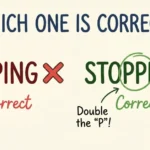
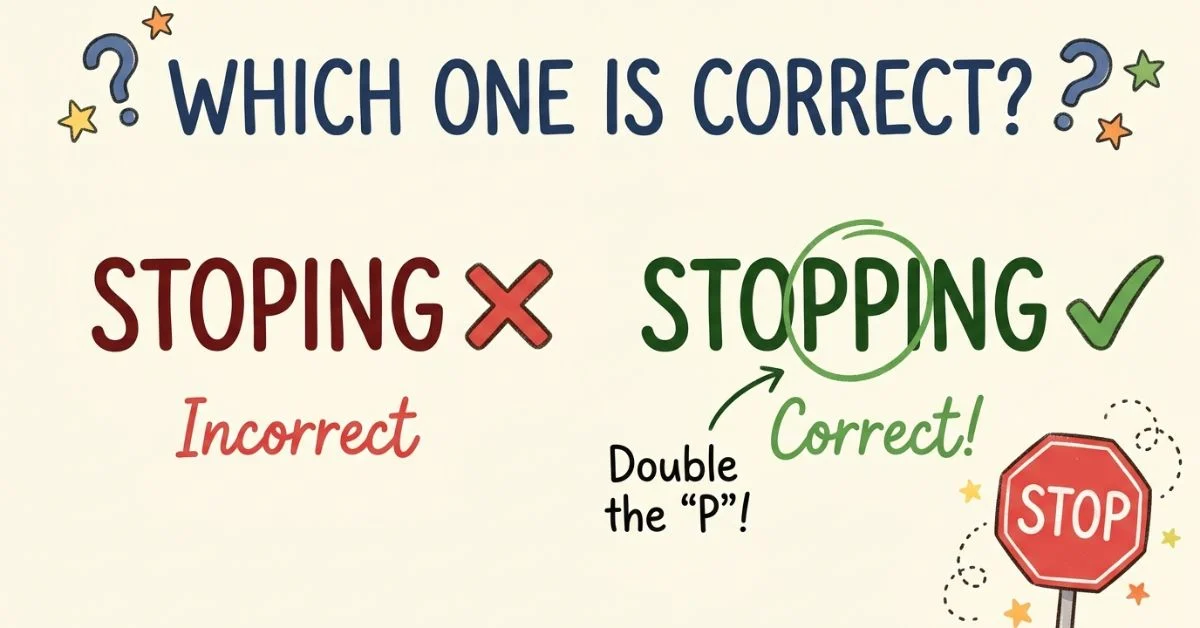
For everyday English, the correct spelling is stopping, with two Ps. It is the -ing form of the verb stop.
However, there is one important exception: stoping is also a real word used in mining. The two words have different meanings, so choosing the right one depends on your sentence. Here is how to spell, understand, and use both words correctly.
Stoping or Stopping: Which Is Correct?
Stopping is correct when you mean coming to a halt, ending an action, or preventing something from continuing.
The word stoping is not the standard -ing form of the everyday verb stop, although it has a separate technical meaning in mining.
| Word | Meaning | Example |
|---|---|---|
| Stopping | Halting an action or movement | The bus is stopping near my house. |
| Stoping | Extracting ore in underground mining | The engineers are studying the stoping method. |
In everyday writing, use stopping when talking about driving, working, studying, exercising, or ending a habit.
For example, if you want to stop receiving promotional emails, you might write, “I am stopping these email notifications.” Writing stoping in that sentence would be a spelling mistake.
Quick rule: Stop + -ing = stopping.
Why Is Stopping Spelled With Two Ps?
The double P follows a common English spelling rule called the consonant-doubling rule.
When a verb ends in a single consonant preceded by a short vowel, the final consonant is generally doubled before adding a suffix such as -ing or -ed, provided the word follows the relevant spelling pattern.
The verb stop follows this rule:
- Stop + -ing = stopping
- Stop + -ed = stopped
The final P doubles before the ending is added.
Other common examples include:
| Base verb | -ing form | Past tense |
|---|---|---|
| Hop | Hopping | Hopped |
| Shop | Shopping | Shopped |
| Plan | Planning | Planned |
| Drop | Dropping | Dropped |
| Grab | Grabbing | Grabbed |
This is why stoping is incorrect when you mean the action of stopping. The double P preserves the correct spelling of the verb as the suffix is added.
What Does Stopping Mean in a Sentence?
Stopping is the -ing form of stop. It can describe an action in progress or the act of bringing something to an end. Its grammatical role depends on how you use it.
Stopping as an action in progress
When used with a form of be, such as is, are, or was, stopping can describe an action that is happening.
Examples:
- The driver is stopping at the red light.
- My laptop is stopping unexpectedly during video calls.
- The rain is stopping, so we can head outside.
Stopping as the name of an action
Stopping can also function as a gerund, meaning an -ing form that acts like a noun.
Examples:
- Stopping suddenly on a busy road can cause an accident.
- Stopping unnecessary subscriptions can save money each month.
- She found that stopping for a short break helped her concentrate.
You may also encounter stopping in expressions such as stopping distance, stopping point, and stopping power. These phrases describe different aspects of bringing movement or an action to a halt.
What Does Stoping Mean in Mining?
Stoping is a specialized mining term. It refers to extracting ore from an underground mineral deposit, usually creating an underground opening called a stope.
For example:
“The mining team began stoping the ore body after completing the safety inspection.”
Here, stoping is correct because the sentence describes ore extraction rather than ending an ordinary action.
This distinction is easy to remember:
- Stopping: The mechanic is stopping the machine.
- Stoping: The mining crew is stoping the underground ore deposit.
The second word comes from the mining verb stope, not from adding -ing to the everyday verb stop. That is why it has only one P.
Stoping vs. Stopping: Real-Life Examples
The best way to avoid this spelling mistake is to look at the context in which the word appears.
| Situation | Correct example |
|---|---|
| Driving | I am stopping at the petrol station before work. |
| Education | The teacher is stopping the test to explain a question. |
| Technology | Restarting the computer stopped the error from appearing. |
| Health and habits | He is stopping his late-night snacking. |
| Sports | The goalkeeper is stopping shots from outside the box. |
| Mining | The engineers are reviewing the underground stoping plan. |
Notice that the first five situations involve halting an action or preventing something from continuing. They require stopping or another appropriate form of stop. The final example uses the technical mining term.
Stop, Stops, Stopped, and Stopping: What’s the Difference?
Learning the main verb forms together makes the spelling easier to remember.
| Verb form | When to use it | Example |
|---|---|---|
| Stop | Base form or after certain auxiliary verbs | Please stop the machine. |
| Stops | Present tense with he, she, or it | The machine stops automatically. |
| Stopped | Past tense or past participle | The machine stopped working. |
| Stopping | -ing form | The machine is stopping again. |
Pay particular attention to stopped and stopping. Both contain two Ps because the final consonant doubles when the relevant suffix is added.
Compare these examples:
- I stop at the same café every morning.
- She stops for lunch at noon.
- We stopped to help a stranded driver.
- They are stopping production for maintenance.
The meaning stays connected to the verb stop, but the form changes to fit the sentence.
Common Spelling Mistakes With Stop
A few simple corrections can prevent the most common errors.
Incorrect: The bus is stoping outside the school.
Correct: The bus is stopping outside the school.
Incorrect: She stoped talking when the phone rang.
Correct: She stopped talking when the phone rang.
Incorrect: I am stoping my gym membership next month.
Correct: I am stopping my gym membership next month.
One important point: do not assume that every word ending in a consonant needs a doubled letter. English spelling rules depend on the word’s structure and stress pattern. For stop, however, the standard forms are stopping and stopped.
Frequently Asked Questions
Is it stoping or stopping?
Stopping is correct when you mean the -ing form of the everyday verb stop. Stoping is a technical mining term with a different meaning.
How do you spell stopping?
Spell it S-T-O-P-P-I-N-G. There are two Ps before the letters I-N-G.
Why does stopping have two Ps?
The final consonant doubles when the verb stop takes the suffix -ing. This follows the English consonant-doubling spelling rule.
Is stoping ever correct?
Yes. Stoping is a legitimate term in mining and geology. It describes processes used to extract ore from underground rock. It is not the standard spelling of the everyday verb’s -ing form.
Is it stopped or stoped?
Stopped is the correct past tense of the everyday verb stop. For example, “The car stopped at the traffic light.” Stoped is not the standard past tense of that verb.
Is stopping a noun or a verb?
Stopping can function as a verb form or a gerund. In “The bus is stopping,” it forms part of a verb phrase. In “Stopping suddenly is dangerous,” it acts as a noun-like expression.
Is stopping spelled differently in American and British English?
No. The spelling is stopping in both American and British English. Neither variety uses stoping as the ordinary -ing form of stop.
What is the easiest way to remember stopping?
Remember the three forms together: stop → stopping → stopped. The final P doubles before adding -ing or -ed.
Final Answer:
For everyday English, stopping is the correct spelling. Use it when describing a person, vehicle, activity, or process coming to a halt or being brought to an end.
Stoping is correct only when you mean the specialized mining term, not the everyday verb stop.
Remember this simple pattern: stop, stopping, stopped. Once you know why the P doubles, you can avoid this common spelling mistake in schoolwork, emails, and everyday writing.

I am Bryan A. Garner a lexicographer, and language expert passionate about clear and effective writing.
I contribute grammar, spelling, and usage guides on Gramiffy.com to help readers improve their English skills. Through my work, I aim to make language rules simple, practical, and easy to understand.